Monday, June 3, 2019

Unearthing Arcana: Hold Person


Wizard: I cast hold person!
DM: OK, the orc boss failed his save and is paralyzed.
All the players at once: I slit his throat!
DM: …

You probably heard that dialogue before at some point of your Referee life (or some variation of it). Which is actually quite acceptable. Yes, acceptable… not just because it is tactically advantageous, but also because RPGs are (or were supposed to be) open-ended games, a unique mix of mechanics and a freeform narration. So, theoretically, if you paralyze your opponent during combat, you can go for the killing strike. If your players never took that opportunity to mercilessly slay their enemies then congratulations: you have heroes at your table (that is rarer than it sounds).

Of course, maybe you don’t have a problem with Hold Person and the way it works like an “instant kill” spell at the lower levels of every edition of the game.

Let’s take a look at this spell.
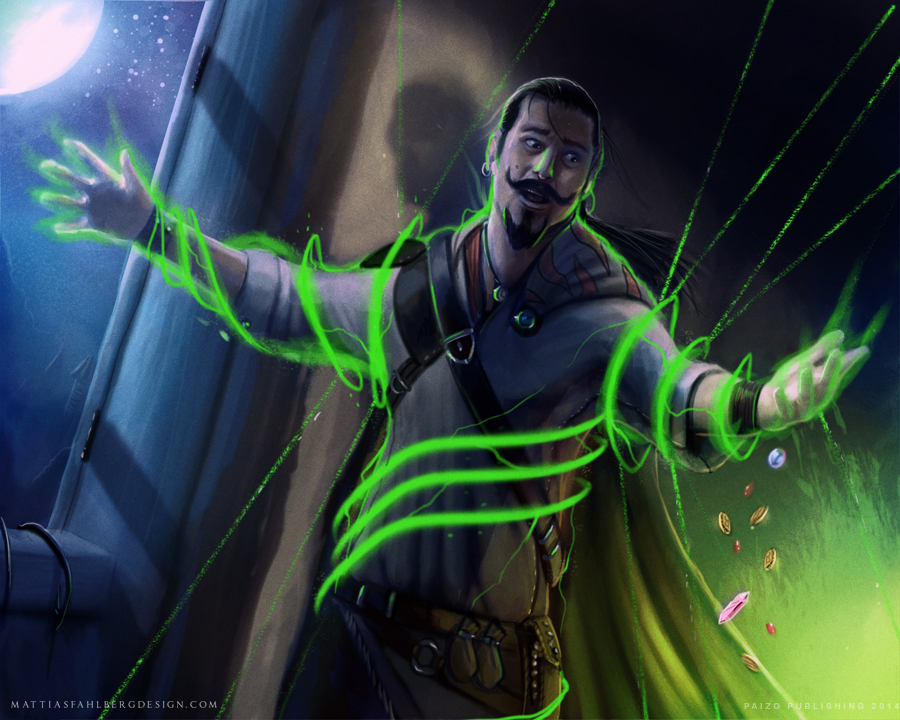
Art by MattiasFahlberg.

OD&D’s Hold Person: A spell similar to a Charm Person but which is of both limited duration and greater effect. It will effect from 1-4 persons. If it is cast at only a single person it has the effect of reducing the target's saving throw against magic by -2. Duration: 6 turns + level of the caster. Range: 12".

OK, as many things in the first version of D&D, the spell entry seems both quite interesting and open-ended (also uncertain). What we can be sure is that Hold Person targets 1-4 targets and has big duration.

The first thing that stands out is the Charm Person reference. In OD&D, our beloved Charm Person where targets that fail their save are “completely under the influence of the Magic-User”.

After reading that we can go back to Hold Person. Actually, for someone like me (that come from BECMI and AD&D 2nd) is hard to see Hold Person as anything different than a paralyzing spell, but that seems to be the case here. If you interpret that Hold Person is just an improved version of Charm Person then things get a lot easier for the Referee (as far as I remember you can’t try to kill a target of Charm Person).

With AD&D 1st, Gary Gygax didn’t wanted to leave doubts regarding his spells. No sir. The duration of Hold Person here is shorter (but still enough for a combat) and it affects 1-3 targets. There is quite an extensive list of what type of humanoids are affected, although we do get the description that this spell “holds immobile” and “freezes in places” the target(s).

You can say that AD&D 1st started the whole issue. When a target is “immobile” and “freezed in place”, then it is safe to assume that the victim is helpless and that a coup de grace is in order.

BECMI and Rules Cyclopedia didn’t added much (besides the Rules Cyclopedia letting clear that Hold Person has an opposed version called Free Person).

AD&D 2nd didn’t changed things either, though it did added: “Held beings cannot move or speak, but they remain aware of events around them and can use abilities not requiring motion or speech. Being held does not prevent the worsening of the subjects' condition due to wounds, disease, or poison”. AD&D 2nd also kept the trend of reducing Hold Person’s duration.

Oh, and did I said coup de grace? Although the rule wasn’t first mentioned in D&D 3rd, that edition surely made it popular. In D&D 3rd the spell lasts even less and the target “may attempt a new saving throw to end the effect” (probably because they finally noticed is such an overkill spell). You can say that 3rd Edition was honest and let it clear that a paralyzed target could be the victim of a coup de grace and, thus, finally officialized the instant kill (and no, 3.5 and Pathfinder didn’t seemed to change anything… interestingly I didn’t found any reference of Hold Person in the Pathfinder 2E Playtest).

D&D 5E at least requires Concentration in the spell duration, which is a nice touch, but it doesn’t change anything regarding the “instant kill” aspect (and yes, 5E doesn’t have a coup de grace rules, only that all attacks against an incapacitated target are automatically criticals, which means that we are back to the “it falls to the Referee to solve the whole conundrum”).

I purposely left Holmes for last because it is has an interesting take on the spell: “Similar to a charm person spell. Affects 1-4 persons. Holds the person or persons rooted to the spot unless released or the spell wears out. Duration is 6 turns + level of caster. If cast at one person alone it reduces his saving throw by 2”.

For me leaving a target “rooted to the spot” and immobilized are different things. I find this version almost as good as OD&D’s Hold Person. Maybe the target is rooted by this feet (or paralyzed from the waist down) and thus she can’t be the target of a coup de grace (although I admit that it leaves spellcasters theoretically free to cast spells… and actually this interpretation kind of equals Hold Person to Entangle).

I also remember that when I played Baldur’s Gate I and II, a Hold Person spell created a shimmering shield around the victim (you could still hit the target for normal damage and, because we’re talking of a vidoegame, coup de grace wasn’t an issue).

OK, all this talk is because I usually hate Hold Person as an “instant kill” spell (too easy, too boring). Last week I bought the D&D 5E Starter Set and runned it for my kids as a straight tabletop RPG for the first time (I had tried RPGs before with them, but always with heavy alterations and lots of dynamic and ludic activities mid session). Because my kids love Super Mario Bros. I reskinned lots of monster and spells as effects that they would recognize from the videogames, and that included a version of Hold Person. That is when it hit me that I had just created not a reskin but a variant of Hold Person, to address the “instant kill” thing.

Here are others!

1D6 VARIANTS ON HOLD PERSON

1 - Magic Bubble - The target is trapped in a magic bubble that is indestructible from the inside (although disintegration might work) but any hit from outside will blow it (leaving the target unharmed). The target floats a few feet over the ground while the spell lasts and a strong wind might move him (like a levitation spell). The good side about this variant is that it doesn’t allow a save each round. (Yes, this is the Super Mario Bros. version I used with my kids and probably moves the spell to the Conjuration School)
2 - Force Shield - The target is restrained by a sparkling shimmering force shield. The shield provides light as torch and provides a weak protection, reducing damage by half against the first attack against the target (which can’t suffer any kind of critical hit or coup de grace). However, attacking the target grants him Advantage in his next saving throw to break free. (This is my feeble attempt of copying the spell from Baldur’s Gate and moves the spell to the Evocation School)
3 - Bilarro’s Equanimous Hold - The target is completely restrained by crackling ethereal bands. If the target suffers damage while under this cantrap, her attacker suffers the same amount of damage as crackling bands snapback. (Another variant that takes the spell to the Conjuration School)
4 - Mesmerizing Gaze - The target is so consumed by the caster’s presence that she can only stare back, immobilized. This version requires that the target can see the caster and the caster remains in line of sight. The charm can be broken if the life of the target is in danger. If the target is attacked he can make new saving throw as a reaction (notice that backstabs are still effective here).
5 - Planar Misalignment - The target isn’t actually immobile but out of phase with the current plane. He can speak or even move, but no sound will come out and she won’t leave the spot where she was hit by the spell. The target can’t affect this reality while under the spell’s effect and every attack against her has a 50% of being completely ignored. (Another variant that takes the spell to the Conjuration School)
6 - Under the nights of Arcadia - The target is enthralled by many sprites and faeries, falling under their enchantment and becoming paralyzed. The only difference here is that the faeries hate when other spoil their “fun”. So anyone attacking the target must also save or become affected by the spell.

Awesome art choice by SeaSkyMoon.


Wednesday, May 29, 2019

The Eternal Empire of Tsan-Chan


Almost settled in the new home (and country!). So, time for another update. Recently I offered to do a “reskinning” of the Player’s Handbook (5E) in order to present a “dark and lovecraftian” campaign setting, without limiting the mechanical options. Here is the (slightly revised) version!

That is not a new subject on this blog. Quite the contrary… you can check my first ideas regarding it HERE and HERE.

The Eternal Empire of Tsan-Chan – a D&D 5E Campaign


Theme: A Dark Fantasy Lovecraftian Setting for D&D 5E

Premise: the Eternal Empire, or Tsan-Chan in the Holy Tongue, is the center of Human power in the Old World. Tsan-Chan is so old and vast that no living bloodline (with the exception of the Elder Races) remembers its dark inception. Even the Empire’s current rulers were merely barbarians that exterminated the last “Heavenly Dinasty” a few centuries ago and took over. More recently, the current Emperor, Hastur the Skinner, declared himself the “Yellow Sovereign”, a living and masked god, forbidding the imperial pantheon of Pegana and throwing Tsan-Chan in civil war.

Who are you? You’re the Heretic, the Banished and the Exiled, living beyond the Eternal Empire’s seals and borders (which hamper much of the old and unsanctioned magic). Maybe you hunger for gold, to conquer a piece of land and become its sole ruler. Maybe you’re a fugitive and desire revenge or the help of the Elder Races (or seek a way to immortality with their Lore).  Perhaps, you’re a member of the Lost Bloodline, the ancient and feared rulers of Tsan-Chan (before it had that name).

Where are you? You live in the Borderlands, either in the last domains of the Elder Races or in the barbaric Dragon Realms, which pay allegiance to the Spawn of Tiamat – Dragons and their degenerated servants, the Dragonborn.  From the Dying West you face the monolithic power of Tsan-Chan; beyond the Borderlands lies the Dooms of this Age – the inhuman might of the Hobgoblins, the ravenous Gnolls, the obscene Sahuagin, which have closed the seas, and – finally – the unstoppable hordes of the Coming Race, the Orcs. It is whispered that orc blood shall run through the veins of the next line of Emperors. Of course, there are older and worse things in Abyss Below and the Stars Above…


Races:

Dwarf – A long time ago the Forgers of Civilizations and True Rulers of the Eternal Empire were banished and exiled to the Abyss Below, the Underdark. Their bane was the loathsome and cannibalistic Tcho-Tcho, forefathers of Humanity. Banished to the depths, the exiled mixed their blood, begetting the Dwarven Races. Dwarves wage an everlasting (and thus far losing) war against Tsan-Chan. Hill dwarves are pariahs whose blood mingled with humans, while Mountain dwarves claim to be royalty. However, they lie and deeply fear “True Dwarves”, who call themselves Duergar. Duergars possess otherworldly magic and knowledge, suffering strange mutations – a few, it is said, can even breathe underwater as a result of their abyssal blood (and perhaps a “gift” from their masters, the Aboleth).


Elf – Beyond the Old World, buried deep in the maddening and deadly fumes of the Lotus, lies another realm, an impossible world of forbidden pleasures, dark joys and unending bloodlust. These are the Dreamlands, which are believed to be Paradise or to hold the secrets to immortality. The Elves are the Souless, the temptation of Man, molded to be perfect of body and untouched by old age. The Elves know in the Old World are the Defeated, the Exiled and the mad Disavowed. Their memories of the Dreamlands are clouded and their crimes are always nebulous. Their drives define their bearing in the Old World. High elves are creatures of art and knowledge, hunting for the forbidden secrets, ever seeking a way back to the delicious madness of their original demesne. Wood elves are satyrs, half-man, half-beast creatures, driven solely by their passions. Dark elves are worst, called by other elves the Disavowed – they voluntarily left the Dreamlands to hunt (and some said, taste) the flesh of humans. Dark elves belief that one day Humanity will release the Great Old Ones or, worse, slay Skarl the Drummer, awakening Mana-Yood-Sushai, the Primordial Law, “and there will worlds nor gods any more”.

Half-Elf – Humans naturally lust after Elves and Elves, also naturally, have many uses for Humans. From that unholy union are birthed Half-Elves, also called Maenads. Creatures of uncontrollable and inconstant urges, Half-Elves are beings of extreme. Many suffer from strange bouts of madness, during which they lose all control and restrain. Half-Elves are easily addicted to the Lotus and many dream of finally entering “in flesh” in the Dreamlands. All Half-Elves are proxies of their elven parents, who can see and hear through their eyes. That is also why Half-Elves are hunted in Tsan-Chan and even in the Dragon Realms. They are natural spies.

Halflings – The Merry Folk are a conundrum, a mortal race seemly free of the taint of Tsan-Chan. They arrived millennia ago on the shores of the Eternal Empire and became a caste of servants and farmers, easily ignored by most people. But the so called Halflings have long and hidden traditions about the Gates Between Worlds. Halflings adventurers are either Assassins (Lightfoot) or Watchers (Stout), which are here ancient roles, not ancestries (there is only on Halfling People). Assassins face those that desire the knowledge of the Gates that were shut to prevent the coming of the Great Old Ones; while Watchers are those that gather lore and magic items to prevent Humanity and other races from bringing the End. This is a secret to all powers of the Old World, which see Halflings as mongrels and slaves.

Humans – You’re the rulers of the decadent Old World, masters of its greater power – the Eternal Empire! The last Elder Races cower behind dragons, barbarians and the Dooms of the Age. There never was and there never will be a greater realm than Tsan-Chan. Humans followed the imperial pantheon of Pegana, the gods that raised them from lowly beasts to the rulers of the world. Their Creator is Mana-Yood-Sushai, the Primordial Law, who shall one day awaken and destroy everything. Today, many humans follow the heresy of the Yellow Emperor or, worst, the lies that equal Mana-Yood-Sushai to its opposite – the Daemonic Sultan Azathoth.

Dragonborn – It is said the when the Yellow Emperor, the Nameless One, revealed itself in Tsan-Chan, the Dragons came forth from the ends of Old World and created vicious domains in the Borderlands. They used their alien magic to change the land and raised the Dragonborn. However, they did not predict that their servants could betray them. You’re either a faithful servant of a Dragon Lord or the descendent of those that slayed their greedy masters. You’re hated by Elder Races and Humanity, and think in ways that most humans can’t fathom. Most dragonborn find peace only in violence, drinking or in the alien paths of the draconic mind. Heretic dragonborn dream of Ascension, of becoming Dragons themselves and flying beyond the Stars Above. The faithful dragonborn know that the True Enemy lies inside Tsan-Chan… they know that the rumors of gigantic humanoids walking in the heart of the Eternal Empire and devouring cattle, halflings and humans are true.


Gnomes – The Eldest are ancient beyond reckoning. Gnarled and ugly, gnomes are called the Wise Ones because it is said that they stole magic long ago from the gods, demons or dragons (it also said that gnomes could save the world with that knowledge… if only they cared). Gnomes are born looking old and wicked, and are said to be immortal. They are the rarest of the Elder Races and claim to one have ruled the world (although everyone know gnomes are liars and devilish).  Forest Gnomes have skin brittle and colored like bark, with twisted hands and feet that look like roots; they live in the wilds of the Borderlands, acting as a mix of boogeymen and hermits. Rock Gnomes plague the cities of the Dragon Realms and are hunchbacked and deformed.

Tieflings – It is said that an Emperor once lived that was wicked as a gnome, vengeful as a dwarf, lustful as an elf and wrathful as dragon. His spirit was so dark that both the Gods of Pegana and the Great Old Ones of Azathoth rejected Him, seeing in Him a cunning beast without sophistication, uncaring of Law and Chaos, desiring only power. His mortal vassals erased his Reign and Name from all Imperial Records and banished his shade to the depths of the Abyss Below with great cost. But legends are hard to kill and He is known today as the Dark One, the Prince of Darkness, the Teuf or Asmo’dien. He was bountiful and his spawn yet lives, deeply inside Humanity – the Lost Bloodline. A Teufling or Tiefling, also known as Darkling, are those mortals that descended from Asmo’dien. When they reach puberty, their tainted souls reveal in their flesh, marking them as condemned to King of Pit. Each tiefling is unique and monstrous… some have obsidian skin that crawls with worms beneath, others have transparent skin that reveals tainted flesh and others have tentacles and strangers mutations. Tieflings are hunted not only because of their legacy, but also because their organs are sought by imperial magicians as potent spell components. Many Tieflings become horrendous monsters as they mature, the most famous examples being the Beast of Dunwich.

Classes:

Barbarians – Those that desire the end of both the Dragon Lords and the Eternal Empire. They represent the natural state of humans in the Old World.

Bards – These mysterious casters and artists are actually “priests” of the Fey, the timeless rulers of the Dreamlands. They are hunted as heretics in the Tsan-Chan and as dangerous cultistas in most parts of the Borderlands (except in the reclusive domains of the Elves, where they’re the effective priests of the Dreamlands).


Clerics – “Cleric” in this setting means someone sworn to a God of Pegana, with the knowledge of his/her Signs. all true clerics were exiled afrom Tsan-Chan, after Hastur, the Nameless Emperor, declared himself God.


Druids – The old, mad and barbarous priests of Shub-Niggurath. Many druids struggle to serve Humanity, despite their heritage.


Fighters – As in the Player’s Handbook. Eldritch Knights learn their after pledging fealty to a Wizard.

Monks – Servants of the Eternal Empire, most monks orders are loyal to the Yellow Emperor (with the exception of a few exiles in the Borderlands).


Paladins – The so-called Dragonsworn are the chosen mortal champions of the Dragons. Each Paladin is a knight devoted to one particular Dragon Lord. Thus, they’re all enemies of the Eternal Empire.

Rangers – As in the Player’s Handbook. Their magic comes from the Fey, very old Gnomes or Elves.

Sorcerers – Children of the Gods, sorcerers are hunted and burned at the stake. Most are tainted by dragonblood or the lineage of the Dark One.

Warlocks – The first spellcasters. Both Clerics and Wizards are “modern” developments of the warlock arts. The most common warlocks are pledged to the Dreamlands (Fey), the Dark One (Fiend) or the Great Old Ones. A few rare warlocks serve the Empyrean Spheres, a strange and elusive coterie of otherworldly realms or entities that values harmony and beauty above even Law or Chaos, these men and women are merciless, amoral and deeply feared*.
*And that’s how I would explain a celestial in a lovecraftian setting.

Wizards – They may deny it, but wizards are actually a type of priest here. They learned their secret craft at the feet of the same Great Old One – Nyarlathotep, the Crawling Chaos and Master of the Arcane Arts. Yes, each wizard is occasionally visited by Nyarlathotep, in dreams or (poor soul) in person. The Crawling Chaos has a plan and He also is an enemy of the Yellow Emperor (and the Dragon Lords, and the Gods of Pegada and, even, Azathoth Itself).


Saturday, May 11, 2019

My daughter’s first RPG creation!


...sort of! First of all, sorry for the absolute disregard for this tower in these last months. I could mention, as a proper excuse, that I just moved with my family to another country, but I know that Dungeon Masters are heartless creatures that feed on dead character sheets, so no one would believe me. Anyway, moving on!

As any other hobbyist enthusiast, I’m probably not the first one to try to get his children playing RPG as fast as possible. I’ve two lovely and devilish goblins, ages 7 and 4. I’ve run a few “RPGs” for them from time to time (they call it “Monsterslaying Games”). Of course, they aren’t conventional tabletop RPGs because my little ones still prefer more ludic and dynamic experiences… actually only 25% of our table time is actually at the table; for the rest of the game session I’m usually creating physical activities and mini-games like “Let’s hunt the dragon hidden in the blankets” or “Sneak through the dinosaur guardian in the living room” (I also use lots of LEGOs as minis/props). In the end, I even created a small resolution system so that my kids get their first taste of rolling dice. I hope that in a year or two both are playing a complete RPG with me and my wife.

While that time doesn’t come, I like to show them my RPG books (I discovered that they love bestiaries) or to talk about game stuff. To my surprise my daughter recently suggested a few “cool powers” that she would love to have in our next RPG session. Here is the closest adaptation of her ideas.

New Spell

Anaoj's Annoying Tickles

[Swords & Wizardry/OSR]
Spell Level: 2 
Range: 30 feet 
Duration: Instantaneous
This spell affects people and living monsters, who start feeling an intense tickling over their entire bodies. If the spell succeeds (saving throw allowed), the creature lose her next action, dropping any items and falling to ground. During combat, the unfortunate victim may open her guard, offering one nearby enemy the chance for a free attack (Referee’s call).
Usually, creatures with natural armor (AC 4[15] or better) are impervious to this cantrap.


[D&D 5E]
Enchantment
Level: 2 
Casting time: 1 Action 
Range: 30 feet 
Components: S, M (harlequin doll and a feather) 
Duration: Instantaneous
A creature of your choice that you can see within range start feeling her entire body tickling. The target must succeed on a Wisdom saving throw or lose her balance. During combat, a creature that fails her save triggers an attack of opportunity.
A creature with natural armor of 12 or higher has advantage on the saving throw. Creatures of the construct, elemental, plant, ooze and undead type are immune to this spell.


[Pathfinder 1st] 
Level: Bard 1, Sorcerer/Wizard/Witch 2
School: Enchantment (Compulsion) [Mind-Affecting]

Components: S, M (harlequin doll and a feather) 
Casting Time: 1 standard action
Range: Close (25 ft. + 5 ft./2 levels)
Target: One creature; see text
Duration: 1 round
Saving Throw: Will negates; see text
Spell Resistance: Yes
The target start feeling her entire body tickling and must succeed on a Will save or become Stunned for 1 round. Creatures on difficult or dangerous terrain (like walking on a tightrope) also fall Prone. Finally, a creature that fails her save triggers an attack of opportunity.
Targets with a natural armor bonus of +2 or higher gain a +4 bonus on their saving throw. Creatures of the construct, plant, ooze, outsider (elemental), undead and vermin type are immune to this spell.
Some spellcasters know this spell as ‘Nightgaunt’s Tickling’.


New Magic Item

Anaoj's Misleading Potion of Ruin

After drinking this fiery and bubbling concoction, the target’s skins gets red and hot as a forge. One round later the target explodes, dealing damage around them as if they were the point of detonation of a 5th level fireball.
The drinker materializes in the next round, totally unaffected by his self-detonation, 30 ft. away in a random direction.

[In D&D 5E this is a very rare potion. In Pathfinder 1st this item practically works as minor artifact.]


Monday, February 18, 2019

Playing with Short/Long Rests in D&D 5E


D&D rules on Short and Long rests can be seen as a compromise between “traditional” (i.e. pre-4E) and most current “modern” takes on the game. These rules all aim at dealing with the famous “15-minutes day” syndrome, where a party awakens, prepare their spells/powers, go “nova” for an encounter or two, then go back to rest (of course, a lot of this “syndrome” comes from forgetting that D&D evolved from wargames and that campaigns where slow and methodical games where the party advanced careful over large areas/dungeons).

Anyway, I’m digressing…. as usual. I’ve been running a lot of D&D 5E playtest lately and that has been an interesting experience. As I said above, in D&D 5E you PC can recover resources through forms of rest:
  • A “Short Rest” requires at least one hour during which a character does nothing more strenuous than eating, drinking, reading, and tending to wounds. If those requirements are fulfilled a character can spend one or more of his Hit Dice (plus Con mod) to recover HPs (besides recovering certain abilities like a Fighter’s Second Wind or a few spell slots for Wizards).
  • A “Long Rest” requires at least 8 hours long, during which a character sleeps or performs light activity: reading, talking, eating, or standing watch for no more than 2 hours (but you can still fight or kick-ass for at least one hour). You regain all your HPs and class features (and half your HDs), but you can’t take more than 1 Long Rest every 24 hours.

Of course, the Dungeon Master’s Guide best chapter (that’s Chapter 9) has all kind of cool variants for rest, with different times. For example, “old timers” like myself love the variant (Gritty Realism) where a “short rest” requires 8 hours and a “long rest” can only be taken once a week (i.e. 7 days). “Younger gamers” like myself (no contradiction here) can enjoy a more dynamic game with “short rests” requiring 1 minute and “long rests” 1 hour (Epic Heroism).

And that’s the point with 5E: it’s entirely customizable! You can play it as you like it.

Now, take for example 13th Age. In that (awesome) RPG a “short rest” ALWAYS happen between fights (unless the party did something terribly wrong) and a “long rest” happen every 4 encounters (give or take). That is an even better rule than 5E IMHO because it can be adapted to the adventure’s rhythm (i.e. the GM doesn’t have to grant a “long rest” exactly every 4 encounters, for examples… particularly if a certain encounter was too easy). Another advantage of 13th Age’s approach is that it’s harder to abuse it.

Let’s get another other example (from another great game): Low Fantasy Gaming. In that OSR/d20 variant, a “Long Rest” requires 1d6 days (or 1d4 in a safe environment). A randomized result is another great and (ye again) it avoids abuse by the party.


Now, here’s an example from a good friend of mine, that manages to bring together 2 styles of play that I really like: dungeon crawl and sandbox. While inside a dungeon he proposes following the rule that a “short rest” requires 1 hour and a “long rest” 24 hours; but, outside the dungeon (i.e. in the wilderness) we follow the variant that one “short rest” equals 8 hours and a “long rest” 7 days. That’s brilliant! You can make the game work inside the gauntlet and - at the same time - avoid the common problem of running wilderness encounters (usually in sandbox crawling the party faces just about 1 our maybe 2 encounters a day; that frequency is bad for classes like the fighter but great for spellcasters, which can “go nova”, spending all their spell slots, because they know that a second or third encounter during the same day will be a rarer event).

Another cool example: I recently run a playtest adventure where the party was crossing a desert. And where is the cool part: the party would only gain the benefits of a rest (short and long) if they managed to reach one of the deserts oasis. That’s it. Without an oasis the party can’t gain the benefit of a rest (short or long). That’s an awesome idea to generate tension and force the party to manage their resources.

Which bring us to the final topic of this post: short or long rests aren’t something set on stone. Quite the contrary: they can and SHOULD be changed to suit an adventure or challenge. They can also work as a great alternative to rewards. Imagine: if the party reach X or defeat Y they gain the benefits of a short (or maybe even long rest). A priest’s blessing could be represented “in game” as a short rest (i.e. recovering small class abilities and spending HD to recover HPs). A dread curse could be represented by increasing the party’s requisites to gain the benefit of a short/longe rest. The requisites to gain a rest’s benefits can be tailored to reflect locations… a long rest in Mordor or the Shadowlands is probably harder to get.

Sunday, February 10, 2019

OD&D was right... (A post about Race/Ancestry and Class for d20)


I’m moving next month so I’m trying to keep my D&D 5E playtest games on schedule (and resisting any irrational but constant impulses of starting anything else). D&D 5E was never my system of choice. As you probably read (a lot) in previous posts, my favorite d20 RPGs are DCC and 13th Age. But my tables love 5E, so let’s give them 5E.

OK, before the current playtests I attempted two other games. One was a small 5E sandbox, as RAW as possible, in the Savage North (Forgotten Realms). But before that, I attempted to create a home setting tailored to 5E’s mechanics (I really like this approach and usually hate just “converting” previous settings to new editions… but let’s not start a rant).

When I wrote my home setting I tried to create a flavorful trait to each of my races. Usually not something very “mechanical” (or crunchy). That isn’t the first time I tried this approach, as you can see here, here and here, so I started wondering why. Here’s what I came up:

First, in most 20 games Race matters only on the first levels. After that you can’t care more about it. Lots of RPGs tried to correct that, for example, Dawnforge for D&D 3rd and the more recent Pathfinder 2E (you can see the racial feats in 5E Volo’s Guide as another attempt).

Second, because Race usually doesn’t matter after a few levels today I usually don’t like lots of racial stats or rules. In the end, as the campaign goes, they are yet just another bit of annoying mechanic to remember (and the players themselves forget them a lot).

That’s when it hit me: Race should only matter if that’s what your character is about. For example: if you’re Elandryel the Fighter, not Elandryel, the Elf, then the ‘elf’ part shouldn’t be the focus of your PC. And that’s (IMHO) the catch: Race should only be, in most situations, a flavor. Ironically, that means that the older editions were right: if your character is defined by his “elveness”, then please play with an Elf, not a Fighting Man or Magic User.


I’m completely aware that my opinion on this goes against players that love the “character building/optimization” bit of the game. And that’s completely fine! I’m getting older and game time is getting harder to manage, so I prefer RPGs with less prep time and more table time. This usually means playing with systems that help the GM on both aspects - which is why I love DCC and 13th Age, and really enjoy games like Savage Worlds (I still love Pathfinder and GURPS, but if any of my players ever saw my GM notes “behind the screen” they would see something a lot like 13th Age and Savage than Pathfinder and GURPS… I just don’t have the luxury anymore of losing time with tons of rules and NPCs’ stats).

Following that idea, I found that the RPG that gives you the best of both worlds is the Freeport Companion for FATE Core. And that is because of Aspects. Your Race in Freeport is just as important (mechanically) as you want. If your Race is just flavor, you won’t waste an Aspect on it (but it will still matter for roleplay and interaction). If you put an Aspect on Race (for example, “the last Elf Swordmaster”) then you’re telling the GM that you want to use your Race to gain bonus and penalties on your rolls. Now, if you buy an Aspect and a Stunt (for those that don’t know FATE, Stunts are like Feats), then you’re really declaring that you want to play with “THE ELF” (all capitals).

However, the funny thing is that you don’t exactly need a different system to that. A good friend of mine (with a better grasp on 5E than me) proposed the “Tolkien Elf Character” in D&D 5E: pick your favorite elf race (Wood Elf) from the Player’s Handbook, get a cool Background (like Outlander, which is perfect for traveling in the wilderness and helping your party) and - finally - pick the Monk class. No, you aren’t a Monk “in game”, that’s just the mechanics. Your character is actually an elf warrior and wanderer, from the “old blood of the West”. Other elves call you “Eldar” and respect your lineage because of the deeds (and losses) that your kind suffered in the past (if the GM doesn’t mind, you can even be ageless… I never saw that trait as an advantage in most tables I run).


Why Monk? Well, a 5E Monk at the 1st level can fight unarmored, which is a perfect elven trait. Also, you get Strength and Dexterity saving throws, besides skills like Acrobatics, Athletics, History, lnsight, Religion, or Stealth. It all screams “Elves!” for me. At 2nd level your movement improves and you can spend Ki Points (let’s call it “Elven Points”) to use Dodge, Disengage and extra attack actions - that’s all “Legolas’ stuff” for me. Wit a little bit of reskinning you can go “full LotR” with the Monk class, easily emulating the stunts that Legolas did in the movies. And that’s great! (in fact, I remember an article a few years ago, here in Brazil, here the author used elven stats and the 3.5 Monk class to create a perfect ThunderCats class).

So that’s the idea of this post: focus on your character’s main theme and built from there. That’s nothing new, but my recent 5E playtest remembered me how important that approach is.


Wednesday, December 5, 2018

On Druidic and my latest 5E Game


For a fan of 13th Age and DCC RPG I’ve been running a lot of D&D 5E lately. I think that I’m a very weird 5E DM... to start some of my favorite rules are from the playtest notes (“D&D Next”) and from the Workshop chapter of the Dungeon Master Guide. However, I got a new and excellent party and they’re loving 5E, so let's keep 5E (for now).

This post is about languages, more precisely about Druidic because one of my players built a Wood Elf Druid. We are running a playtest adventure (which is kind of new for me and doesn’t allow me to “go crazy” like I usually do… but it’s an excellent change of pace… and the adventures that we’re playtesting are really great!).


I’m the kind of DM that loves social and cultural interaction. I like adventures where the party meet weird societies, with bizarre or different rules of etiquette (Jack Vance and Robert Jordan are some of my favorite authors precisely because of that). I find this type of “social exploration” as fun as the traditional “physical exploration”. When I wrote the races for Chronicles of the 7th Moon (a setting co-wrote some 10 years ago), I was given the task of giving a new flavor (but no rules’ change) to the D&D 3.5 Core Races (elf, dwarf, halfling etc.); it was a blast and I had a very good time precisely because I had to work with society and culture. My players really enjoyed it too.

So, I like to highlight different cultures. That means that I love languages! And languages with a twist. Tolkien is just the beginning, check Warren Ellis’ Ocean, Jack Vance’s Moon Moth or Wolfe’s Book of the New Sun (particularly the Ascians). By consequence that means that I usually hate Common as an “universal language”, although of late I prefer to keep it, because I know that some players just hate to have to pay attention to different languages (it can get frustrating for some classes, like Bards).

That leads to other “universal” languages: the various Alignment Languages (something I always like to address, but not here), Thieves’ Cant and Druidic.

Thieves’ Cant is easy for me. It’s not a language but actually a way for members of the criminal underground to get in touch with each other. In fact, I usually employ Thieves’ Cant as a “free rumor” our “free contact” character trait - Rogues can use it to find other thieves in taverns or to know the latest heist in the area. It gives a social touch to the Rogue, something that I find quite missing in most settings.


Now… to Druidic. Sincerely, I see no point in keeping Druid in my D&D games. In fact, in my previous groups, I noticed that official adventures and DM’s Guide encounters used a lot more Sylvan than Druidic (so much that seriously considered removing it for Sylvan, which has a lot more use and flavor for Druids in most settings/adventures).

However, something came up recently: I was running the aforementioned playtest for an awesome adventure where the party travels through an exotic realm where most of the natives don’t speak Common (which makes language one of the challenges of the entire thing). At some point I noticed that the adventure didn’t provide any information on local priests or healers. Because of the nature of the setting I didn’t think that Clerics or Paladins fitted the local religion. Thus (and also because D&D 5E still doesn’t have an official Shaman class) I decided instead to place a NPC Druid…

… and that’s when Druidic made sense for me. It was actually an accident on my part, when I placed the NPC Druid. I had completely forgot about the language part. I don’t like to backtrack on my narrative (the now famous “Yes” rule), so instead of removing the NPC I played along and allowed the Wood Elf in the party to talk to him, using Druidic. In terms of flavor, it worked perfectly and enhanced the narrative (and everyone loved the scene).

Ironically that’s how I see Druidic now: the only universal and constant language among mortals. Old and almost sacred. You can be of any place or culture, but Druidic still is the same thing everywhere in my setting. That means that for many societies Druids are the only reliable source of information or communication between far or isolated communities. That also makes Druids a good contact options for Bards (which is a great homage to the original Bard from AD&D 1st).

It may seem dumb or too obvious, but this small detail gave lots of ideas about how Druids fit in my home settings. I hope it can help you too.
