My kids (and I) love TTRPGs and Zelda: Breath of the Wild (and yes, we are having a blast with Tears of the Kingdom). Obviously, I decided to bring those two love interests together. As you may know by now, given my previous post about ancestries, I already use elements of lore from Zelda in many of the games with my children. In fact, our current Wilds of Hyrule game started sometime after I wrote that post.

Basically, I wanted a TTRPG that gave the same design and aesthetic experience as Zelda: Breath of the Wild (BotW). BotW is not only an amazing and beautiful videogame, but it is also unbelievably simple and practical in its presentation. You not only learn the game as you play, but everything is so minimalist that the immersion aspects are a thing of pure genius!
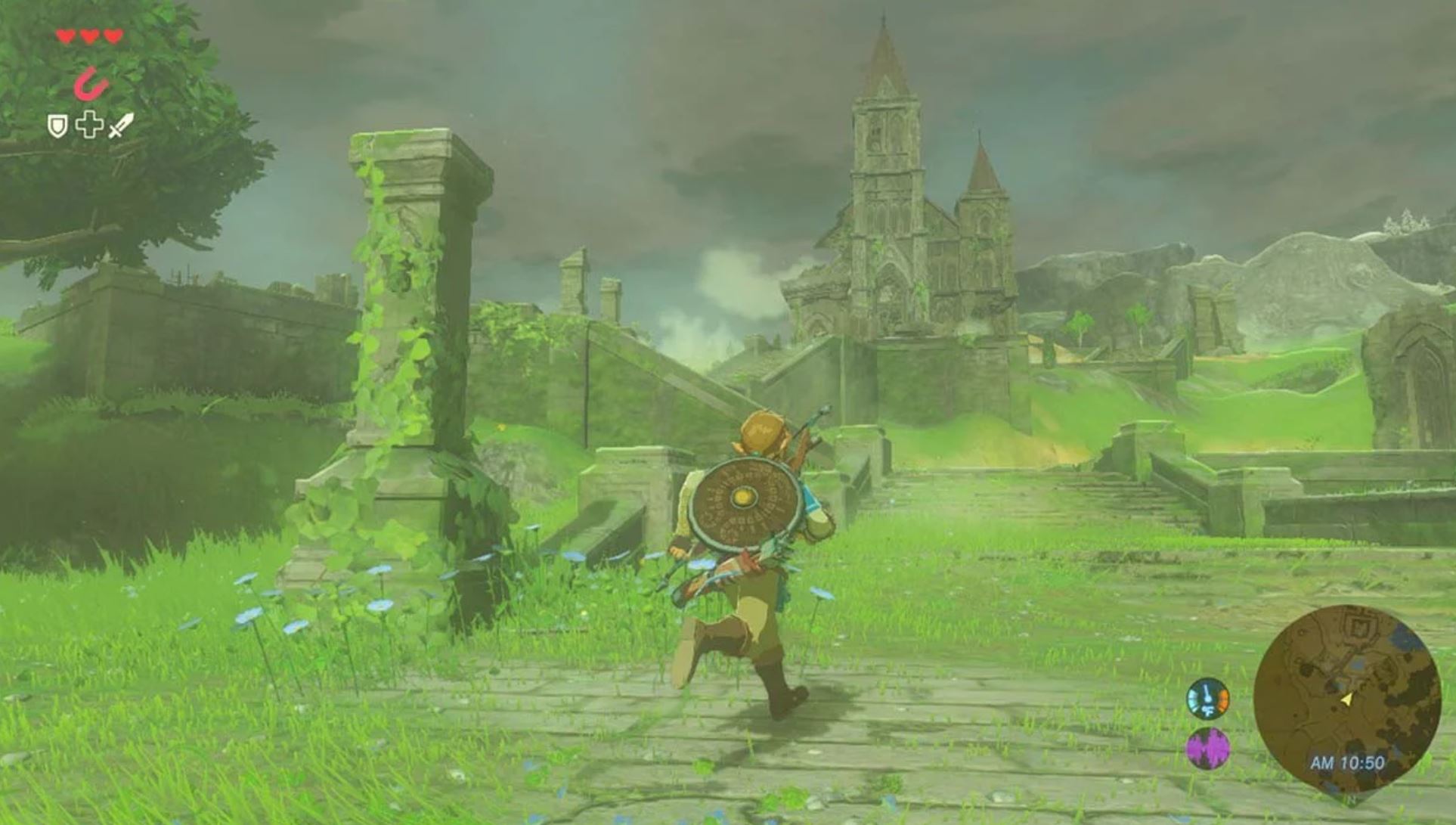
In TTRPG terms, I wanted something as diegetic as possible. In other words, I wanted the game mechanics to, as often as possible, never break the immersion. More importantly, character advancement and change should be a result of the narrative, never of non-diegetic elements such as XP, milestones, advancement tracks etc. Advancement should also never refer to lists of feats, skills, etc. Everything, in the end, must emerge from the narrative itself. Of course, I started with FKR principles. The initial game mechanic is quite simple and well-known: if dice are necessary during the narrative, the player rolls 2d6 against the gamemaster with the highest roll determining who dictates the resolution.
I also like to roll one FUDGE/FATE die with any relevant 2d6 check. Those extra die era excellent for providing non-binary results ("Yes, but...", "Yes, and...", "No, but...", and "No, and..." results). They are also a good indicator regarding equipment damage, something important in a survival-like game like BotW. Usually, after three minus results in the die I declare that an item is broken (but, again, that depends on the narrative).
Like in BotW, each player has only two mechanical stats (and I wanted them to be the only thing in the game that is strictly diegetic): Hearts and Stamina.
You start with 3 Hearts. Every time you fail a dice check in combat you usually suffer 1 Heart of damage, although a high margin, the enemy’s size, and other factors might inflict more damage. If lose all of your Hearths and suffer a new injury then, considering the narrative, I let the player decide between falling unconscious, suffering a serious wound (which fills a part of your sheet, more on that later), or deciding to suffer a deadly wound and keep fighting. Again, everything must make sense in the narrative, not in the rules. I usually don’t let characters suffer more than one serious wound, because I don’t want too much bookkeeping, but that might change. A deadly wound usually means you are going to die barring some extraordinary event (like a Princess using the Triforce to heal you or the Sheikan Chamber of Resurrection). If you are already with a deadly wound and receive another hit, you are dead.
You also start with 3 Stamina. You can use those to push your roll, usually adding +1d6 (and picking the 2 better rolls), although I can see you using Stamina to move further, execute another minor action, concentrate on something like aim without missing your main attack etc. Like in BotW, Stamina also is impacted by extraneous physical and mental effort: a difficult climb, a long journey, surviving inclement weather etc. I like to use it also as a sign of bruises and scratches, or maybe as a result of a hit that is not enough to remove Hearts. Stamina also works as a source of power if a character is doing magic or if I want to apply a success with cost ruling.
 |
| Just the 2 Stats in the left, while on the right they can register their items and possibly specific wounds. There is a second sheet for equipment carried in a backpack, belt, or mount, as well as space to list deeds, friends, enemies, and anything else that your PC learned. |
Those 2 stats and your character sheet, as you can see below are all that there is to your character. EVERYTHING else is diegetic. Do you want to learn to use a sword? Train, find a master, get possessed by the spirit of the Hero etc. Do you want to learn magic? Find a way, maybe with a master, an ordeal dictated by Korok spirits, a journey to the Font of Wisdom etc. The best part is that I can use the amazing Hyrule lore and BotW map as the location for my sandbox-like game.
 |
| I printed a big laminated version of this map to use in my games. |
We have played as of this writing close to 10 game sessions and the character have developed quite well. To make sure that the video games are a good source, we established that my kids’ PCs are exploring Hyrule roughly 100 years after the events of BotW (and now Tears of the Kingdoms). Thus, they can use the lore they know from the game to discover what happened with Zelda and Link (who are now legendary figures whose fate is unknown).
Meanwhile, my kids already were cheated by the Yiga Clan (twice!), save the Captain of the (now a) city of Hateno, and journeyed to the top of Mount Lanaryu (which allow me to explore a skill challenge and point-crawl format while still keeping the game 99.99% diegetic).
 |
| The PCs could see through this map to visualize how their climbing was going, while from the GM side I could keep track of encounters and challenges like a point-crawl. |
So far in the campaign, one of my kids managed to learn the basics of water healing magic from a Zoran, while the other saved (unknowingly) the old champion of an ancient god and was given a blessing of Strength. Both PCs also conquered a dungeon (inside a shrine, because this is BotW) and were blessed with either an extra Hearth or Stamina).
Wilds of Hyrule has been a simple but wonderful experience for me about how an (almost complete) diegetic campaign can be run.
 |
| Now I have to add all the cool stuff from Tears of the Kingdom! |


