Tuesday, April 14, 2020

Your wizards are losers!


Everyone, after reading enough D&D, will eventually ask why do wizards (or magic-users) adventure at all? Their magic is derived from their knowledge, from their grimoires… from books! So, if they read and study more, they should be more powerful. I can’t count how many times a player told me that he would like to use downtime to study magic (i.e. level up).

One of my favorite RPGs (and in fact one of the best ones) is Ars Magica. Wizards in Ars Magica follow almost the same flavor as traditional D&D Wizards: they’re bookworms who learn magic from experiment and ancient texts. They are “medieval scientists” if you prefer. Ars Magica’s wizards spent most of their time locked away in their towers and covenants studying and perfecting their Art. You can say that one of the awesome things about Ars Magica is how every wizard trope makes sense in the setting and in the system (there are a lot of other awesome things regarding Ars Magica and you should definitely take a look if you don’t know it yet: the 4th Edition is free!).

Still one the best RPGs out there!

Anyway, as I said, D&D Wizards work (in terms of setting and lore) almost like Ars Magica mages. They should indeed get more powerful by spending less time adventuring and more time researching. Of course, that is a rather boring way of playing D&D if you ask me. So why does it not happen?

Basically: your wizards are losers!

Yes, losers. Wizard PCs are the failures, rejects, heretics, the unorthodox, the mad and those who for same reason couldn’t stay locked in the tower studying. Maybe they disgraced their masters, or betrayed them or discovered the dark about them. I don’t know. That is the funny part and the players (and the table) should figure that out.

Without access to a master and powerful knowledge, your wizard is forced to crawl in the mud with other pariahs, doing lowly things like treasure hunt or (worst) living side by side with sorcerers and warlocks. What a shame! That is literally rock bottom!

Arcane scum! That is who you are!

OK, now you have something to work for your Wizard PC the entire trope of “book mage” makes more sense maybe***. Lets move to the second aspect of this post, what I’m calling at the moment the Tower Wizard.

Illusionist's Tower... don't trust anything you see, hear, touch etc. Also don't trust your party.
Tower Wizards never failed their master (or just killed and took their place). They never lost time with such stupid things such as adventuring and carousing. No sir, they remained locked in their sanctums and demesnes, devling in forbidden and powerful arcane knowledge nonstop. They are the real deal. Most are mad and too much removed from mortal life or reality itself. Practically all of them are dangerous and uncaring (even the rare good ones, actually I would say especially the good ones… they are almost as dangerous as your usual holier-than-thou saint).

Necromancer's Lair and its guardians: lots of dead trees.
Thankfully, Tower Wizards are completely uninterested (most of the time) in the affairs of the world - or if they are interested it is because they need a charmed minion, dominated slave or bound demon to fetch something for them (or those misfits known as adventurers). Or maybe they need to place an entire city sleeping, so they can harvest the perfect 11.111 nightmares provoked by a Far Realm abomination as a component for that one ritual that will prove that the Demiplane of Shadows and the Nightmare Dimension are one and the same. You see, that kind of “academic” stuff.

Yup, that is an Evoker Tower (of course, it is also a volcano).

Tower Wizards are the bogeyman of the arcane world and their domains are filled with treasure, monsters, traps and grimoires. In other words: the perfect place to raid (and die).

Abjurer's Fortress and its scary arcane defenses.
I would treat a Tower Wizard as a boss monster. A thematic one. Forget the spells that Wizard PCs use. That is the “player side” of the game. Create new stuff. After all, Wizard PCs are losers that play with just a shard of true arcane magic. Create a dungeon for each Tower Wizard around the chosen theme. For example: if facing a Necromancer, fill the place not only with undeads, but also with a nexus between the Positive and Negative Places, machines powered by ghosts etc. Instead of a spellbook, the Necromancer keeps his arcane knowledge locked in skulls of dead wizards. Create a Transmuter obsessed with teletransportation and space, his dungeon filled with non-euclidian rooms, gates, creatures that play with space and time etc. You see, Tower Wizards are like “small Saurons” - a great part of their mojo is invested in their domains. That is why they don’t adventure and why they are so powerful. But destroying those places and picking together part of the rubbles, your PC Wizard can discover new spells and stuff.

Transmuter's Tower... hidden behind that gate/trap/monster/thing.

***Actually, older editions of D&D came up with all kinds of interesting stuff to explain why wizards adventure. I remember fondly how D&D BECMI defined the relation between a low level wizard and his master, and how you would always return to your master between adventures to learn more. Other campaign settings, like AD&D Dragonlance, also created good excuses for the Wizards of the High Orders to travel and adventure. I just wanted to create something different.

That is some cool wizardly real estate!

Sunday, March 15, 2020

The Guardian, a (martial controller and) new class for 13th Age


The idea for this class came from years ago, still during D&D 4E, when everybody was debating how a martial controller would look like. For those of you that never played 4E, the game had different sources of power (Martial, Divine, Arcane, Primal etc.) and roles (Striker, Defender, Leader and Controller). While I was still reading 4E it seems that most or all combinations were accounted for (Martial Striker, Arcane Controller etc.) but we never saw a Martial Controller. That is when I started thinking on this class.

Now, the funny thing is that I never intended to use the 4E rules and the original design was for Pathfinder 1E. However, I never managed to do it (I created a Warlord class for Pathfinder though). Then 13th Age came along and I started thinkering again.

An important warning: this is my first 13th Age class and is probably grossly unbalanced/overpowered or even unplayable. The fact is that 13th Age is one of those RPGs where I’m sincerely intimidated/afraid of writing a class (I love to write races, powers, feats etc. but not classes). It took more than a year for me to finish this first draft. Now it is the time to test it. I still have one or two other classes that I want to create for 13th Age, but let's see how this one here fares.

The idea of the Guardian is, as I said, that of a Martial Controller. Unlike the Commander, which theoretically would be a Martial Leader, the Guardian seeks to control battlefield movement and excels against Minions (instead of directing his allies like the Commander). While everybody likes the Cleric, the party as a team should LOVE to have a Guardian around. Guardians should not inflict much damage (except against Mooks) but Conditions. They should change the tactics and dynamics of an encounter. I’m not sure that the tradeoff of “half damage” for Conditions is a good one, but I can’t think of anything else now.


On Guardians and Rangers
In portuguese Aragorn and the Dúnedain aren’t called Rangers but Guardians (and for the record, in my opinion the best translation for “ranger” in Portuguese would would be “patrulheiro”, which was the actual name used by one of the first editions of a Lord of the Rings RPG in Brazil back in the 90s. Strictly speaking “patrulheiro” means patrolman, but it sounds right as a “ranger” equivalent).
The flavor of the Guardian class is that of a dedicated warrior, an exotic duelist, a ritual fighter - maybe one who follows a martial school, tradition or a legacy, either by blood or heart. The names of the Stances, Strikes and Maneuvers are all “kind of” Eastern-style and suggest something different from a “common” Dragon Empire fighter. Inspiration came from a lot of unrelated sources, from Arcana Unearthed, to Exalted, Wheel of Time, KSBD and a lot of other mashup craziness. Guardians see more in common with Monks and behave usually in a more civilized or ritualistic way. And yes, Aragorn’s role in a battle - for me at least - is that of a Guardian. In fact, if I wanted to play Aragorn in 13th Age, I would build a Guardian with, perhaps, the Sacred Warrior talent to represent the royal Dúnedain bloodline.
A Guardian facing a Fighter (or probably a Barbarian if you're really facing the Mountain That Rides)

Saturday, February 29, 2020

Here is a table of fey curses


A friend of mine asked for a table of random fey curses because one of the PCs on his table got a cup or two of Feywild wine. So here is a table of unusual curses and fey magic effects for when you party break one of the many (contradictory) rules of the Fair Folk, or just think it is a good idea to get inside Wonderland without paying attention.


Friday, February 21, 2020

The Cyclops (DCC RPG Class)


I'm a great fan of Krull and also of DCC so why not place those two together? Here is a new (and totally not playtested) class for DCC RPG - the Cyclops! Hope you liked it.


Thursday, February 13, 2020

Utility powers, level-less effects and the kitchen sink


WARNING: This is a 100% verified rambling post. I started talking about “utility” effects (that’s a 13th Age term I believe), went over "edition-neutral" abilities, my usual rants and… I guess I’m all over the place (Sanity 1/1d3). So, please enjoy the post but be warned.

Random thought of the day: through the Open Game License, and more recently the DIY and OSR, everyone is sharing their ideas about their (mostly) d20 Fantasy games and that is awesome, but I often get the impression that we’re missing a good chance of thinking outside the box. 

The thing is D&D created benchmarks for power and effects that are still taken as sacred cows in most d20s and these limits are in my opinion mostly arbitrary. In other words, they don’t affect game balance (13th Age addresses the issue quite well when it discusses utility spells for wizards).

Read this gem!

For example, why is Augury a 2nd level spell/effect? (i.e. you only get it at 3rd level) The information provided by Augury does not correlate to level at all. It is just a yes/no question for something happening in the immediate future. It is useful at 1st or 20th level. Another example would be Disguise Self or even Speak with the Dead. These effects are useful at every level (or potentially irrelevant, given the campaign). They are things that are hard to quantify with levels. OK, you can quantify/rank them among themselves (divinations, illusions… practically anything else, that is not a problem), but that is not the same thing as stating that they correlate to a certain level/tier/power.

The idea (I guess) is that we could label those effects as “level-less” effects play more loose with them, especially when creating new stuff (and variants). This is also (at least for me) a reminder that we can create new stuff outside of the traditional d20’s effect mold. An example: you may not like D&D 4E, but at least it killed the idea that teleport must always be a high level effect. Today, in 5E, we have teleporting elves at 1st level and it doesn’t break the game (although I know some DMs who hate it).

And they named them Eladrin in 4E... oh, the hate!

One of the reasons I love the Warlock class is that it kind of steps out of the traditional class template for D&D. It is a good source of ideas for creating new and different classes… and really, new classes should only exist if they do things mechanically different, otherwise just reskin, multiclass or (if you really must have something different in the rules) try a subclass or a feat.

There are some “level-less” abilities that are just ridiculous. Tongue of the Sun and the Moon from the Monk is the perfect example. Why in the Nine Hells does it take a 13th level Monk to do that?! Usually by that point language barriers are completely non-existent (i.e. irrelevant) in most campaigns. Tongue of the Sun and the Moon would be a lot more useful at middle (and lower) levels.

There are effects that are just hard to quantify “in game”, like all the flying stuff (levitate, fly etc.) and things like gaseous form. They are amazingly useful and allow you to bypass a challenge “for free” or completely irrelevant to adventure, but that is something dictated by the narrative, not the “innate power” of those effects (unless, of course your flight gives you a really fast Speed or a new attack form).

An amazing book to show how “level-less” stuff could work on d20 games (without going completely nuts like Lamentations of the Flame Princess) is Wonder & Wickedness. This OSR sourcebook creates a flavorful, simple and entire “level-less” spell system, without shying away from high level stuff like summoning and teleport. If I had more free time, I’d be tempted to change all DCC spells to a “level-less” system (after all, they are all based on rolling the result of spellcasting on a table, so basically you’re just modulating their effects). I’d probably separate spells by rarity instead of level if I did that.

Wonder & Wickedness

Now, the worst offender in 5E might be Timeless Body. It is usually given as a high level class feature. It is awesome as a dramatic trait but completely useless as a class power. I’m more biased here because I usually see classes as a set of “combat powers”, so anything outside of combat usually doesn’t have a “minimum level requirement” for me. To make things worse, we have the same class feature giving different things for different classes in 5E (check the Druid and the Monk). Timeless Body would be a lot better as a feat (actually as a boon/reward it would be perfect). Anyway, I don’t have anything better to do right now so here is a feat:

Timeless Body
You’re untouched by the ravages of mortality. This may be because of a divine blessing, magic, esoteric training or ancestry. You suffer none of the frailty of old age and can’t be aged magically. Also, choose one of the two options below:
- You do not need air, food or water.
- You can use a short rest to remove 1 level of exhaustion or transfer 1 level of exhaustion from someone else to you. You need a long rest to regain this ability***.
Define the source of your longevity. You might be an elf of an ancient bloodline, a warrior trained in mystic forms of mediation or a druid stepped in the Old Lore. You must also determine if you age at a slower rate or if you’re immortal. The last option is more interesting if bound by some condition or circumstance. For example, your druid might not age, but only while living in the Greatwood.
(With the Dungeon Master’s authorization, after completing a specific quest, you can use downtime to gain the other option.)

***Sidenote: Exhaustion is a weird thing in 5E. I think there is just one 5th level spell and one magic item - Potion of Vitality - that can recover Exhaustion. Sometimes it seems almost like an afterthought, not widely used but at the same time lethal and hard to recover. The Exhaustion chart is a brilliant mechanic that completely ignores level and hit points, which is something that I like. I wish it was more integrated into the game (the same holds for Hit Dice, which sounds a lot like Recoveries from 13th Age but doesn’t receive the same attention).

Since we’re talking about Timeless Body, I remember that when I started playing RPGs one of the most overrated abilities was longevity. To be an immortal elf or wizard was seen as so crazily awesome. The funny thing was that most of the time it was completely useless (that’s why it is usually so cheap to buy Ageless in GURPS). In my almost 30 years of gaming I remember longevity being important just ONCE: we were playing Dragonlance and (rather suddenly) the DM declared that, after an adventure, 20 years have passed. Everyone at the table was pissed off (except the elven players), and I think the half-ogre player even tore his character sheet at that moment and stopped playing. My point is: the problem there was not even the party’s lack of longevity, but an arbitrary decision by the DM, who should have told everyone that the campaign would have long time jumps between adventures.

Don't worry, 5E has no "old age" rule.

Still on longevity and immortality: so, it obvious I believe both are “level-less”. Time for an extreme example: in Brazil the most famous fantasy campaign setting is Tormenta and it has a god of prophecies and resurrection. Yes sir, a “deity of raise dead” (I can’t think of a more authentic “D&Dish” god and I love it). His name is Thyatis (I’m not sure if it is a homage to Mystara’s Thyatis or not, I hope so). So, Thyatis’ clerics can cast raise dead at 1st level and sincerely that is great! It solves A LOT of problems regarding lethality at low levels (particularly for AD&D 2nd, Tormenta’s original system), it keeps the game going and (most important) it is fun!

If you think that the above example is absurd then please let me introduce you to Thyatis' paladins: the dudes are immortal. Yeah, you kill one and she eventually will come back from the grave. Oddly, that doesn't generate any kind of balance problem at the table. Quite the contrary: Thyatis’ paladins are one of the coolest character classes in Tormenta and at the same time they don’t rule over the table’s dynamic while in play. They don’t come back from the dead right away and when they die they don’t get any XP for the game session in which they died. Now, the funny thing is that some players (dare to) complain that losing XP is too much. It is interesting, but XP is a lot more important than dying in D&D (oh boy, I miss the old energy drain rules), so in my opinion it balances quite nicely. And the fact that your PC will come back from the grave is pure badass. And no, Tormenta’s parties aren’t filled with Thyatis’ clerics and paladins.

Of course Thyatis is a phoenix!

Another example of an immortal class is from Castles & Crusades (C&C), from Troll Lord Games. The first book that I got from them was Codex of Erde, a flavorful Tolkien-like setting for D&D 3.0, published back in 2001, which also presented the first “races as class” for 3rd Edition - The High Elf (haters went crazy at the time). As I was telling, the Player’s Guideto Aihrde, a more recent sourcebook for C&C, has an Eldritch Goblin class called the Ieragon, which is immortal, only dying under specific circumstances. Each Ieragon has a unique knack or gift. It is a very flavorful class and the fact it can “raise dead itself” doesn’t seem to break any balance during play (I believe there is a 5E version of the class).
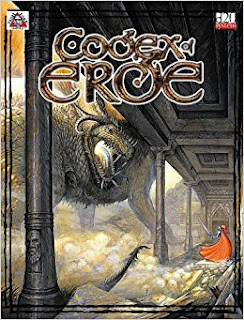
That cover!

Let me dig more crazy stuff.

Another area where I believe that “level-less” works nicely: weather. I’m not talking about raining lightning bolts upon your enemies, or destroying castles with tornados, but changing the weather (from a sunny day to rain for example). It is narratively powerful, definitely, but not game breaking (unless playing Dark Sun I guess). Most players love to have that kind of influence. I think Dungeon World’s druid has a move that does that (and I don’t understand why it is a high level move… especially in a Powered by the Apocalypse© game).

There is a Golden Age of Piracy sourcebook for D&D 3rd called Skulls & Bones. It has a lot of amazing subsystems, but I remember in particular a mystic sailor prestige class who could create small islands in the middle of the ocean. That is an awesome power, definitely not unbalanced and quite interesting in terms of narrative consequences.

The system was clunky (D&D 3.0) but full of good twists.

Another good source of weird and new powers is Legend of the Five Rings (1st Edition! Before “game balance” was an issue… 4E is so boring and I still have to read the last version). Take for example the (original) tattooed monk from the Way of the Dragon sourcebook. It would be an excellent starting point for a new class in 5E (maybe just reskinning the warlock would do it). For example: the Centipede Tattoo allows the monk to start running and reach anypoint in the same continent by the next mid-day. It is something different and potentially useful (but not abusive, because the monk can’t carry anyone with him). The power also has a drawback: the monk is considerably tired after running at such speed, which could be represented in 5E by 1d4+1 levels of Exhaustion. The power has so many conditions and limitations that it would work fine as a 1st level thing.

Probably unbalanced, but fun as hell!

Let’s keep digging: Monte Cook’s Arcana Unearthed, which was a huge influence for all d20 spellcasting systems that came later, including 5E, has a wizard’s class feature where your character can hear when someone else in the same plane speaks his name. That is an ability which should be available at 1st level because (if you stop to think about it is 100% controlled by the DM). Is it flavorful? For sure! But there is no excuse to wait for like 10 levels before getting that mojo (unless it gave you a distinct advantage, like allowing you to teleport to the side of the speaker, for example).

Still one of the best D&D variants.

Now, want a (crazy) source of ideas? Check the “D&D Next”, that was the name of 5E playtest, before fandom and commercial interest brought things back to a more common D&D experience (playtests are always the best spot to see different rules). See, for example, the initial idea for the Sorcerer. It was a class that used magic points (I believe the name was willpower), instead of slots. That is not the point, the interesting bit about the original Sorcerer was that it gained powers when his Willpower (i.e. Magic Points) started running low: for example, a Draconic Sorcerer would start manifesting claws and scales when its magic points were finishing. That is an original and cool idea both from a narrative and mechanic point.

I must also (morally and totally) suggest the Red Box Hack. I don’t have the slightest idea how it started, it is not a d20-based system. Red Box Hack is a free RPG with a splendid assortment of classes. Each class (except maybe the warrior) is a box of cool mechanics and they touch on a lot of topics described in this post. Read it, it is definitely worth of your time. Pay attention on how most classes do stuff completely different.

I started this post commenting (complaining?) about D&D traits and how they are compartmentalized in arbitrary limits and effects. I think I ended up quoting a lot of what I call “edition neutral” traits - that is, stuff that could work on any edition (and theoretically level) of D&D. To finish this rambling I’d like to share one last source of crazy powers, if you don't mind “narrative RPGs”: Spire. It is a very original take on fantasy stereotypes (drows, elves and gnolls in particular), with interesting rules (the Resistance System). However, Spire shines on its wild take on “classes”. There are good ideas worth mining there for any RPG. Take a look.

What a wonderful twist on D&D tropes.


Sunday, February 2, 2020

RPG with my kids


Our first game, just lots of Lego, toys, tokens, a die and a map. 

I’ve been running a few games for my kids for the last few years. Right now they’re 7 and 4. I’m still focused on light game sessions of 30-40 minutes. When I started the “RPG” (my kids called it the “Monster Slaying Game”) it was a mix of dice, minis (Lego!), ludic and playfulness, to keep them engaged (they even started associating RPGs with that way of playing and today I’m trying to teach them the difference). Last year, with my wife’s help, I managed two “true” RPG sessions, where I narrated DCC RPG’s Doom of the Savage Kings (heavily reskinned as a mix of The Hobbit, Super Mario Bros. and Disney). It worked great but I noticed that they still weren’t thrilled by the RPG experience and prefered something more “ludic” (they usually tell me that they like the dice and minis, but love it when I insert challenges in the middle of the adventure, stuff like “Run to your room and look for the lost magic sword hidden amid the dinosaurs”).

Digging out my old AD&D First Quest box.

My search for a good system was interesting. I searched for RPG for kids and was initially impressed by Faery's Tale, but later found it too complex for my kids. Because I loved the OSR, I jumped instantly to Dagger***, which is probably the best option. The funny thing is that I left Dagger because of one of its best features - it didn’t use Ability Scores, focusing on Classes, which is great to simplify the game. One the other hand, Ability Scores are some of the RPG’s most compelling aspects for beginners - the fact that you can build a super strong hero or a very smart one, is something that my kids love. Also, I want them to understand the rules, which is why Ability Scores also help - they’re easy to explain. The end result was that I used Black Hack 1E (with armor rules from 2E) to run my reskinned Doom of the Savage Kings. I kept the players focused only on the Ability Scores, Class and Hit Points. I used ICRPG’s approach to hit points (Hearts) and Target Number, which was excellent for my kids to keep track of (the big d20 in the middle of the map is hard to miss). I created the idea of “1 power per level” so they would feel the difference of leveling up and that worked great for the game. However, my youngest still didn’t pay attention for more than half an hour and although they loved their character sheet (in great part because of the art I guess), I needed my wife as a player to keep their attention.

***OK, I might have confused Dagger with Kids & Dragons, which is the brazilian version of this awesome post from The Contemptible Cube of Quazar. Both seem to be the same game. Anyway, I just want to give all the sources right here.

We didn't play S&W White Box, but I want my kids to love the sight of that dragon.

So, I went hunting again for other games...

The first was Hero Kids, which I found nice because of the dice pool, it was simple to visualize. But in the end, Hero Kids didn’t clicked for me. I think it was mainly because of the art (c’mon, kids playing RPGs don’t want to see themselves dressed up for Halloween as the characters!) and the lack of rules for building new characters at the time.

Princess Peach against the Doom of the Savage Kings!
And valiant Sr Owen, Dinosaur Knight.

I got really good recommendations from a friend to try Adventure Maximus!, but I never managed to get a copy and the game requires a lot of props.

Next one was was FirstFable. I remember enjoying reading FirstFable because it really considered that you were running games for kids. Take Hero Kids, for example, where you just have a D&D with kids’ art and a new system, but at the end of the day you’re still killing things and taking their stuff. FirstFable was different, and the adventure was focused on challenges and interaction (I remember when the party has to find a mythical creature that they made up at the beginning of the adventure, it was a great idea to engage the kids). The advice and the material in FirstFable were spot on and I ended up using most of it in other systems. The irony is that I couldn’t find a way to teach my kids the FirstFable rules.

Clone Troopers run from (a definitely cute) Cthulhu in a forgotten star system.
Roughly one year ago I started using a homemade system. It was something really simple but visual, and they liked it. Basically, each player has a half-page character sheet with 3 stats - a Heart (for physical stuff), a Wing (for dexterity and precision) and a Light Bulb (for perception and mental actions).

Just 3 stats and a die for each. It worked! (the toys above were equipment)

After giving my kids the character sheets I would give them a d8, a d6 and a d4, then place a die inside each stat. I told them that bigger die were better. The rule was simple: roll the stat you wanted to use and try to get 4 or bigger to succeed (I think I stole that from Savage Worlds, but I believe both Hero Kids and FirstFable use a similar TN).

Behold the power of Lego!

Each character has 10 hit points (as in ICRPG) and usually a strike deals the character’s Heart in point of damage (so a strong PC, with d8 in Heart would deal 1d8 of damage in melee hits). Ranged attacks would deal damage with Wing and Magic would use (I guess) the Light Bulb stat.

Each character would also have a theme, like “Dinosaur Rider” or “Jedi”, to keep the player focused on what kind of actions they could do (otherwise they would use their imagination and create all kinds of superpowers and sidekicks to help them… all the time! I can’t forget my son using “summoning a T-Rex” to save the day). I discovered that open-ended themes worked a lot better than a specific set of powers, like feats (Cleave, Power Attack etc) or spell lists.

Lots and lots of Lego!

My last attempt added a 4th stat - Spirit - used for courage and willpower (represented by a golden circle, because all stats must be graphic, so that the player can place the die inside). So far this system (with maps and tons of Lego) is what they like more as an RPG. “Advancement” is done by loot (like getting a lightsaber) or new themes (usually at the end of a “campaign”, like after 2-3 adventures).

Last version of our home game. Rey and BB8 from Star Wars hunting for lightsaber crystals.

As they get older I’m tempted to return to my hack of Black Hack. I’m not sure if I would keep the D&D Ability Scores and the classes (probably yes because I want them to play d20 games) . I would definitely use ICRPG approach to Heart and Effort, probably skipping attack rolls and using just damage, as in Into the Odd (which also avoids the whiff factor of ICRPG, where you roll great at the Stat, but poorly at Effort). 

This used to be my "RPG Kid" game kit.

Finally, there was the “Dinosaur Battle Royale game”… this came in one afternoon where my daughter didn’t wanted to play, but my boy was begging for a RPG. He has a lot of dinosaurs (and knows a lot about them) and also loves rolling my dice, so I drafted a small table (calling it a combat matrix is a bit much) and we started rolling battles between his team of dinosaurs and mine. Later I added some tactical choices - like choosing to get an extra attack with the risk of suffering damage - and also a common enemy: I placed a Bowser (from Super Mario Bros.) in the middle of the battlefield. Every attack roll had a chance of “triggering” Bowser to attack you, so you had to decide before rolling if it was worth to attack first Bowser then go for your enemy (at the time my daughter was also playing with her stuffed animals team, so choosing the right target was important, and alliances also occurred). It was a lot of fun (definitely not a RPG) but I’m tempted to try something more complex.

I found this online and love it. Still hope my daughter will enjoy it in a few months ;-)


Tuesday, January 21, 2020

On (another) variant Ranger for 5E


[lights a candle] Oh, you’re still here? I’m glad for that! I haven’t keep this tower properly maintained. Sorry, I was busy facing the most horrendous and Challenge Rating scored beast ever - Real Life! Man, that’s a lost fight, but we have to fight it. To complicate matters, I must confess that I named this tower most adequately, as I see myself (again) without victims (i.e. players). So, here I'm back again to fill you with cantankerous monotone diatribes. Hope you enjoy them, dear delver!

So… Rangers for everyone's favorite second take on D&D!


OK, if the Ranger is following its tradition there are probably A LOT of homemade 5E Rangers out there already. I actually like the official Ranger quite enough, however I also believe that class features like Favored Enemy and Natural Terrain are a pain in the ass, because they limit the character to certain parts of the campaign setting (I’m tired of seeing the disappointment on a player’s face when the party leave his Natural Terrain). So, here is so far my “homemade” Ranger.

Except where noted, everything in the Player’s Handbook is kept.

Favored Enemy:

1) If you want something simple and direct:
Remove Favored Enemy and replace it with Hunter’s Mark. Now, that is a 1st level class feature. For simplicity’s sake keep all the mechanics in place. It still requires a bonus action to activate and concentration but it isn’t a spell (actually,  in my opinion, stuff like Hunter’s Mark for the Ranger and Compelled Duel for the Paladin aren’t true spells but “hidden” class features, which I deeply hate because I prefer a more “open” approach to game design, like 13th Age).

2) If you still like something more crunchy for Favored Enemy:
Beginning at 1st level, you have significant experience studying, tracking, hunting and even talking to a certain type of enemy.
As a free action, choose a type of favored enemy and declare that you’ve been studying their lore and tactics: aberrations, beasts, celestiais, constructs, dragons, elementals, fey, fiends, giants, monstrosities, oozes, plants, or undead. Alternatively, you can select two races of humanoid, such as gnolls or orcs (and no, you don’t have to choose both races at the same time).
You have advantage on Ability checks related to or against your favored enemy.
You have advantage on Damage Rolls against your favored enemy. If you use the Help action to instruct an ally to attack a favored enemy, you can grant advantage to your ally next Damage Roll against the favored enemy.
If you don’t speak their language (and if they have one), you can understand the basic meaning of what they’re saying and also keep a simple conversation (the DM might allow you an Ability check, perhaps with disadvantage, to decipher runes, written messages or more complex conversation). If you know their language, the DM might grant you advantage for tasks like reading lips.
You keep your current favored enemy until you use Downtime to study a new favored enemy and switch your tactics. To choose a new favored enemy you must have access to information about them or have survived at least one combat against them (as always, DM’s call).

Natural Terrain: use the Unearthed Arcana’s Revised Ranger class feature.
