Showing posts with label review. Show all posts

Monday, October 2, 2023

Augury: Black Star


100% Recommended!

Recently my daughter discovered Clone Wars and to my total delight she devoured all the series like there was no tomorrow. Then she jumped to Rebels with equal enthusiasm and we both watched Ahsoka together – with made the experience something that I will treasure for the rest of my life., She then asked (no… demanded!) that I run a Star Wars RPG for her and my boy. Being a “old school” Star Wars gamemaster, I immediately recovered my Star Wars d6 (2nd Edition, Revised & Expanded) and used Bill Slavicsek’s house rules to de-crunch it a bit (you can find his excellent advice at the end of Defining a Galaxy: 30 Years in a Galaxy Far, Far Away, a must read for fans!).

Our first Star Wars d6 session was (of course) a mission for my daughter’s padawan and my son’s clone soldier. They enjoyed the narrative but complained that they felt limited by the rules. While I deeply love and still run Star Wars d6 I do admit that it is better suited for a level power close to Rogue One and Andor than Clone Wars (I mean, you can run it for Clone Wars with Jedi and Clone Commandos, but it requires character that are a lot stronger than traditional initial PCs… which also means rolling lot of dice all the time).

So, I started searching for another option. I am running a Dragon Ball Z FKR campaign for my kids, so I didn’t want to use the same approach for Star Wars. I briefly considered the awesome Star Wars Saga (d20) or using my old Star Wars FATE hack. I was tempted to dust off my Star Wars books that used Genesys (I love those dice), but I didn’t have the time to read the rules again. While I felt that my daughter might enjoy any of those options, my younger boy would get bored quickly. So I went looking for something not overly minimalist but also avoided traditional systems – and this is where I found Black Star.

LakeSide Games' Black Star is a not-Star Wars rules light player-faced game. All checks are made with 2d6 against a difficulty of 9, but the game also incorporates a lovely success with cost rule based on a limited resource: Resolve. Resolve is literally “dramatic hit points”. As long as you have 1 Resolve you still can do stuff, but if it hits 0 you are at the mercy of the opposition. Mixing traditional hit points with metagame currency is never a safe bet, but for the pulpy feel of Star Wars (especially the Clone Wars series)… damn, it works like a charm. Of course, it is a fine balancing act. I saw myself in situations where my kids faced the choice of either burning Resolve and trying something cool or not burning Resolve but suffering Resolve as damage. However, that kind of situation is a natural consequence of such systems and I never felt that it “broke” the game (more importantly, it never shattered the narrative reality). But it remains perhaps the weakest point of Black Star if you don’t like that kind of mechanic.

The rest of system use positive and negative die do adjudicate difficulty (kind like D&D 5E’s advantage and disadvantage, but cumulative). Gear, ships, and NPCs use a clever tag system that builds upon that system. Characters are defined by a set of universal skills, their archetypes, and their talents. Gear is part of the narrative but when it really matters mechanically then it is a talent, and that is a design decision that I totally approve (and which screams Star Wars!).

The book provides a cool set of not-Force powers, adventure samples, and everything you need to start kicking your campaign in a far, far away galaxy. I have already run 4 sessions for my kids and we are having a total blast. I cannot recommend enough this game for people that are looking for a rules light Star Wars option but who find things closer to FKR (like the awesome Galaxy Far Away) too light.

A typical Black Star player character.


Monday, November 21, 2022

Augury - Pan, His Majesty in Yellow


Nymphs of rain and despair, the Greek deity Dionysius, a mortal shepherd stolen from his world, and the jealous god Hastur… Who would ever imagined that Peter Pan and the King in the Yellow would mix so nicely? That is precisely the theme of the Pan, His Majesty In Yellow (PMIY), a beautiful hexcrawl for Old School Essentials, currently in his last week of crowfuding.

After a brief introduction (and a poem!), the book opens with a nice “Once upon a time…” section devoted to the weird and mysterious life (and death) of Hyas or Pan, touching not only upon the original source, but also in Greek mysteries and the Hastur legendarium. These days I am usually wary of background in OSR modules (as I don’t by OSR for that reason), but PMIY managed to make it not only succinct (just 2 pages) but also very flavorful. After it we get a d66 Things Pan Might Say, followed by more details on the (very weird) Boy Who Would Not Grow Up. In PMIY, Pan is the centre of a struggle between Hastur and Dionysius (or his nymphs). As a result, Pan’s spirit is fragmented and quite mad, split in different personas (including Captain Pan, a pirate, and the evil King in Yellow), while Hastur seeks to reclaim him. If this sounds confusing and dream-like that is precisely the idea. It works beautifully with Hastur’s own mythos. Yes, we get (various) stats for Pan and they are all scary!

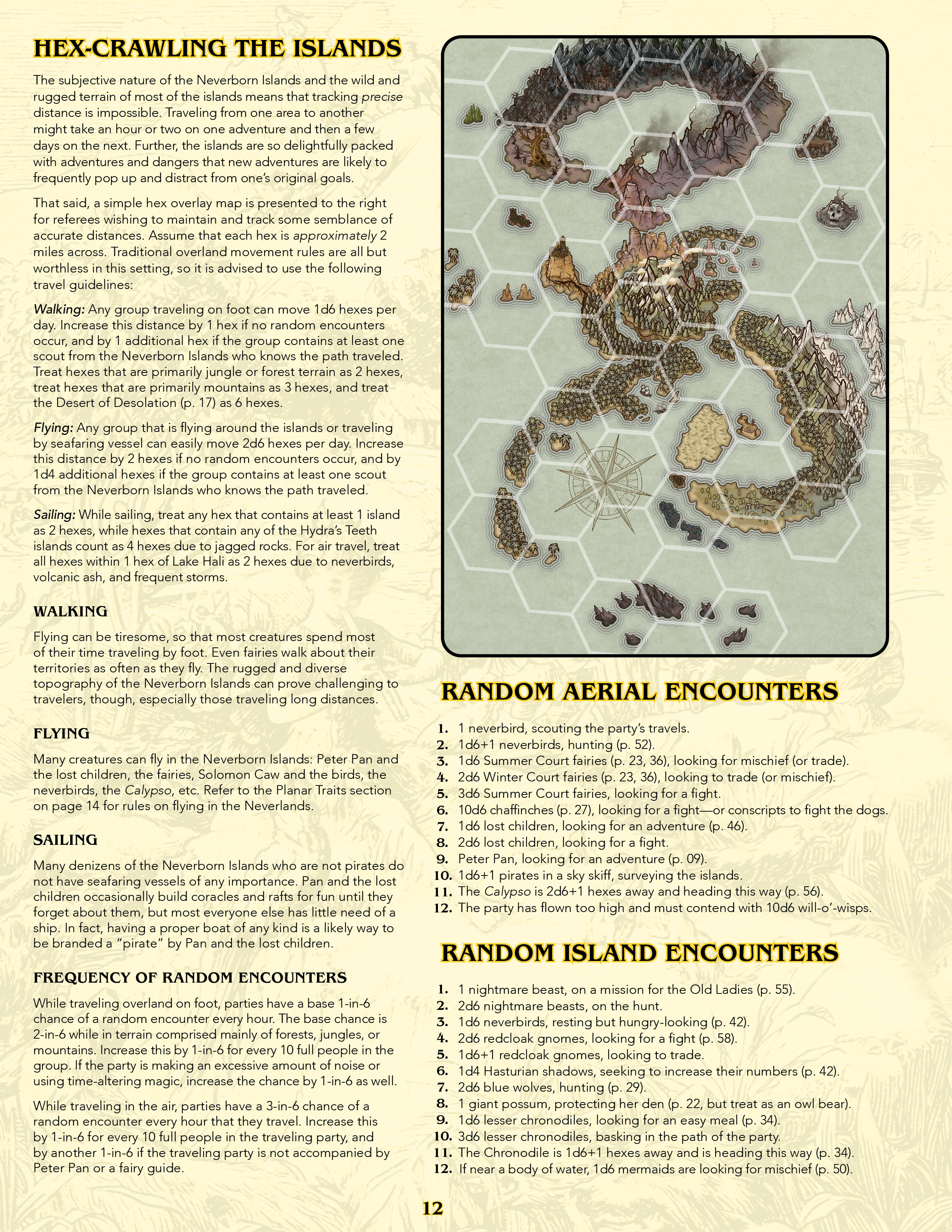
The next part is a full description of the Neverborn Islands, including maps (one with hexes), encounter tables, and the weird planar rules of the fantasy realm. “Fantasy” is the word here. The Neverborn Island operate on dream logic and much of the new mechanics are about that: memory loss is a constant threat and death is not the end (this last bit is perhaps the most distinguish factor in PMIY, a campaign setting where forgetting who you are is a lot more dangerous than dying). However, travelers be aware: Pan CAN kill you (permanently). Oh, and yes, if you believe hard enough you CAN fly! The unique mix of new rules makes the Neverborn Island a very interesting scenario to visit and I am already tempted to attach it to most of my current settings just to see what will happen.

Each part of the Neverborn Islands get a small but flavourful description, followed by a few adventure hooks. My favourite locations are those where the dream-like atmosphere and “unrealness” of the setting are highlighted, such as the Dog’s Cemetery. There are a lot of cool references here and there, such as in the Emerald Island and in the Hydra’s Teeth. After the gazetteer, we are presented to the Underhome of the Neverborn Islands (i.e., please insert you favorite dungeon here) and to Carcosa. Both Hastur and Carcosa itself are more of a background threat than a NPC and a location, and PMIY recommends using them to generate an atmosphere of dread and alienation.

The next part of the book is about Denizens, which ran from wonderfully illustrated bleeding trees, blue wolves, and mermaids, to a surreal version of Captain Hook (the undead fairy-slaying pirate, who pillaged Carcosa). Yes, we get a description of the Jolly Roger Pan, together with a map! PMIY’s version of the crocodile is called the Chronodile, a magic warping gargantuam monstrosity. Creatures have stats for OSE, but use some concepts from D&D 5E, such as legendary actions (which work quite nicely in my opinion, but leaves some of the creatures really tough). Other Denizens include the various faeries, Sir George (THE Sir George), the gingerbread demon, a statless Hastur (but with stats for his shadows), the Kraken, Ladon (the famous Hydra), Lost Children, among others. There is a lot of stuff here. PMIY also offer new magic items, including Captain Hook’s coat, the Chronodile Scale, and (of course) the Tatters of the King.

PMIY is a unique book. The flavorful atmosphere, mixing Barrie’s original work with Greek mythology and Ambrose’s Carcosa is so cool that I would still recommend the book even if there were not stats for the Denizens. The fact that the author uses the “original” Hastur and not the Cthulhu pastiche is a plus for me and the part of the setting that I like most. I think that the unique Denizens are a bit too powerful, especially those that use 5E-like mechanics, but that is counterbalanced by the normal monsters, most of which are there more to be interacted with rather than fought (especially the fairies, mermaids, and Lost Children). Finally, it is impossible to read PMIY and not compare it with Neverland by Andrew Kolb. Neverland picks Peter Pan after the events of the original novel and extrapolate a unique OSR for hexcrawling (while updating the setting in matters of sensitivity). Its monsters are some of the best of the OSR. PMIY is widely different. It is a fever-induced mélange of Classics, Ambrose’s alienating Weird Tales, and horror. Both Neverland and PMIY are amazing works and I am happy to have them in my collection. That said, Neverlands is a flavorrful but traditional hexcrawl, while PMIY is a surrealistic, cruel, and tragic scenario. You can visit the Neverborn Islands and try to make sense of it, but if you try to engage it as traditional hexcrawl you will end mad or in the belly of Chronodile in a short time (and yes, that is a compliment!). PMIY reminds me of H.P. Lovecraft’s Dreamlands at its best: a dangerous and beautiful world that doesn’t make sense where your goal is to keep your wits and survive until you can scape it. In fact, I like it mix of fantasy and horror so enthralling that next time I won’t send my players to Ravenloft, but to the realm of Pan, His Majesty in Yellow, below the Hyades and above Carcosa.


Sunday, August 28, 2022

Augury - The Book of Ebon Tides (D&D 5E)


This review is based on the PDF of Kobold Press’ Book of Ebon Tides. Although tailored specifically for their Midgard setting, it offers an interesting plethora of characters for the Shadow Realm, which is a demiplane that is made of equal parts of Brothers Grimm’s fairy tales, eastern European legends, D&D famous’ Demiplane of Shadow, and the Feywild (but as if seen through a delightful darker glass). The Shadow Realm was discovered by the goddess of moon and magic Hecate who, after fashioning it more to her liking, populated it with goblins, shadow fey (the Scáthesidhe) and their servants, besides bearfolk, human night worshippers, and other races.

After that brief history, the book details the eerie and mutable nature of the Shadow Realm. This is perhaps the most interesting aspect of the plane. Unlike the Material Plane, the only things that are eternal in the Shadow Realm are, well, shadows. Everything else is affected by the so-called ebon tides, which produce slow and dream-like but constant changes: rocks, trees, and other physical landmarks, even entire forests and mountains, inexorably change their location and even aspect. The natives discovered ways to bind or hold certain places together through unique magic and materials, such as wood taken from the holy wood of Hecate. These isles of stability are connected through the equally magical Shadow Roads. The book provides a table with suggested manifestations of the ebon tides to increase the setting’s weirdness. The Book of Ebon Tides also provides further details on holydays, weather, gods, fey etiquette, and customs.

We next get to “Umbral People and Heroes”. Here we get new races: bearfolk (the shadow bearfolk subrace), darakhul (the Midgardian High Ghoul, with new templates for bearfolk and shadow goblin), the famous shadow fey, the luminous lunar elves, the rare sable elves, the cunning and provocative shadow goblins, and umbral humans (with the subraces changeling and gifted). We also get stats to play with the fey-like quicksteps, the squirrelfolk ratatosks (with the subraces ekorre and tradvakt), erinas (spiritfarer), shades (Stygian), ravenfolk (sublime), satarre (unbound), and gnomes (wyrd). In terms of Midgardian lore, the sable elves are probably the most interesting one, presenting a decadent and weakened branch of the ancient elves that once shaped worlds like Midgard itself. Mechanically speaking the most interesting entry is the Gifted Umbral Humans, which represent mortals who made some pact with the fey in exchange of power or a perk. The ratatosks are a bizarre mixture of themes (squirrels, celestials, Yggdrasil… you name it) that are not only remarkably original but offer some very fun options as a race (specially the tiny ekorre). Finally, it is worth mentioning that all the races receive the most recent D&D 5E mechanical treatment, with flexible options for ability scores for example.

The Book of Ebon Tides also offers plenty of new options in terms of subclasses. We have the Circle of Shadows (druid), the College of Shadows (bard), the community-based Keeper Domain and the mandatory Shadow Domain (both for cleric), the original (and unexpected) Light Weaver Origin (sorcerer), the poison-obsessed Mother of Sorrows (warlock), the Shadow Arcane Tradition (wizard), the smoke/mist-based Shadow Gnawer (barbarian), the Umbral Binder (rogue), and, finally, the charismatic Way of the Prophet (monk). Seeing in darkness or similar forms of darkvision are, obviously, ubiquitous here. And yes, I did miss a new Fighter archetype.

The next part of the book is about magic. First we get rules on how illusion spells (with the shadow and illumination keyword) are empowered in the Shadow Realm. There is even some advice on how to describe the malleable nature of that plane through some spells. I wished that the book devoted more attention to that last bit, as I feel it is what makes the Shadow Realm so unique and different from other planes, Shadowfell, or Feywild. After that we get into the meat of the chapter: new spells! I am more mindful of flavorful then merely tactical spells and the Book of Ebon Tides did not fail me. There are plenty of awesome magic here, such as the 1st level Blade of Blood and Bone (you can create and store a magical dagger made of your bones and blood) and the grotesque 7th level Charnel Banquet (a disgusting but invigorating repast). There are a lot more of those: Child of Light and Darkness, Conjure the Ferryman, Conjure Giant, Deep Roots of the Moon, Doom of Poor Fortune… originally, I ended listing basically 90% of the new spells here. Usually, I can’t bother even reading magic chapters in most book as they are so bland, but the Book of Ebon Tides is simply otherworldly (no pun intended) when it comes to magic. I would buy the PDF for this chapter alone.

‘The Nature of Shadow’ feels like a continuation of the book’s introduction, further detailing the weirdness of the fey plane. How to get in (and out) of the Shadow Realm, its beasts, features, hazards, traveling, and my favorite one: Shadow Corruption. The Book of Ebon Tides builds its planar corruption mechanic upon the chassis of one of D&D 5E’s most neglected (but potential) rules: Exhaustion. So, here we get a 6 levels chart of progressive Shadow Corruption that gives not only disadvantages but also a few perks, such as (surprise!) darkvision. It is a simple but flavorful way to build a new mechanic and I quite like it. The chapter also details a few specific locations.

The next bit of the Book of Ebon Tides is all about intrigue: we get more details on the fey courts and their servitors. These courts are like locations and are more detailed than the previous chapter. Some are little more than a giant manor, while others are basically cities. Among those there is, of course, the one ruled by my favorite Midgard NPC/villain: the Court of the Moonlit King. This is one of the biggest chapters of the book and there is a lot to process here, all pure campaign setting. There are even details on fallen courts. In ‘Realms Beyond the Courts’, we get further places to explore, such as Fandeval, the City of Goblins, and Merrymead, the City of Revels. Again, there is a lot to use here.

Next, we reach the deities of the Shadow Realm, each one with a full description, including some good DM advice, such as Midgard’s wonderful approach to gods and goddess trough masks, which lend a lot of mystique back to religion (something that I sorely miss from most D&D books). ‘Monsters and NPCs’ comes next with 25 new entries, including stats for a lot of ready-made NPCs such as bearfolk, elves, goblins, among others.

The Book of Ebon Tides, like any other D&D sourcebook, has its own chapter of magic items. Like spells, these are usually things that I usually pass by, but the magic paraphernalia lovers are for a treat with some 80 new items among weapons, armors, artifacts, and wondrous items. I often feel that good magic items are more about telegraphing to the reader the unique flavor of the setting than just “kool powerzs” (although I also like nice powers), and the Book of Ebon Tides sets a good example. We have the Book itself as an in-world wondrous item. Remember that bit about the Shadow Realm being flux and malleable? Well, the Book of Ebon Tides is how you funk with that. Other examples of flavorful or just outright awesome magic items are the various memory philters, the illusion seeds, Hecate’s Lantern, and my all-time havoc-unleashing favorite: the collapsing mountain (yeah, your read that right).

The Book of Ebon Tides closes with three Appendixes. The first one has tables describing lesser magic items. These are pure gold and I love when authors take some time to create these trinkets, as they always are a lot more flavorful to a setting than endless lists of new magic swords or staves. There is also tables on fey pranks and tricks, court fashion, pets and mounts, food, cantrips, omens, secrets, lore and weird servants. The result is that these tables (and the awesome art) manage to pack more flavor than a lot of chapters put together. More importantly, they are useful to any fey-themed campaign.

The second Appendix has encounter tables, while the third Appendix has a list of monsters separated by terrain (very good) and CR (not very useful in 5E). We also get some battlemaps for generic locations, such as a fey court, roads, and dark woods.

Before I forget, the Book of Ebon Tides (to my surprise, given the flux nature of the place), also has a beautiful two pages color map of the Shadow Realm (of the type that you would love to have printed and hanged on your wall).

The Book of Ebon Tides is a refreshing surprise in terms of 5E sourcebooks as it manages to be not only an original reading (in crunch and flavor) but it is useful both for players and gamemasters. The Shadow Realm’s planar nature makes it easy to attach it any world or campaign. For old Midgard fans, it is a must, providing perhaps a first full picture of the world, especially for those like me that love to play around Zobeck and the original locations of the campaign setting (where the shadow fey have a strong presence).


Thursday, March 24, 2022

Augury - Fleaux!

In my last Kickstarter rampage I fell victim to Fleaux!, a wonderful French RPG (you can find the original french version here) that seems to me to be a mix of Black Hack (roll under attribute) with Warhammer Fantasy.

In Fleaux! (which means ‘scourge’ or ‘plague’) you play with criminals and outcasts at the edges of civilization, trying to survive in a 17th or 18th century fantasy world that just suffered a massive civil war. There are ruins, devastation, and opportunity aplenty for rascals like you to get rich.

The B&W art and layout are flavourful and beautiful, with a total Warhammer Fantasy vibe. I say Warhammer because while the world is going down in misery and war, you get a sense that you can dive into it, face its challenges, and come out rich. It is not as satirical as the original Old Word, nor as hopeless as Mörk Borg (which actually is so nihilistic that I can’t stop laughing while reading it… I do love dark humor). The cover art of Fleaux! is one of the best in the OSR.


The rules are ridiculously simple and inspired by many of the best tropes of the OSR. You have six attributes (Strength, Dexterity, Erudition, Charisma, Guts, Melee, and Shooting). Origins are Human or Halfling, Dwarf, Elf, Goblin, and Ogre-Blooded. You can roll or choose one. Each Origin has a d6 table where you find where your grew up (and receive an attribute bump of +1). For example, your Dwarf might have received her education “under the blows of the mine guardian’s instructors”, gaining a +1 to Melee. After that you roll your crime, which basically defines why you run from home. Perhaps you were accused of making a pact with a demon, or of bribing a royal office. The entries provide a nice hook for each character.


Now we roll to see how your survived, which defines your Profession. Your can select Resourcefulness, Isolation, Violence or Knowledge. Each one opens a table with a row of professions, which are occupation-style names like smuggler, mercenary, barber-surgeon (yes, there is a ratcatcher). A profession gives your another +1 do an attribute, plus a small advantage. Mercenaries, for example, increases his damage die by one, while barber-surgeons can restore hit points with a successful check.

In Fleaux! your hit points are determined by your Strength, and damage is abstract, usually fixed at d6. Your equipment is determined by how much money you have, as well as your career (and thankfully there is a simple rule for upkeep, which I always find useful). Finally, you have Willpower, which is a Usage Die rule used for special actions and to resist certain effects.

Fleaux! uses a simple 10 level progression. Character gain XP at a pace set by the referee. Leveling up gives you small +1 bonus to stats and HPs. At certain levels you might gain other benefits, like a second profession, or talents. The last ones are like feats. I quite like the fact that in Fleaux! you gain your first talent at 2nd level. That is nice because it allows players to first learn the rules and play a little with the game, before selecting mechanical benefits. The fact that you have to choose talent later means that character creation is a lot faster and more immersive. That said, there are only 2 pages of talents and they are easy to understand.

Next are the rules. As I said, these are pretty simple and intuitive. Roll below your attribute to succeed, 1s are criticals and 20s are fumbles. You have 2 actions per round and Fleaux! uses Advantage and Disadvantage (made famous by 5E). We also get the full details on Willpower, which is used, for example, when you want to cast spells or when your want to do 2 actions of the same type in a turn (such as attacking twice). Losing all your Willpower triggers a panic roll (which can be quite deadly). Combat is straightforward: roll below your Melee or Shooting and if you succeed roll damage. You can dodge or parry. Armor grants damage resistance and shields grant Advantage against melee attacks (I do miss a rule for shields allowing you to defend better against ranged attacks). Falling below 0 hit points means that you are out of combat and possibly dead. Fleaux! uses a Helpless table to determine (after combat) the fate of your outcast (it reminds me of the great Roll the Body rule from DCC RPG). You might have survived with some damage, a scar, a permanent injury, or you just died.

Fleaux! characters are scum, but tough scum, so we have rules for short and long rests. We also get 2 pages on Firearms, because this is the frigging Modern Age! There are also a few guidelines on how black powder and sorcery are a dangerous (bot exploitable) combination. And speaking of the Devil, sorcery is next. Spells in Fleaux! might misfire and exhausting your Willpower will trigger a Chaos Revenge roll (which is basically a slow death spiral table, with the classical possibility of a daemon dragging you screaming to another dimension). The spells are are small and flavourful. There is nothing so simple (and boring) as “deal X damage to Y”. For example, there are spells to make your blood turn to acid, or to leave your reflection locked in a mirror, so you can spy on others. After that we get “charms, curses and other incantations”, which give some minor spells that are equally interesting. Fleaux! also covers Alchemy, allowing the party to forage for monster parts and create elixirs (without going into big “shopping lists” as some other rules do). This part of the book ends with a few guidelines for enchanted items. This might be the weakest part of Fleaux! because we only get basic rules on how enchanted items work (Mörk Borg’s list of awesome magic items seems to me to be a better approach).


Next, Fleaux! presents us with a complete bestiary and an adventure. I always believe that new RPGs tells us more about themselves through adventures than through rules or setting and Bloodbath at Castle Kragstein is a fine example of that philosophy. It hits home with all the core points of Fleaux! Bloodbath is an open-ended scenario where PCs start as prisoners (for the crimes rolled during character creation) sent to a forlorn prison in the mountains. The location is going to be the stage not only of a barbarian raid but also of a fell necromancy ritual by cultists hidden among the prison’s wardens. It falls to the PCs to survive this gauntlet (and yes, they can ally/betray/interact with all factions, which is a plus!).

Fleaux! has a setting with an Old World-like vibe (but here the Not-Holy Not-Roman Empire crumbled due to civil war). There is a very brief description of each region, just a paragraph, followed by 6 adventure seeds. Interestingly the main threat appears to be an elven empire from the East that employs changelings as infiltration agents (I loved it). There is considerable racial tension between Dwarves, Elves, and Humans, which lends a nice Witcher flavour to the whole thing. We also get details on Ur-Hundun, a parallel world and possible place of origin of Elves, Dwarves, and magic.

The final pages have references for most of the rules, as well as spells organized in card-like fashion. We also have the (beautiful) character sheet.


Fleaux! is definitely worth a look and it provides a different flavor of OSR, more embedded in European modern fantasy than most games. While it has its own unique setting, I can’t avoid the temptation of using it to run a Warhammer Fantasy roleplaying.

Saturday, July 27, 2019

What I’ve been reading - Tequendria Fantastical Roleplaying


Tequendria Fantastical Roleplaying - The Dunsany RPG

I’m a great fan of rules-light systems (hey, I’m an OSR guy! And I usually associate that movement with rules-light and practical RPG systems). More than that, I’m a total Lord Dunsany fan! You don’t know Lord Dunsany (a.k.a. Edward John Moreton Drax Plunkett, 18th Baron of Dunsany)?! Google it! But to make it short: Dunsany is an amazing fantasy author who was an important inspiration to other 2 authors that I really like (and you probably know): Tolkien and Lovecraft. If you want to start Dunsany my suggestion would be The Gods of Pegana (and also this post and this post).

OK, what I’m talking about is Tequendria Fantastical Roleplaying. This is an awesome PWYW RPG, with 77 pages, by Scott Malthouse (with art by Sidney Sime and Ivan Bilibin!), from The Trollish Delver. It is powered by the Unbelievably Simple Roleplaying system (USR) and has cool OSR-flavor (minimalist but oozing flavor).


You distribute a d10, d8 and d6 between your 3 stats (Action, Wits and Ego) and pick one of the 20 Archetypes, which give you Starting Specialism (skills and knacks), Starting Equipment and an Ability (kind like a Feat from d20 Fantasy games).

The Archetypes are amazing and tell you a lot about the surrealist and weird flavor of Tequendria: Aethership Pilot, Bathraka Cloudmind, Celador Knight, Doomgaunt, Ember Goblin, Fallen Monarch, Gravekeeper of Zum, Hand of the Blue Court, Icur Sorcerer, Jewellery Thief, Khartoov Griot, Long Wizard, Moonblade, Necronaut, Priest of Mana-Yood-Sushai, Questing Dwarf, Reapermancer, Savage Elf of Allathuria, Tulthian Warrior and Vunsa Mystic.

Each Archetype is cool and gives so many ideas and images that you practically want to focus an adventure on each one (they also are great seeds for NPCs organizations and factions, easily used in other RPGs… I wanted to change a lot of them into 5E backgrounds or d20 prestige classes). For example: 

Aethership Pilot - “As a young lad, he dreamed of soaring through the aether, feeling the rumble of the star engine and the wind in his hair. Now he lives the dream, his face blackened by aether dust and a grin across his face. Whether it’s soaring over the Bounds of Leng or sailing over the vast Kuth Nebula, he is at home in the Aether.

Doomgaunt - “Born from the skeleton of the last goliath, Doomgaunts are blackened constructs of bone and marrow. Their blue eyes piece through a dark visage, a rumbling voice that few soon forget - the Doomgaunt is an abomination to some and a saviour to others.”

Long Wizard - “Stretched and distorted, the Long Wizards of Buckfast Reach are 8ft goliaths, their beards swaying by their ankles. They smoke pipes of crushed drake horn, feeling a high that powers their magical abilities. In the small hours they can often be heard singing the traditional song of the Long Wizards - a low, ghostly hum, a tale of ancient ships crossing the aether and the birth of stars in the firmament.”

Some archetypes are so “Dunsanyian” that make me want to open a book from author right away - like the Fallen Monarch and Priest of Mana-Yood-Sushai. Other plants the seed for the setting, telling us about the fairy-like Blue Court, the violet moon, the grand thief Thangobrind, the people of Khartoov and their battled against the otherwordly demonic Kaido, the purple-skinned and horned Tulthian.

The next chapters are small and right to the point, showing us equipment, spells, treasure, magic items and the USR rules (with are intuitive and light, easily fading in the background during the game).

After that we reach the World of Tequendria itself - these are all short entries on a lot of cities, realms and famous locations. The game doesn’t lose time with minutiae and useless details. Tequendria reminds me of Lovecraft’s Dreamlands, which were based on the work of Dunsany. We learn about the glass palaces of Babbulkund, seat of Queen Faria, dark-skinned and green-eyed; about the forest of Allathurion, lair of the Gnomes of Zuf and of Savage Elves, who live inside the hollow trunks of Gulgar trees; about the coastal City of Durl, where the Hand of Iyfer emerges from the water to crush fleets; about Vunsa, a city that moves through the desert; the Tower Unvanquishable; the Dim City of Carcosa; the red dwarf of Xoth (who are astronomers of the Aether); etc. The setting is a wonderful read.

The next part of the PDF is the Bestiary, full not only of animals and famous monsters (like dragons, giant eagles and the Yellow King itself), but also of Dunsanyian creations such as Gibbelins and Gnoles.

Tequendria closes with guidelines for creating or reskinning monsters and “Selected Works of Lord Dunsany” (Idle Days on the Yann; Distressing Tale of Thangobrind the Jeweller; and The Fortress Unvanquishable, save for Sacnoth).


Wednesday, July 3, 2019

Stuff for ‘The Sea Demon’s Gold’ adventure


Howdy folks!

As one of the playtesters of Shane Ivey’s awesome adventure I don’t think I’m the best person to offer a review. You don’t know what ‘The Sea Demon’s Gold’ is? It is a 1st level dungeoncrawl for D&D 5E, offering a brief glimpse in the author’s Broken Empires setting (more info here). In this adventure, you play raiders tasked with exploring a disturbingly organic temple (with lots of Yog-Sothothery) in a godforsaken island.


I’m obviously giving some SPOILERS from now on, so don’t read if you want to play this adventure later!

Here is basically what I liked or did with ‘The Sea Demon’s Gold’:

- It is a 1st-level adventure that fulfills what a campaign starter should do in my opinion (i.e. leaving a few loose ends for the DM to explore, like a possible warlock pact with the Sea Demon herself) but it is also perfect for a one-shot game (because it offers everything that a good game night needs in one package). Usually, when someone asks me to run for them a “traditional dungeoncrawl” – i.e. Old School style - I use the ‘Tower of the Stargazer”. Now, when someone who already plays D&D (or d20 Fantasy in general) asks me to start a new game, I use “The Sea Demon’s Gold” right away.
- It has a strong theme (Lovecrafthian horror + dungeoncrawl, without going into cliché territory) and it throws you directly into the chaos (the first combat encounter is one of the best I’ve read in a long long time). 
- It is an interesting read, giving you lots of ideas (the Sea Demon herself is a good new deity/demon lord/kraken to use as a villain or evil patron and the Sea Folk is a nice addition to any campaign setting).
- Like the DCC RPG adventures, it uses its own monsters and breaks some conceptions of what dungeoncrawling is at low levels. I had a player asking me to start a game at 3rd level, because he wasn’t much interested in “killing goblins and kobolds that were sacking farms”. What I did? I started a 1st-level game using ‘The Sea Demon’s Gold’ as an answer. 
- Although written as a 1st-level adventure, the entire thing is easily adapted to higher levels. With a minimum fuss you can run it on the spot for 2nd or even 3rd level parties. In fact, because its implied setting is indeed ‘semi-historical’, it has a really strong S&S vibe and uses Cthulhian-style adversaries, I’ve already hacked versions of “The Sea Demon’s Gold” for other RPGs (it is that easy). One for Modiphius’ Conan 2d20 RPG, using only monsters stats from the Corebook (you can also use it on Mongoose’s excellent Conan d20). The other version is for a Call of Cthulhu/BRP game where the party plays 9th century vikings raiding a lone Orkney island. The adaptations required were minimal because the dungeon itself is quite somber and avoids goofy or “gamey” elements (c’mon, even the gelatinous cube is basically a shoggoth when you see what it does in the setting… it is there as a horror element).

OK, here are a few things I added when running the adventure for D&D 5E. I hope it can also help your table.

The Heart of Iron crew

As you know, the first part of the adventure is all about surviving a merciless encounter with the Sea Folk. The basic idea is that the party has established some connections with the crew of the ship, the Heart of Iron, and they will try to save those NPCs during combat. Those relationships depend on your style as a DM and on how much time you want to spend roleplaying things before they get messy. At one of my tables, we spend one entire session just roleplaying with the crew, while at another I felt that the players would appreciate just rolling dice to see with whom they have created bonds. In both cases, I created small secrets and weird stuff about the crew - enough to draw the players in and make them remember the NPC that I was going to try to kill in the first encounter (a fun commentary: at one table, the roleplaying created rivalries between PC and NPC, so that the players actually tried to use the first encounter to toss the rival NPC in the seas).

The adventure provides us with 2 named NPCs (captain Helia Lin Haerrean and sailor Pitaja, and invites you to create more). Here’s the crew that I use:
- Captain Helia Lin Haerrean is a no-nonsense leader and a fearless woman (from an exotic land of your home setting). Her best friend (and fellow adventurer) is Riala (see Alahir below). The first time I run ‘The Sea Demon’s Gold’, Helia was actually the only survivor of the first expedition to the island and only escaped because she made a pact with the kraken. She was ashamed of her past but also needed to offer more sacrifices to the Sea Demon in one year or she would begin to transform in some kind of monstrosity (a deep one/sahuagin). In another run of the adventure, she owned a priest money because of a raise dead spell and her time was running out.
- Sailor Pitaja is a carefree young ex-pirate. I portray him as a friendly NPC that loves to gain (or lose) money by gambling. There’s always a player who likes the idea of carousing.
- First Mate Alahir is the weird NPC. He’s a brute man, always drunk and menacing. The entire crew is afraid of him and bizarrely he has the trust of Captain Helia. He has a temptress as his mistress, the fair lady Riala. Riala can only be seen at night, while has husband is passed out at his cabin. Alahir is the NPC that I created to be hated, but inquisitive players will find his relationship with Riala weird and possibly investigate it. Actually, Alahir and Riala are the same person and the woman is the true face of this NPC. A curse acquired in Riala’s adventure days with Captain Helia forces her to become an ugly and brute man during the day. Riala is so disgusted with her state that she spends most daylight hours drunk, channeling her hate against the lazy crew. One party at my table had his PC fall in love with Riala (and he was quite shocked when the truth came out) while other party actually managed to kill Riala while searching for Alahir.
- Sailing Master Hasfullihatrandy a.k.a. Master Nose is a gnome born on sea and fated to die if he ever touches land. He is a strange creature, all tattooed that goes almost naked, but with an almost supernatural scent, particularly useful to find good winds, avoid storms and direct the ship to land. In my campaigns gnomes are usually creatures defined by obsession, so this is my “sea gnome”. You can easily change him to a human, also tattooed, and regarded with awe by the crew due to his “magic nose”.
- Master Shoufa is the comic relief. He is the ship’s cook and an open promoter of cannibalism as a way to “steal your enemies’ strength”. He won’t eat any of the crew or the party, only enemies (actually, if he’s a true cannibal or not is up to the DM, because the Captain uses him as way to keep the crew in check). At one table, Soufa was a half-orc, because it fits nicely, but you can use him as a human.
The rest of the ship was just a series of names and small traits, which I used most for flavor:
Rusa (ugly as sin, possibly Hagborn), Jadikira (claims to come from another world with 3 Moons), Kitana (woman, amazing sailor, Shoufa’s girlfriend), Redrik (one eye, one hand, one ear), Bal’zahar (tattooed, no hair), Haddan (wants to be captain), Frog (jumps at everything, Gollum-like), Monkey (a kid, good at the riggings), Luha (another kid, runner), Shafik (strong) and Eyes (curious, want to be adventurer, stupid but lucky).

A Random Encounter Table

‘The Sea Demon’s Gold’ is a static dungeon. Except for the gelatinous cube, each encounter is fixed in place. Clever parties that notice this detail might be able to face each encounter and then retreat for a short or long rest at the ship. There is nothing stopping a DM from making the dungeon reacts once the party gets in, but I particularly likes surprises. Thus, I came up with a random encounter table that I used everytime the party attempted a long rest (or after 2-3 short rests).

Please, bear in mind that the adventure as written already had a deadly trigger for parties attempting a long rest: the aforementioned gelatinous cube. What I intended with the encounters below was to add dynamism and more flavor, just that:

Roll a 1d6:
1 - 1d4+1 Sea Folk. These are “holy champions” sent by the Sea Folk to try to kill the temple’s ghostly priest. The Sea Folk deeply fear the kraken (their goddess), but also want to defeat its priest. A decadent and barbaric civilization, they only approach the dungeon through religion (where a group of “chosen ones” is selected to face the Sea Demon in ritualistic combat). All end eventually killed by the gelatinous cube, which is actually the point of the entire thing (the Sea Folk leaders knows that, and use the champions as “cannon fodder” to keep the Sea Demon placated). This encounter only happens once during the adventure. If you roll it a second time, nothing happens.
2 - 1d4-1 Giant Crabs (a ‘0’ result is just a dead crab). 
3 - 1 Darkmantle.
4 - 1d4 traitorous pirates from the ship, converted to the Sea Demon through dreams.
5 - The Mud Mephit, carrying loot to his lair. Only use it once, after meeting the creature for the first time. Otherwise nothing happens.
6 - Water level raises, making all rooms difficult terrain for the next 1d4 hours.


Sunday, September 3, 2017

A review for Sharp Swords & Sinister Spells – Addendum


One the best aspects of the OSR movement is the DIY attitude. In the last years, this principle gave us not only excellent retroclones but also original games; some of those are of particular interest to me because they’re clearly “built” from pieces of other RPGs, but in a very interesting way. Examples are Aspects of Fantasy, Dungeons & Delvers - Black Book and, of course, Sharp Swords & Sinister Spells.

Sharp Swords & Sinister Spells (or SS&SS) came to my interest originally because the author is a fellow brazilian – and the one responsible for translating to portuguese DCC RPG (one of my all-time favorites RPGs). However, after reading SS&SS I became instantly a fan of this little gem. You can see my review here, but the elevator pitch (in my opinion) is that SS&SS is a variant of Black Hack that incorporates a lot of cool rules in order to create a light Sword & Sorcery game. Its classes take the best of others games that I appreciate and its spellcasting system seems to me almost like a lite version of the DCC RPG casting system.

OK, enough for introductions. What Sharp Swords & Sinister Spells Addendum is about? First, it is a B&W PDF with 90 pages (the original SS&SS is just 50 pages). Like the core, the Addendum is available as PWYW product at DriveThruRPG.


The Addendum opens with guidelines for using Vocations (the hero’s open concept, like “Barbarian from the Iron Horde”) almost like FATE’s Aspects. This is something that I already did, but it’s great to see the author defining it with more concrete (but simple) rules. For those that don’t like Aspects, there’s no problem: the rules just show you how to use Vocations in a positive or negative way (with Advantage/Disadvantage), also allowing the hero to recharge his Luck.

Next topic is Multiclass. Here SS&SS takes my favorite approach: instead of pre-build kits, it provides simple rules for mixing and matching all Archetypes (Warrior, Specialist and Magic User). Actually, it goes further and lets you built different heroes, like nonhumans. I loved it. My only worry is the balance factor. Multiclass heroes usually requires more XP (game sessions) to advance. I’m not sure that’s the best approach and I’m tempted use in my tables something involving a few “free” Negative Die/Setbacks/Complications per session (or maybe something making Luck harder to recharge, I’m still not sure).

The next topics are a few guidelines for Languages and rules for Zero-level PCs (this last one clearly inspired by DCC RPG). Also inspired by DCC are the Learning New Abilities section, which show us how heroes may gain specific new abilities (like fighting techniques, mystic powers, etc.) and even list a few examples. It’s my favorite approach to PC development and I’m glad to see another RPG embracing it.

Next we get the Blood rule. This basically matches a PC’s Physique ability score as his hit points, which is nice because the game (like many D&D-derived RPGs) is very lethal at lower levels.

The SS&SS Addendum also provides a Sanity & Madness section. I missed more concrete rules here. I believe Madness could be faithful recreated in SS&SS by giving the poor hero a “Madness Vocation”.

Resources & Treasures gives you abstract rules for money and rewards and is another awesome example of the versatility of the Usage Die (I hope to write a review of Dungeons & Delvers - Black Book, which is a game that really shows you how far you can push the Usage Die). Of course, Resources & Treasures is followed by a now classic “Where did my gold go?” table, in perfect Sword & Sorcery fashion (although I missed a gamble aspect to table, like Jeff Rients’ carousing rules).

Next topic is Quick Equipment. It may seem silly, but ready-to-use equipment kits are in my opinion one of the most important rules for any game. Most of my tables hate to buy equipment and when you’re introducing the game to new players (or just want to get direct into action), things like skill/feat/equipment lists are true let downs.

Drunken Luck is our next academic topic, and it’s an awesome variant rule for heroes that bet in their liquor to keep kickass-ing (which reminded me of the equally great rule from the D&D 5E playtest).

Adventuring Companions is a rule to form bonds between the PCs.

Journeys and Travels is a good cut-scene rule, for when you the party must get to the next spot, but the referee also wants to keep verisimilitude – so the PCs make a Luck check to avoid hazards.

After travel hazards we get rules for ‘Strange Effects of Ancient Spellbooks’, 20 new spells, True Names and True Sorcery. This last one is where you get those earth-shattering spells and dooms usually employed by the Evil Wizard of many S&S sources. Here are the guidelines for spells that target armies and affect entire fortifications. While the SS&SS Addendum does provides concrete rules for using True Spells (including the caster sacrificing ability score points permanently), I prefer the old Swords & Wizardry approach, where you basically threat high-level (or epic) spells as unique magic items.

Still talking about the arcane, we get a lite but very flavorful rule for Arcane Corruption, where the more spells a Magic User knows the more inhuman he gets. The next wizardly topics are Rare Ingredients and Drugs & Other Preparations (yes, lotus dust is here).

All those variants and additional rules don’t encumbrance the game and rarely occupy more than a page or two. In fact, it’s amazing how broad the SS&SS Addendum is, because we just reached the middle of the PDF.

Next part is a Monster Generator. This is the supplement’s biggest section and is mostly covered by system-neutral tables with basic ideas and descriptions for monster (aberrations, animals, beings from the future, undeads etc), although at the end we get a list of 100 special abilities (with rules), besides suggestions for monsters’ Weaknesses and a rule for Mooks.

After the monsters we get an excellent rule for creating Rumors, in which the entire table participates. This is a brilliant way of engaging the players, besides helping the referee. I’m extremely tempted to use it in all my tables right now.

SS&SS Addendum isn’t done with us yet. So we get tables and rules for Forgotten Artifacts, Random Life Events, “What Has Changed Since We Left?” (a table used when the PCs return to a town or outpost they’ve visited before) and an Adventure Title Generator.

The SS&SS Addendum is a perfect example of a supplement that highlights its’ Core Book without changing the game’s strong points. There’s so much stuff you can use here that I can’t recommend it high enough – be it for SS&SS, Black Hack or other similar fantasy games.