Showing posts with label Lovecraft. Show all posts

Tuesday, September 14, 2021

Crawling Ones, a new DCC RPG class!

Happy is the tomb where no wizard hath lain, and happy the town at night whose wizards are all ashes. For…the soul of the devil-bought hastes not from his charnel clay, but fats and instructs the very worm that gnaws; till out of corruption horrid life springs, and the dull scavengers of earth wax crafty to vex it and swell monstrous to plague it. Great holes secretly are digged where earth’s pores ought to suffice, and things have learnt to walk that ought to crawl.

-         The Festival

You are the worms that, after eating enough corpses, come together and become something more than the diminished sum of their parts. Crawling Ones are what happens when maggots and worms feed on body (and soul?) of spellcasters. Over the centuries all that eldritch power builds up and usually it just requires one more corpse, spell misfire or arcana calamity before a Crawling One shows up.

Yes, this is the famous Worm That Walks and the main inspiration is Gareth Hanrahan’s amazing Black Iron Gods Trilogy where spellcasting is practically magic plutonian – it is powerful, but deadly and poisoning; and most humans can’t stand much of it before burning out or dying it. Experienced sorcerers are rare and extremely careful. Other races fare better in spellcasting such as Ghouls, but now one beats the Crawling Ones’ natural gift for it. I could go on and on about the origins of the Worm That Walks but someone one did that better, so take a look at TV Tropes and open the tabs on Tabletop Games, where you can the find the origins of the critter back to it’s Call of Cthulhu origin (besides a lot of other cool games.

The idea here is a DCC RPG class that you can use since level 1, it could even be used to continuing play with a 0-level character that didn’t survive his Funnel, but whose death triggered the emergence of a Crawling One. Is the Crawling One the soul of the dead character? Maybe a bit of that soul mixed with others eaten before? Or perhaps – as in Gareth Hanrahan’s Black Iron Gods – they really are their own bizarre thing, an entire race of worm-sorcerers who feeds on the memories of the dead.

The class herein try to play on all those angles, leaving the final answer to the player and Judge. This is a mash-up of D&D, Black Iron Gods and Kill Six Billion Demons (because I absolutely LOVE Gog Magog, which is like the uber-epic-Joker-version of a Crawling One).

So, to the Crawling Ones Class…


"There is no mask!"

Hit Dice: d4. On physical combat a Crawling Ones are ridiculously easy to put down.

Attacks and Action Die: Again, like a Wizard. Your Critical Hit dice and table never improves, Crawling Ones are physically puny.

Saves: Crawling Ones are adaptable. They start with their saves as a Wizard, but when they REST for at least 8 hours they can “change” their saves between Fort, Will and Save, representing the worms rearranging and adapting.

Weapons: all one-handed weapons. The only ranged weapon that you can eventually master are crossbows. No thrown weapons.

Armor: None.

Conquering Worm: you are a mass of worms, so as long as one survives you are fine. At any moment a Crawling One can use an Action Die to scatter itself over the area. In this “unassembled” form they are immune to anything that is not an energy area attack. However, they do take a long time to reform.

A Crawling One risks death or a Roll the Body check only when brought to 0 hit points or less by an energy area attack (fire, acid, lightning, and other forms, like pure magic energy). Attacks from really big creatures also fit (Judge’s call, but this should be rare and forewarned to the player).

Otherwise, when brought to 0 hit points or less you require 1d6 turns to reform. You reduce this time to 1 turn by suffering 1d6 points of damage to Stamina AND Strength.

You are immune to diseases. Finally, if hit by a poison attack, instead of rolling a save you can “expel” the poisoned worms by suffering 1d6 Stamina damage.

Eldritch Might: Crawling Ones can spellburn any Ability Score to cast spells, not only physical ones.

Burning Magic: you ALWAYS must spellburn at least 1d3 points of damage to cast any spell. If a spell naturally requires at least 1 spellburn, the Crawling One don’t need to pay anything extra (yes, finally Chill Touch is not useless… actually, it might be a Crawling One spell).

Dead Memories: your memories are scattered through the worms and its hard to focus. You are not trained in any skill, but you can burn 1 point of Intelligence to become trained for 1 turn in things related to magic, worms, dead (and un-dead) things, graveyards (and the dungeons below them), and ghouls and other “rivals”. As usual, as the Judge.

A Mass of Horrors: you are disgusting and unnatural. Animals will flee in horror if they sense or smell you. Predators will attack you in rage if cornered. You are untrained in any social checks against humanoids (except intimidating attempts). However, you are trained in social checks against all un-dead, even mindless ones, and can try to avoid them or negotiate with them (Judge’s call). You can be turned by Law and Neutral Clerics.

Worm That Walks: you are a mass of worms and can thus pass through any place that an individual worm could given time. If time is not of essence, you could pass through a keyhole. To affect anything physically using your Strength or Agility you need to be fully assembled, which usually require 1d6 turns.

Corpse Eater: you can feed on one humanoid corpse during 1 turn to do one of the following (a) heal 1 Hit Dice; (b) heal your level in Ability Score damage (distributed as you choose); (c) gain your level in trained skills that the corpse possessed (Judge’s call) for 1 day; (d) gain 1d3 questions related to things that that corpse knew.

Finally, you can devour a corpse for magic power. This takes longer, usually 1 turn per HD/level, but it grants you 1 “spellburn point” per HD/level. These “spellburn points” last for 1d6 hours after you feasted. These are not cumulative (i.e. you can’t devour an entire village… of course, the Judge is welcome to create some grotesque Quest for the Impossible just to allow you to do that. May the Gods have mercy on her soul.) 

In Unhallowed Ground: you can only regain hit points by eating corpses (or by magic).
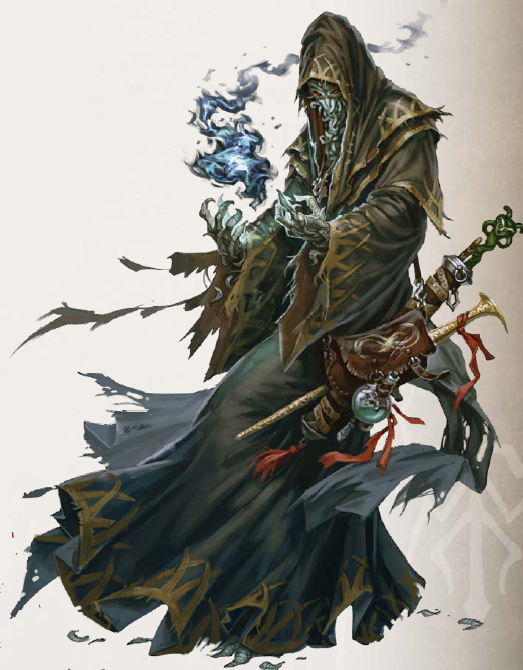

Worm spellburning! RUN!


Thursday, August 22, 2019

Ghouls and Stone Men from 'The Gutter Prayer'


I’m reading right now Gareth Hanrahan’s debut novel - ‘The Gutter Prayer’. It is an amazing dark fantasy book, filled with ghouls, alchemical superscience, bloodthirsty goods and super-powered lepers. It is that good. You don’t know Gareth Hanrahan? Well, he is the guy responsible for 13th Age’s megadungeon - The Eyes of the Stone Thief. When I first heard that Pelgrane Press was doing a megadungeon for 13th Age I was devastated… c’om, the most funny and vanguard d20 Fantasy RPG out there doing a frigging megadungeon?! Then I started reading the book. Oh boy! I have used the Stone Thief in all my 13th Age campaigns (and even in D&D 5E). It does to megadungeons what 13th Ages does to D&D (if you don’t know what that means stop everything and get 13th Age). Gareth Hanrahan’s stuff is also worth your time. He is responsible for an absurd amount of good material, from the The One Ring to Night Black’s Agents. I just treat him like Kenneth Hite: buy it first, read it later, never regret it.


Enough marketing… As I said, ‘The Gutter Prayer’ is a dark fantasy novel focused on the underworld of Guerdon, a city filled with thieves and scoundrels, that sell alchemical doomsday weapons and tries to remain neutral in the apocalyptic Godswar, a world conflict powered by the best version of D&D’s clerics that I have ever seen in literature. But Gareth loves Yog-Sothothery, so Guerdon has ghouls. No your D&D-style undead ghouls. Something more flavorful and close to Lovecraft’s Dreamlands Cycle (which I absolutely love and tried once to mix with Fritz Leiber’s ghouls). Another thing that screams Cthulhu is the past of Guerdon and the origins of the ghouls - there is a Sarnath/Ib written all over Guerdon’s murky origins.

OK, so I loved ‘The Gutter Prayer’ and I also have the bad habit of translating things to d20 Fantasy before finishing the damn novel (hello Malazan Book of the Fallen!). So here is how I would run Guerdon in D&D 5E (its races at least… excluding Crawling Ones, that deserves a special post):

RACES

Ghouls: you’re a Lovercraftian ghoul. Carrion-eater humanoids with hooves and slightly canine features. Cunny but bestial, you’re comfortable in dark places and the underground. You constantly fight your unholy urge to consume the bodies of the dead and frolic in the stinky and loathsome depths, but you’re also afraid that your hunger will transform you in the feral form of your parents… deadly predators that stalk the deeper levels below Guerdon. Actually, you’re afraid that you might not only go feral but “live” long enough to become an elder ghoul - a giant and obscene carrion mystic that channels the darkest sorcery and communes with Elder Things best left unsaid. 

Ability Score Increase. Your Dexterity score increases by 2 and your Constitution by 1.
Size. Medium.
Darkvision. 60 ft.
Speed. 30 feel. Your claws and heightened senses gives you a 30 feet climb speed.
Keen Senses. A ghoul has advantage on Wisdom (Perception) checks that rely on scent. A ghoul can also use an action to pinpoint, by scent, within 30 ft, the space where a hidden or invisible creature is (but still attacks such target with disadvantage). Ghouls are naturally attuned to magic and can roll a special Wisdom (Perception) check, with disadvantage, to feel if magic is being used within 30 ft (just the presence of magic, not its location).
Corpse Eater. You have cold, radiant and necrotic resistance. However, you only gain half the benefit of healing magic.
Unholly Hungry. You have advantage on Constitution checks to resist the effects of hungry and thirsty. While you can consume food as a normal humanoid, you find it bland and tasteless. However, if you consume the flesh of a fallen humanoid (at least half a corpse), you can recover 1 Hit Dice plus your level in hit points. You must wait a short rest before gaining hit points in this fashion again. In narrative terms, eatings tons of corpse flesh is a sure way to become a feral ghoul and leave the campaign, but let us leave that to each DM and table.
Criptbound. You thrive in the underworld. While in a dungeon, cave or underground terrain (DM’s call), you can reroll a Strength (Athletics), Dexterity, Intelligence (Investigation) or Wisdom (Perception) check. You must declare your reroll before the DM declares the outcome of your action. You must wait a short rest before using this feature again. 

Stone Men: funny how this one even has the exact same name from the magic plague of A Song of Ice and Fire. Anyway, this one is more dramatic (and definitely best for RPGs). Basically, you’re slowly being petrified by a curse that carries all the stigma and prejudice that leper did in our world. Your fate is literally to become a living statue, entombed in your own body and slowly dying of hunger or asphyxiated (if your lungs petrify first). The only thing that can keep the Stone Plague away - for a time - is alkahest, an expensive alchemical concoction. Meanwhile you’re a moving stone body. The more the disease advances, the more resistant and stronger you are. Its an awesome concept for a novel or RPG - the PC that gets more power but also is closer to death. I don’t remember reading something this cool since the Book of the Shadowlands for L5R.

Here is how I’m doing it. First, to keep things simple, it only works in Humans and it is represented by feats.

Stone Men I
You are afflicted with the mysterious Stone Plague. After the shocking news you probably tried to get alkahest to avoid the worst effects. This feat represents those that failed in that first attempt, either because they were too late or because they didn’t have a way to find alkahest. You suffered the first stage of the plague, gaining a shell of stone shards over your body. You gain the following traits:
  • Increase your Strength score by 1, to a maximum of 20. You have advantage on Strength checks to break or lift things.
  • Your stone skin gives you an AC of 16 (no Dex bonus). You can’t use armor, only shields. Reduce all slashing, piercing and bludgeoning damage by 3.
  • You’re very slow, reduce your speed to 20 feet.
  • You’re bulky. You have disadvantage on Acrobatics, Sleight of Hand and Stealth checks, and automatically fails Athletics checks to swim (you sink).
  • Your unarmed attacks deal 1d4 points of damage.
  • Alkahest: you must take constant doses of alkahest. That means expeding the equivalent of a Comfortable Lifestyle (60 GP/month) just to pay your doses. Failing to do that gives your a Stone Plague level 1. This works (almost) like Exhaustion. Increase your Stone Plague level by 1 after 1d6 days not taking the alchemical drug (the GM rolls secretly) and it increases 1d6 days after (also a secret roll). Only alkahest (or a wish?) will reduce the Stone Plague level, usually by 1 per week at most. See the track:

1) Disadvantage on all non-Strength ability checks.
2) Your Speed is reduced to 10 feet and you can’t Dash.
3) Disadvantage on attack rolls and saving throws. You gain Stone Men II feat, if you don’t have it.
4) Hit points maximum halved. You gain Stone Men III feat, if you don’t have it.
5) Speed reduced to 0.
6) Death by petrification.

Stone Men II
If you stop more than a few hours you’re probably stuck. Here is the rule stuff (besides what you gained before).
  • Increase your Strength score by 2, to a maximum of 24. You can use a two-handed weapon in one hand.
  • Increase your AC by your proficiency bonus. You have resistance against cold, fire, poison, slashing, piercing and bludgeoning damage.
  • Your unarmed attacks deal 1d6 points of damage.
  • You’re too clumsy, especially with what is left of your hands (they probably look more like pads). You automatically fail Acrobatic, Sleight of Hand and Stealth checks (your passive Stealth is 0). You can’t use Light weapons (or anything that requires more finesse, probably stuff like crossbows). Finally, you have disadvantage on Initiative checks. Don’t take this feat if you want to cast spells with somatic components (because you can’t).
  • Alkahest: same stuff, but now you’re paying a Wealthy Lifestyle (120 GP/month).

Stone Men III
You are a living stone golem!
  • Increase your Strength score by 3, to a maximum of 24. Your strength is a danger to you and others. You can’t feel things by touch. On the other side, Stone Men at this level are ridiculously strong, so you always deal maximum damage against objects and structures and can probably walk through a brick wall as if it was paper (5E likes to play fast and loose with object rules, so this trait basically gives your PC “free collateral damage”).
  • Your unarmed attacks deal 1d8 points of damage and you can grapple creatures of any size.
  • You don’t feel anything, remember? That includes pain. You can postone, as a Reaction, any damage, for 1 round. That means that if you took 50 hit points of damage, you can set it aside for 1 round (and if you get healed meanwhile, you can use any healing or hit point recovery to reduce postponed damage). You’re immune to massive damage if your DM uses that rule.
  • You’re immune to petrification, because - c’mon! - you’re already in that stone grave.
  • You have resistance to acid damage, because there is too much stone between the acid and your (remaining) flesh.
  • You have disadvantage on any Wisdom (Perception) check that relies on sight, smell or taste, and fail anything based on touch (you probably won’t feel that halfling on your back).
  • Your petrification is so advanced that stopping for more than a few hours will literally kill you. You just can’t sleep more than 4 hours in the same stop. You have a permanent Exhaustion level 1 (excluding Strength ability checks to break stuff).
  • Alkahest: you need a dose every day basically. That means paying 300/month and probably making you the slave of someone. And the good news is, if you miss your alkahest dose, your Stone Plague level rises by 1d4 instantly (the bad news is that, after the dose, it still only goes down 1 per week).

Wednesday, May 29, 2019

The Eternal Empire of Tsan-Chan


Almost settled in the new home (and country!). So, time for another update. Recently I offered to do a “reskinning” of the Player’s Handbook (5E) in order to present a “dark and lovecraftian” campaign setting, without limiting the mechanical options. Here is the (slightly revised) version!

That is not a new subject on this blog. Quite the contrary… you can check my first ideas regarding it HERE and HERE.

The Eternal Empire of Tsan-Chan – a D&D 5E Campaign


Theme: A Dark Fantasy Lovecraftian Setting for D&D 5E

Premise: the Eternal Empire, or Tsan-Chan in the Holy Tongue, is the center of Human power in the Old World. Tsan-Chan is so old and vast that no living bloodline (with the exception of the Elder Races) remembers its dark inception. Even the Empire’s current rulers were merely barbarians that exterminated the last “Heavenly Dinasty” a few centuries ago and took over. More recently, the current Emperor, Hastur the Skinner, declared himself the “Yellow Sovereign”, a living and masked god, forbidding the imperial pantheon of Pegana and throwing Tsan-Chan in civil war.

Who are you? You’re the Heretic, the Banished and the Exiled, living beyond the Eternal Empire’s seals and borders (which hamper much of the old and unsanctioned magic). Maybe you hunger for gold, to conquer a piece of land and become its sole ruler. Maybe you’re a fugitive and desire revenge or the help of the Elder Races (or seek a way to immortality with their Lore).  Perhaps, you’re a member of the Lost Bloodline, the ancient and feared rulers of Tsan-Chan (before it had that name).

Where are you? You live in the Borderlands, either in the last domains of the Elder Races or in the barbaric Dragon Realms, which pay allegiance to the Spawn of Tiamat – Dragons and their degenerated servants, the Dragonborn.  From the Dying West you face the monolithic power of Tsan-Chan; beyond the Borderlands lies the Dooms of this Age – the inhuman might of the Hobgoblins, the ravenous Gnolls, the obscene Sahuagin, which have closed the seas, and – finally – the unstoppable hordes of the Coming Race, the Orcs. It is whispered that orc blood shall run through the veins of the next line of Emperors. Of course, there are older and worse things in Abyss Below and the Stars Above…


Races:

Dwarf – A long time ago the Forgers of Civilizations and True Rulers of the Eternal Empire were banished and exiled to the Abyss Below, the Underdark. Their bane was the loathsome and cannibalistic Tcho-Tcho, forefathers of Humanity. Banished to the depths, the exiled mixed their blood, begetting the Dwarven Races. Dwarves wage an everlasting (and thus far losing) war against Tsan-Chan. Hill dwarves are pariahs whose blood mingled with humans, while Mountain dwarves claim to be royalty. However, they lie and deeply fear “True Dwarves”, who call themselves Duergar. Duergars possess otherworldly magic and knowledge, suffering strange mutations – a few, it is said, can even breathe underwater as a result of their abyssal blood (and perhaps a “gift” from their masters, the Aboleth).


Elf – Beyond the Old World, buried deep in the maddening and deadly fumes of the Lotus, lies another realm, an impossible world of forbidden pleasures, dark joys and unending bloodlust. These are the Dreamlands, which are believed to be Paradise or to hold the secrets to immortality. The Elves are the Souless, the temptation of Man, molded to be perfect of body and untouched by old age. The Elves know in the Old World are the Defeated, the Exiled and the mad Disavowed. Their memories of the Dreamlands are clouded and their crimes are always nebulous. Their drives define their bearing in the Old World. High elves are creatures of art and knowledge, hunting for the forbidden secrets, ever seeking a way back to the delicious madness of their original demesne. Wood elves are satyrs, half-man, half-beast creatures, driven solely by their passions. Dark elves are worst, called by other elves the Disavowed – they voluntarily left the Dreamlands to hunt (and some said, taste) the flesh of humans. Dark elves belief that one day Humanity will release the Great Old Ones or, worse, slay Skarl the Drummer, awakening Mana-Yood-Sushai, the Primordial Law, “and there will worlds nor gods any more”.

Half-Elf – Humans naturally lust after Elves and Elves, also naturally, have many uses for Humans. From that unholy union are birthed Half-Elves, also called Maenads. Creatures of uncontrollable and inconstant urges, Half-Elves are beings of extreme. Many suffer from strange bouts of madness, during which they lose all control and restrain. Half-Elves are easily addicted to the Lotus and many dream of finally entering “in flesh” in the Dreamlands. All Half-Elves are proxies of their elven parents, who can see and hear through their eyes. That is also why Half-Elves are hunted in Tsan-Chan and even in the Dragon Realms. They are natural spies.

Halflings – The Merry Folk are a conundrum, a mortal race seemly free of the taint of Tsan-Chan. They arrived millennia ago on the shores of the Eternal Empire and became a caste of servants and farmers, easily ignored by most people. But the so called Halflings have long and hidden traditions about the Gates Between Worlds. Halflings adventurers are either Assassins (Lightfoot) or Watchers (Stout), which are here ancient roles, not ancestries (there is only on Halfling People). Assassins face those that desire the knowledge of the Gates that were shut to prevent the coming of the Great Old Ones; while Watchers are those that gather lore and magic items to prevent Humanity and other races from bringing the End. This is a secret to all powers of the Old World, which see Halflings as mongrels and slaves.

Humans – You’re the rulers of the decadent Old World, masters of its greater power – the Eternal Empire! The last Elder Races cower behind dragons, barbarians and the Dooms of the Age. There never was and there never will be a greater realm than Tsan-Chan. Humans followed the imperial pantheon of Pegana, the gods that raised them from lowly beasts to the rulers of the world. Their Creator is Mana-Yood-Sushai, the Primordial Law, who shall one day awaken and destroy everything. Today, many humans follow the heresy of the Yellow Emperor or, worst, the lies that equal Mana-Yood-Sushai to its opposite – the Daemonic Sultan Azathoth.

Dragonborn – It is said the when the Yellow Emperor, the Nameless One, revealed itself in Tsan-Chan, the Dragons came forth from the ends of Old World and created vicious domains in the Borderlands. They used their alien magic to change the land and raised the Dragonborn. However, they did not predict that their servants could betray them. You’re either a faithful servant of a Dragon Lord or the descendent of those that slayed their greedy masters. You’re hated by Elder Races and Humanity, and think in ways that most humans can’t fathom. Most dragonborn find peace only in violence, drinking or in the alien paths of the draconic mind. Heretic dragonborn dream of Ascension, of becoming Dragons themselves and flying beyond the Stars Above. The faithful dragonborn know that the True Enemy lies inside Tsan-Chan… they know that the rumors of gigantic humanoids walking in the heart of the Eternal Empire and devouring cattle, halflings and humans are true.


Gnomes – The Eldest are ancient beyond reckoning. Gnarled and ugly, gnomes are called the Wise Ones because it is said that they stole magic long ago from the gods, demons or dragons (it also said that gnomes could save the world with that knowledge… if only they cared). Gnomes are born looking old and wicked, and are said to be immortal. They are the rarest of the Elder Races and claim to one have ruled the world (although everyone know gnomes are liars and devilish).  Forest Gnomes have skin brittle and colored like bark, with twisted hands and feet that look like roots; they live in the wilds of the Borderlands, acting as a mix of boogeymen and hermits. Rock Gnomes plague the cities of the Dragon Realms and are hunchbacked and deformed.

Tieflings – It is said that an Emperor once lived that was wicked as a gnome, vengeful as a dwarf, lustful as an elf and wrathful as dragon. His spirit was so dark that both the Gods of Pegana and the Great Old Ones of Azathoth rejected Him, seeing in Him a cunning beast without sophistication, uncaring of Law and Chaos, desiring only power. His mortal vassals erased his Reign and Name from all Imperial Records and banished his shade to the depths of the Abyss Below with great cost. But legends are hard to kill and He is known today as the Dark One, the Prince of Darkness, the Teuf or Asmo’dien. He was bountiful and his spawn yet lives, deeply inside Humanity – the Lost Bloodline. A Teufling or Tiefling, also known as Darkling, are those mortals that descended from Asmo’dien. When they reach puberty, their tainted souls reveal in their flesh, marking them as condemned to King of Pit. Each tiefling is unique and monstrous… some have obsidian skin that crawls with worms beneath, others have transparent skin that reveals tainted flesh and others have tentacles and strangers mutations. Tieflings are hunted not only because of their legacy, but also because their organs are sought by imperial magicians as potent spell components. Many Tieflings become horrendous monsters as they mature, the most famous examples being the Beast of Dunwich.

Classes:

Barbarians – Those that desire the end of both the Dragon Lords and the Eternal Empire. They represent the natural state of humans in the Old World.

Bards – These mysterious casters and artists are actually “priests” of the Fey, the timeless rulers of the Dreamlands. They are hunted as heretics in the Tsan-Chan and as dangerous cultistas in most parts of the Borderlands (except in the reclusive domains of the Elves, where they’re the effective priests of the Dreamlands).


Clerics – “Cleric” in this setting means someone sworn to a God of Pegana, with the knowledge of his/her Signs. all true clerics were exiled afrom Tsan-Chan, after Hastur, the Nameless Emperor, declared himself God.


Druids – The old, mad and barbarous priests of Shub-Niggurath. Many druids struggle to serve Humanity, despite their heritage.


Fighters – As in the Player’s Handbook. Eldritch Knights learn their after pledging fealty to a Wizard.

Monks – Servants of the Eternal Empire, most monks orders are loyal to the Yellow Emperor (with the exception of a few exiles in the Borderlands).


Paladins – The so-called Dragonsworn are the chosen mortal champions of the Dragons. Each Paladin is a knight devoted to one particular Dragon Lord. Thus, they’re all enemies of the Eternal Empire.

Rangers – As in the Player’s Handbook. Their magic comes from the Fey, very old Gnomes or Elves.

Sorcerers – Children of the Gods, sorcerers are hunted and burned at the stake. Most are tainted by dragonblood or the lineage of the Dark One.

Warlocks – The first spellcasters. Both Clerics and Wizards are “modern” developments of the warlock arts. The most common warlocks are pledged to the Dreamlands (Fey), the Dark One (Fiend) or the Great Old Ones. A few rare warlocks serve the Empyrean Spheres, a strange and elusive coterie of otherworldly realms or entities that values harmony and beauty above even Law or Chaos, these men and women are merciless, amoral and deeply feared*.
*And that’s how I would explain a celestial in a lovecraftian setting.

Wizards – They may deny it, but wizards are actually a type of priest here. They learned their secret craft at the feet of the same Great Old One – Nyarlathotep, the Crawling Chaos and Master of the Arcane Arts. Yes, each wizard is occasionally visited by Nyarlathotep, in dreams or (poor soul) in person. The Crawling Chaos has a plan and He also is an enemy of the Yellow Emperor (and the Dragon Lords, and the Gods of Pegada and, even, Azathoth Itself).
