Thursday, March 24, 2022

Augury - Fleaux!

In my last Kickstarter rampage I fell victim to Fleaux!, a wonderful French RPG (you can find the original french version here) that seems to me to be a mix of Black Hack (roll under attribute) with Warhammer Fantasy.

In Fleaux! (which means ‘scourge’ or ‘plague’) you play with criminals and outcasts at the edges of civilization, trying to survive in a 17th or 18th century fantasy world that just suffered a massive civil war. There are ruins, devastation, and opportunity aplenty for rascals like you to get rich.

The B&W art and layout are flavourful and beautiful, with a total Warhammer Fantasy vibe. I say Warhammer because while the world is going down in misery and war, you get a sense that you can dive into it, face its challenges, and come out rich. It is not as satirical as the original Old Word, nor as hopeless as Mörk Borg (which actually is so nihilistic that I can’t stop laughing while reading it… I do love dark humor). The cover art of Fleaux! is one of the best in the OSR.


The rules are ridiculously simple and inspired by many of the best tropes of the OSR. You have six attributes (Strength, Dexterity, Erudition, Charisma, Guts, Melee, and Shooting). Origins are Human or Halfling, Dwarf, Elf, Goblin, and Ogre-Blooded. You can roll or choose one. Each Origin has a d6 table where you find where your grew up (and receive an attribute bump of +1). For example, your Dwarf might have received her education “under the blows of the mine guardian’s instructors”, gaining a +1 to Melee. After that you roll your crime, which basically defines why you run from home. Perhaps you were accused of making a pact with a demon, or of bribing a royal office. The entries provide a nice hook for each character.


Now we roll to see how your survived, which defines your Profession. Your can select Resourcefulness, Isolation, Violence or Knowledge. Each one opens a table with a row of professions, which are occupation-style names like smuggler, mercenary, barber-surgeon (yes, there is a ratcatcher). A profession gives your another +1 do an attribute, plus a small advantage. Mercenaries, for example, increases his damage die by one, while barber-surgeons can restore hit points with a successful check.

In Fleaux! your hit points are determined by your Strength, and damage is abstract, usually fixed at d6. Your equipment is determined by how much money you have, as well as your career (and thankfully there is a simple rule for upkeep, which I always find useful). Finally, you have Willpower, which is a Usage Die rule used for special actions and to resist certain effects.

Fleaux! uses a simple 10 level progression. Character gain XP at a pace set by the referee. Leveling up gives you small +1 bonus to stats and HPs. At certain levels you might gain other benefits, like a second profession, or talents. The last ones are like feats. I quite like the fact that in Fleaux! you gain your first talent at 2nd level. That is nice because it allows players to first learn the rules and play a little with the game, before selecting mechanical benefits. The fact that you have to choose talent later means that character creation is a lot faster and more immersive. That said, there are only 2 pages of talents and they are easy to understand.

Next are the rules. As I said, these are pretty simple and intuitive. Roll below your attribute to succeed, 1s are criticals and 20s are fumbles. You have 2 actions per round and Fleaux! uses Advantage and Disadvantage (made famous by 5E). We also get the full details on Willpower, which is used, for example, when you want to cast spells or when your want to do 2 actions of the same type in a turn (such as attacking twice). Losing all your Willpower triggers a panic roll (which can be quite deadly). Combat is straightforward: roll below your Melee or Shooting and if you succeed roll damage. You can dodge or parry. Armor grants damage resistance and shields grant Advantage against melee attacks (I do miss a rule for shields allowing you to defend better against ranged attacks). Falling below 0 hit points means that you are out of combat and possibly dead. Fleaux! uses a Helpless table to determine (after combat) the fate of your outcast (it reminds me of the great Roll the Body rule from DCC RPG). You might have survived with some damage, a scar, a permanent injury, or you just died.

Fleaux! characters are scum, but tough scum, so we have rules for short and long rests. We also get 2 pages on Firearms, because this is the frigging Modern Age! There are also a few guidelines on how black powder and sorcery are a dangerous (bot exploitable) combination. And speaking of the Devil, sorcery is next. Spells in Fleaux! might misfire and exhausting your Willpower will trigger a Chaos Revenge roll (which is basically a slow death spiral table, with the classical possibility of a daemon dragging you screaming to another dimension). The spells are are small and flavourful. There is nothing so simple (and boring) as “deal X damage to Y”. For example, there are spells to make your blood turn to acid, or to leave your reflection locked in a mirror, so you can spy on others. After that we get “charms, curses and other incantations”, which give some minor spells that are equally interesting. Fleaux! also covers Alchemy, allowing the party to forage for monster parts and create elixirs (without going into big “shopping lists” as some other rules do). This part of the book ends with a few guidelines for enchanted items. This might be the weakest part of Fleaux! because we only get basic rules on how enchanted items work (Mörk Borg’s list of awesome magic items seems to me to be a better approach).


Next, Fleaux! presents us with a complete bestiary and an adventure. I always believe that new RPGs tells us more about themselves through adventures than through rules or setting and Bloodbath at Castle Kragstein is a fine example of that philosophy. It hits home with all the core points of Fleaux! Bloodbath is an open-ended scenario where PCs start as prisoners (for the crimes rolled during character creation) sent to a forlorn prison in the mountains. The location is going to be the stage not only of a barbarian raid but also of a fell necromancy ritual by cultists hidden among the prison’s wardens. It falls to the PCs to survive this gauntlet (and yes, they can ally/betray/interact with all factions, which is a plus!).

Fleaux! has a setting with an Old World-like vibe (but here the Not-Holy Not-Roman Empire crumbled due to civil war). There is a very brief description of each region, just a paragraph, followed by 6 adventure seeds. Interestingly the main threat appears to be an elven empire from the East that employs changelings as infiltration agents (I loved it). There is considerable racial tension between Dwarves, Elves, and Humans, which lends a nice Witcher flavour to the whole thing. We also get details on Ur-Hundun, a parallel world and possible place of origin of Elves, Dwarves, and magic.

The final pages have references for most of the rules, as well as spells organized in card-like fashion. We also have the (beautiful) character sheet.


Fleaux! is definitely worth a look and it provides a different flavor of OSR, more embedded in European modern fantasy than most games. While it has its own unique setting, I can’t avoid the temptation of using it to run a Warhammer Fantasy roleplaying.

Wednesday, March 16, 2022

A Study of Madness for 13th Age (theoretically Part II)

OK, I already went through a few (famous) madness systems in the last post. Basically, I need madness rules for my 13th Age game. There are no official madness rules and theoretically this is not a game for that sort of thing (after all, 13th Age is High Fantasy). But I want to use madness to reflect the flavor of certain factions and to enrich the roleplaying. Let me see my what I can tinker here.

BASIC RULE
The closest thing to be crazy in 13th Age is the Confused condition (in fact, all Derros are eternally Confused according to the rules). Confused is a powerful condition: “You can’t make opportunity attacks or use your limited powers. Your next attack action will be a basic or at-will attack against any nearby ally, determined randomly”. The idea is that crazy folk are a danger to their own allies.

THE HIDDEN RULE IN THE BESTIARY
During my first 13th Age campaign I used the Wendigo’s Hunger’s mechanics (Bestiary, p. 212) to reflect the effects of lycanthropy on a character (if you are interested you can check it at Escalation Fanzine Issue 2). That rule could work as more nuanced Confusion condition if that is the type of thing you are looking for.

THE HIDDEN RULE IN 13 TRUE WAYS
In the Underkraken section the authors almost deliver a madness point system to reflect Terrible Enlightenment due to contact with the soul flensers (critters that drain your soul, which in 13th Age means getting all your cool powers). 4 points of Terrible Enlightenment is crazy territory, and the rules suggest that characters with 8 points you become a non-Euclidian tentacled entity.  13 True Ways also suggests that the benefit behind Terrible Enlightenment would be forbidden knowledge about the Underkrakens, but it does provide much detail on that.

INSANE BACKGROUNDS
I can’t remember where but I read a long time ago an amazing idea for “negative backgrounds”. For example, if the GM wants to use rules for permanent wounds and things like that all she needs to do is add a negative background like “Broken Leg -2” and anything related with that would suffer a -2 penalty on their d20 checks.
We could use something similar for madness inflicted by, let’s say, the Derro. After escaping a harrowing torture from the Derro, a PC might have “Blades Under My Skin 3”. The difference here is that this can be used positively or negatively. This could give him a bonus to checks related with bladed weapons, wounds provoked by them and perhaps interactions with madmen. However, this would be a penalty to checks regarding resisting pain, moving in proximity to bladed weapons or traps (like a phobia), or activities in dark places where Derro might hide etc.
My only concern with this approach is that it is one more thing for the GM to track.

INSANITY DIE
OK, this one here came after my reading of the Book of the Underworld and the Calling’s rule. Basically, every Point of Madness work like an inverted Icon Die. You choose a theme for your Insanity Die, based on the inflicted madness (let’s say for example: Pyromaniac 1). You roll your Insanity Die together with the Icon Die. If you roll 1-2 you trigger an Insanity Episode that will complicate matters at some point. Our pyromaniac, for example, could set the ship the party is travelling on fire. The GM (or the table) control the problem generated. Now, if an Insanity Die comes with a 6 the PC receives an Insane Illumination. This last benefit is controlled by the player. Coming back to our pyromaniac, he could spend his Insane Illumination to determine who created a fire camp, how many where there etc. Or he could declare that he can talk and come to an understanding with a fire themed monster, avoiding a possible combat.

INSANITY DIE (Corrupted Icons)
This works almost exactly as the last approach, but here each madness corrupts one Icon Die of the PC. For example, our above Pyromaniac PC could select his negative relationship with the Three as the corrupted Die. Every time he rolls that Icon Die and gets a 1-2, he triggers an Insanity Episode. Otherwise, the Icon Die works normally. The Icon corrupted could colour how the madness manifests. With the Three that might mean something that our pyromaniac sees himself as a red dragon and behaves accordingly. I honestly preferer the first option (without Corrupted Icons), because of a possible 6 on the die roll.

INSANE ESCALATION
Here madness is something linked to the monster. So battles with the Derro could use a different take on the Escalation Die. Because horror and madness are sometimes tied with loss of control, leave the ED unpredictable. At the start of every round, roll a d6. If it matches the current ED, the enemies steal the ED and it can only be recovered if one PC accepts the Confused condition (save 6+ or 11+ for tougher enemies).

INSANITY TRESHOULD
This approach uses the Fear rules, which kind of make sense. Here we don’t track Points of Madness. A PC is either afflicted by a madness or they are OK. For example: Paranoid. A Paranoid PC that goes below his Fear Threshold hit points would trigger the madness. This could be used just for a Confused condition (save DC could be adjusted to reflect the degree of the madness, otherwise just use 11) during combat. Or this trigger could mean an Insanity Episode after combat, determined by the GM or the table. Note that, during combat, the GM can change the Confused condition to something more specific. For example: Confused makes sense for a Paranoid PC, but a Pyromaniac PC would probably use this action to set something on fire (hurting as many people, including allies, as possible). A PC with hallucinations or something closer to schizophrenia, might stop being considered an ally for the purpose of his party’s spell until he gets rid of the condition. If you find the Fear Threshold too much, just change that; insanity here would be triggered just by being Staggered.

INSANE CHAKRAS
Here madness builds up and taints a PC’s soul, making her more susceptible to magic items. There are two ways to do it. One simple way is that each Point of Madness reduces your character level by -1 for the purpose of controlling magic items. A 1st level PC with 1 Point of Madness would be automatically controlled by any True Magic item that she attunes to (because Level 1 minus 1 Point of Madness equals 0, so our PC cannot resistant True Magic items’ influence). For the moment this would be my favorite approach. Madness.
If you desire more granularity, you could this approach differently. Instead of reducing the number of True Magic items that a character can use without being dominated, corrupt specific chakras for each madness. For example, a character that becomes consumed by phobia might not be able to resist the quirks of Belts, while a Sadistic character is always affected by the quirks for Melee Weapons. There are 17 chakras to choose. I particularly find it too much granularity and prefer the first option.

FINAL THOUGHTS?
Sometimes I wish I could create a set of customized new Conditions inspired by Darkest Dungeon. Basically, madness would trigger class (or race) specific Conditions that would offer benefits and complications to the character. For example, a Paladin’s Madness could be Zealotry, which would increase his critical hit range by +1 for each round of combat if the only actions taken by the paladin are to attack and damage others (if he do something else or heal using a quick action, he loses the ability to do critical hits and must build his threat range from scratch). Something along these lines might work better.
Another interesting concept would be to use the Devil’s Due like mechanic (from 13 True Ways). Basically, a mad character loss access to the ED unless he “unlocks it” with a specific action driven by his madness. For example, a Paranoid PC can only use the ED in battle after refusing one beneficial effect from an ally.
Of course, who said that we have to use only one approach? Mixing some of the options above might be a good idea to reflect different flavors of insanity.

Cthulhu F’tangh to you all!


Sunday, March 13, 2022

A Study of Madness (Part I)

To all my 13th Age players: stay out! (The Lich King knows when you are reading this!)

This blog has yet again been left for ruin, but for good (?) reasons. First, thanks to the great crew of the Tales from the Smoking Wyrm, I’m still writing stuff for their zine that will hopefully see the light of the day during the next numbers. Second, we have reached a good level and conclusion to our 9-year-old DCC RPG campaign, and I wanted to switch gears to the other RPGs that I’ve been dying to try. Now it is the time of 13th Age, for two very specific reasons: I want more improvisation and player input at my table, but I also want a more tactical and impartial combat. And this exactly what 13th Age delivers*.

*Yeah, I know that OSR systems are famous for an impartial referee and a likewise impartial but brutal combat. However, OSR (and DCC RPG) in my mind discourages combat because it is wildly unpredictable. 13th Age is from another RPG school which actually encourages cinematic and tactical combat (but it also retains some aspects of Old School that I enjoy, like the idea that not all combats have to be fair, and the party should exercise some strategy about what battles are worth).

This is my second 13th Age campaign. So far we have concluded one adventure and, due to 13th Age’s crazy improvisational rules, I am dealing with 2 factions that I never thought I would use (much less at the same time): Derros and Star Masks.

Derros are your well known crazy-degenerate-dwarves from the Underworld. 13th Age escalates the craziness, with a good dash of other themes: psychic powers, torture/sadism, and a lot of conspiracy theory-like madness. You see, derros in 13th Age believe they have seen “The Truth” in the depths of the Underworld and they are more than happy to share it with you (it also involves a lot of torture, alienation, and mortification of the flesh). It can become very creepy, very fast, depending on how much horror you want.

Star Masks are awesome pseudo-Cthulhoid horrors from the Void, living masks that dominate people, create space zombies, organize cults, give birth to giant alien brains that twist reality in non-Euclidian ways. A nice mix of mindflayers and intellect devourers, plus cultists!

As you can guess, I ended up with 2 factions that both deal with madness as a theme. I don’t want to overdue the theme, so I will be using derros most for the madness and Star Masks more for the whole “Body Snatchers” cult-like stuff.

That said, this is a post about madness in my campaign. 13th Age does not technically have madness rules and I want to find a good approach for it. I checked all my RPG library and here is what I found so far…

Call of Cthulhu: The Great Old One of RPGs. Madness here is basically mental hit points. If you lose all you are kaput, if you lose a considerable amount real quickly you get a temporary madness. Madness is rolled in tables or chosen based on the circumstances. Simple, intuitive, easy to use. While I like the idea of creating a Sanity/Mental Stress track or points, my 13th Age campaign is not about horror, so I will pass this option.

GURPS: the Fright Check. One simple check that based on what you are facing can trigger a wide range of mental effects. GURPS makes it easy because it has an extensive list of mental Disadvantages to represent madness. Again, very good for a mortal-level and detailed game, but not what I am looking for.


FATE: FATE has the best approach to madness when we are talking about rules. Basically, madness would be an Aspect, a statement about you character that gives you Fate Points (mechanical bonus) if you can bring it up during the game. This means that it is entirely up to the player to portray their madness. This is very useful, but in 13th Age would require some form of “Fate Point” economy to work (Recoveries?) and I am a bit hesitant to change the game so much at this point (unless my entire campaign really goes down the Madness Lane). Of course, I could use the Background rules instead of tinkering with Recoveries.


D&D: You get the special Ravenloft checks, which are basically special saving throws that make you roll on Madness tables. 5E learned a lot from Fate and uses Madness basically as Aspects, linking them to the Inspiration mechanic. While not D&D, but still pretty much d20, the good (3rd Era RPG) Wheel of Time used a pool of Madness that went from 1 to 100, to represent the growing taint of the One Power. You got progressively worse until you became completely insane and start breaking the world all over again (only male spellcaster got this). A progressive mechanic would work nicely in 13th Age and there is the suggestion of such mechanic within 13 True Ways.


Warhammer: This beauty follows Call of Cthulhu and integrates it nicely with Medieval Fantasy. So you have Sanity Points and Madness Tables. 3rd Edition, despite the boardgame components, add a Stress Mechanic that is really cool (inspired by FATE).


Trail of Cthulhu: This probably the most dramatic (but interesting) approach to Madness. The rules themselves are quite simple, using a pool of points. The implementation, however, is totally novel (but would require approval from the table, as it can be invasive). Basically, when you get a madness, the GM and the rest of the table create it and start roleplaying (without you hearing the details). Lets say, for example, that you character starts hallucinating due to a recent madness. The entire table will in this case create a few imaginary NPCs. Note that you – the player! – will be deceived, as you don’t know that those NPCs do not exist within the game’s reality! The entire idea is tricking the player, changing her perception of the game. If that table is OK with that, it is an awesome experiment. I might use this approach in 13th Age as it does not require me to change anything in the system itself.


Lamentations of the Flame Princess: The “Edgy” OSR game. LotFP uses a simple and completely non-mechanical approach to madness. Basically, it states that madness rules break immersion and should be avoided. What the GM should aim to do is create challenges and situations whose ordeals are the kind of thing that normal people would not do. Then, the GM should show how the setting reacts to the characters, treating them – literally – as madmen! Like Gumshoe, it requires a careful approach and a completely honest talk with the table, as it might no be everyone’s cup of tea. There are a lot of examples from LotFP adventures, such as one scenario where the party might end up killing nuns and children that are actually doppelgangers (imagine how the rest of the world would see that butchery?) or one scenario where the key to understand the plot requires one character to kill and eat the villain’s brain. The funny thing is that if every GM pays attention to what the PCs are really doing in most games, (and make society reacts to it), it is pretty easy to create an atmosphere of alienation and make the players wonder how sane their characters really are.


I remember one example from my old AD&D 2nd table, where they party got a ring of regeneration and used it (and abuse it) to keep them alive. At one point, one character was infected by some kind of flesh-eating ooze (I can’t remember which), and the rest of the party decided to cut his arm off to save him (they also decided to cut part of his face to remove another part of the ooze). To my surprise, the infected player started to roleplay his character’s hesitation to so much suffering, arguing that they could find perhaps a priest or sage to save him. In the end, the entire party put the regeneration ring on the poor soul, restrained him, and went happily (?) to chop him off in order to remove the ooze. The party’s argument was that those actions were the “most rational way” of saving the character’s life. The entire scene was completely insane (and another player even started roleplaying Gollum-like behavior towards the ring, because he didn’t want to part with it not even to save a fellow party member). THIS is madness!

After this brief tour of craziness, my next post will show how I will implement madness within the (cool) rules framework of 13th Age.

Sunday, January 30, 2022

On DCC RPG and Halflings


A long time ago (actually in 2013 when I started my current DCC RPG game), I created a few variant dwarves, with different racial traits instead of the famous “Smell Treasure” ability. The main reason was that we had more than one dwarf in the party and I wanted to give each player a unique flavor. Now let me see if I can give the same treatment to Halflings. In fact, I wanted to create halfling variants since my first reading of DCC RPG, considering that each party can only benefit from one “lucky halfling” (with Good Luck Charm).

The Halfling in the DCC RPG Core Rulebook is now called the Lucky Halfling. Here are a few others:

The Halfling Burglar

A burglar, not a thief. Not much of a fighter. Remove Two-Weapon Fighting, Stealthy, and Good Luck Charm. Halfling Burglars gain the following new racial traits.

Burglary: You can use the Sneak & Hide bonus as a Thief to Sneak Silently, Hide in Shadows, Pick Pockets, Climb Sheer Surfaces, Pick Lock, Urchin and Rat Crawling. Urchin work as Disguise Self but you can only used it to pretend to be a child of one of taller folks (like Humans or Elves). Rat Crawling is a new Thief skill that allows a Halfling to contort his body to scape bonds and crawl through spaces that only a rat could (if you saw Ladyhawke you know what I am talking about). For Rat Crawling a DC 5 let a halfling free himself from ropes, manacles, and handcuffs. DC 10 let him crawl through any space that could fit his read, including most cell bars. DC 15 and lots of patience would let him crawl under a wooden door either quickly or quietly (a bit of pushing and kicking a few boards would be necessary). DC 20 is where things get weird. If no one is watching and there is plenty of time, a halfling will find a way to leave a closed cell or room (provided that there is any place a rat could use to escape).

The Tool for the Job: You can burn 1d3 points of Luck to declare that you have a common/mundane item in your backpack or pocket. Examples include rope, torch, candle, caltrops etc. Judge’s call is important here. If the party was just searched by guards, declaring that you have a shorts word in your backpack does not make sense.

A Thief’s Luck: You recover your level in Luck points after a night of rest and every time your burn Luck you gain double the bonus.

Just a Halfling: if you haven’t attacked anyone, you are not holding a weapon, and there are more dangerous looking target in sight, you can burn 1 Luck to be considered harmless for the moment and ignored for the round. If you attack anyone this ability is instantly negated.

The Hin Friar

You come from a distant realm ruled by Halflings, maybe an idyllic kingdom in the deep south, beyond forgotten realms, or perhaps from folkloric shires (in number of five?) somewhere in the west. Who knows? A realm run by Halflings could not be serious. You are a wandering friar or priest of the Small Folk, protecting Halflings everywhere (or Hin as you call Halflings) and ranting about a land that no one believes. Remove Two-Weapon Fighting and Good Luck Charm. Hin Friars gain the following new racial traits.

Alignment: you must be Lawful or Chaotic Alignment. Lawful Friars follow a creator deity known as Yondalla, a matriarch who created and nourished the Halflings. Yondalla is interested in protecting and spreading Halflings, on abundant food, and peace. Chaotic Friars follow a mysterious entity known as the Blackflame. The Blackflame seeks to keep Halflings secret and protected at all costs, including resorting to artifacts, black magic, and anything stolen from the Bigger Races.

Magic: Followers of Yondalla gain magic as a lawful cleric of the same level. Servants of the Blackflame gain magic as an Elf of the same level (they cannot gain Patron Bond and Invoke Patron, as the inhuman Blackflame does not negotiate pacts or allow servants of other entities).

Lawful friars can offer sacrifice (as clerics), recovering 1 Luck for every 50 gp offered. Chaotic friars can spellburn (as wizard/elves) to recover Luck (recovering 2 points of Luck for every 1 point of Spellburn).

The Halfling Strider


Striders are a weird folk even for Halfling standards. They are the declared self-protectors of the few Halflings settlements still hidden out there. Striders are famous hunters, rangers, and loners. They guard those places tenaciously and using any means possible. Most Halflings are deadly afraid of Striders, considering them crazy folk who use wield “Smoke Magic”. Remove Good Luck Charm. Hobbits gain the following new racial traits.

Ways of the Land: Strider can use their Sneak & Hide bonus to track, find food and generally survive in the wilds. Outside of big cities they recover their level in Luck points after a night’s rest.

Smoke Magic: Striders actually know the secret of blackpowder and firearms, guarding it jealously. Each Strider begins the game with either two pistols or an arquebus. Pistols do 1d6 points of damage range of 10/20/30, arquebus do 1d10 points of damage, range of 10/30/60, and both take 3 rounds to recharge. Firearms ignore any medieval armor (and perhaps monster AC, Judge’s call) within the first range and all damage rolls are open-ended (if you roll the maximum result in the die, roll it again and add to the total… if get another maximum result keep rolling!). These firearms have a fumble range of 1-2 and under rain or slightly wet they become useless for combat (but do not fumble) on a 1-9 in the Action Die. Under water they are useless automatically. A fumble with a firearm always ruins the weapon for the combat and deal the weapon damage on the Strider (don’t forget to reroll if a maximum result shows up). Fixing the weapons require a few days of peace and something around 300 gp in costs (adjusted for the Judge campaign). One shot usually costs 10 gp (again, adjusted for each campaign).

Strider can also produce small bombs. They need at least 50 gp in “blackpowder components”, one minute of work, and 1d3 Luck Points. Carrying bombs is too dangerous so Striders only prepare them right before they need to use the bomb. A bomb is a throw weapon (fumble range 1-3, range 5/10/20) that does 2d6 of damage to anything within 5 feet (Refl DC 20 for half). Remember that the damage roll is open-ended. Bigger bombs require more Luck and material. If Luck is reduced to 0 or the attack roll fumbles, they explode. Clever Striders use bomb outside of combat. Generous Judges should let a 1st level Strider start with 5 bullets and enough material for 1 bomb. Carrying too much blackpowder component is dangerous… after all, a fireball or a red dragon can make your Strider goes BOOM!

The entire idea for this crazy mix of the original Strider and blackpowder weapons came from the awesome post Guns of Middle-Earth (From the Sorcerer's Skull).

The Hobbit


Finally, the most rare and strange Halflings. Yep, Shire Folk, lovers of good food (but also treasure and adventure). Probably a subrace of Halfling that few know. Remove Two-Weapon Fighting, Infravision, Slow, Stealthy, and Good Luck Charm. Hobbits gain the following new racial traits.

Two Breakfasts Before Elevenses: After eating triple rations you recover 1d6 hit points or 1d6 Luck points. Excess hit points become temporary hit points that disappear the next time you use this. Obviously, you can only eat so much once per day and this usually take at least an hour. (This is inspired by the great Heroic Fantasy RPG.)

Hobbit Magic: When you do an Agility check to hide or sneak you can spend 1 point of Luck. If you do, consider that you rolled a natural 20 instead of rolling. You must be without any armor check penalty and unencumbered. Hiding and sneaking must be physically possible for this to work. If you are close to any cover (including bigger creatures than you), you can try to hide even while watched, but you must burn 1d3 points of Luck instead of just 1.

The Best Cooking: If the hobbit prepares the food then they party know they are for a treat. Hobbit-food requires twice the normal amount of rations and can affect two characters per level of the cooker. The dedication required to prepare this food requires 1d4 Luck points from the hobbit. The cooker must roll 1d20 + his level and check the Cleric’s Lay on Hands (Adjacent column) to see how many hit points are recovered by those that partake of the food (roll 1d20 for each target). This hobbit buffet only works once per day. While this food won’t fix bones or regrow limbs, the Judge can use the Cleric’s Lay on Hand rules to see if hobbit food can heal diseases, poison, paralysis, among other effects.

Remarkably Resilient: Hobbits recover their level in Luck after every night of sleep. Also, hobbits are tenaciously resistant to black magic. They can burn 1d6 points of Luck to automatically succeed at a save instead of rolling. The second time they this increases the Luck cost by +1 Die. This progressive cost resets after a night of sleep.

Stone Throwers: Hobbits can throw stones with they bare hands for 1d4 damage against any target at 30 feet. If using a sling they do 1d6 points of damage. Hobbits can choose also one of the following at the beginning of every round: they can either attack twice (using the same Action Die) or they can increase the Threat Range by their level (so a 1st level hobbit throwing a rock deals a critical hit on a 19-20, while a 5th level hobbit does the same on a 14-20!).

The Kender


OK, there is something more rare than Hobbits. These Crazy Halflings that won’t shut up and who don’t understand the idea of private property. They are considered a mental disease among Halfings. Remove Two-Weapon Fighting, Slow, and Good Luck Charm. Kenders gain the following new racial traits.

Taunt: Kenders don’t know when to stop talking. A Kender can burn 1d3 Luck Points to taunt a target at 30 feet. The target can resist with a Will save DC 20. Failure forces the target to forget everything and try get in melee with the damn Kender and beat the shit out him/her. The target suffers a -2 Die penalty to all his actions (except damage rolls) while attempting to get to the Kender. Each taunt lasts a number of rounds equal to the level of the Kender.

Madness: Kenders don’t have the slightly sense of self-defence or danger. They are immune to fear or effects that provoke confusion or madness. Maybe because they are mad they have survived for so long. Kenders recover their level in Luck points after a night’s rest. They also recover 1 point of Luck every time they fumble or roll a critical success. Kenders can spend Luck to reduce damage done to them.

Deep Pockets: Kender like to check each on others’ pocket (and unfortunately other people’s too). This is something done almost unconsciously. In combat, a Kender can burn 1 Luck point and roll under his Luck every time he comes into melee range with an enemy. Success allows the Kender to roll a free pick pocket roll as if he was a Thief. The check is made with a d20 + Kender’s level. Every time the Kender goes inside a city he also gains a free check when they leave. During their “stay” they found something nice inside someone else’s pocket. Outside those occasion (or when the Kender purposely wants to steal someone) he rolls just his Agility as any other untrained character. Judges should use their favorite table of trinkets or random equipment in these situations.

After all this madness, I think I should have created the "Gollum-variant" too, but let us leave that for another post. (And I don't need to say but nothing of the above is playtested.)

Friday, October 29, 2021

Cyclopes & Tales from the Smoking Wyrm...


(Warning for shameless self-promotion post!) Hey, I am on a kickstarter! That is thanks to the awesome crew of the Smoking Wyrm who were gracious enough (or mad enough) to let me play with their Trolls for DCC RPG.


This is a troll, by Paul Bonner.

You see, everything started with Cyclopes. Not any cyclopes, but the true ones, from Krull (the first and only D&D movie). Basically, I created a Cyclops class for DCC RPG. In Krull, cyclopes are a cursed folk who traded one of their eyes with the Beast in exchange for the power to see the future. However, they were deceived and the only future they can see is their own deaths. To represent that mechanically, I change how the Luck stat works for them because Cyclopes are DOOMED! Doom works as a variant Luck if you will. It is less versatile but more powerful than normal Luck. However, when you Luck runs out (i.e. you reach Doom zero) your Cyclops dies.

I friend of mine (and fellow judge) loved that approach and encouraged me to use it to represent the fading of Elder Races from the Tolkien imaginarium. The result is this post on not-Tolkien Elves and Dwarves and their own racial Ability Score instead Luck. At this point I had basically defined that Luck is a thing for “common folk” such as Halflings and Humans. Other races have a different stat and mechanic.


This is ALSO a troll (or two trolls actually), by Ward.

If you liked any of the above, you will definitely be interested in this 4th zine of Tales From the Smoking Wyrm. I was given the chance to create the racial Ability Score for Trolls. These mythological creates are so varied, each one so different from the other (ranging from elven-like beauty to grotesque giants), that only one concept could represent their racial stat – the Weird. I also wrote an open scenario for a Troll party to explore. However, the real deal is the authors’ amazing take on Trolls as a character class for DCC RPG. 

If you are interested in any of the above, please consider backing. You won’t be disappointed.


Did I told you that the kickstarter art is from John Cobb?


Tuesday, September 14, 2021

Crawling Ones, a new DCC RPG class!

Happy is the tomb where no wizard hath lain, and happy the town at night whose wizards are all ashes. For…the soul of the devil-bought hastes not from his charnel clay, but fats and instructs the very worm that gnaws; till out of corruption horrid life springs, and the dull scavengers of earth wax crafty to vex it and swell monstrous to plague it. Great holes secretly are digged where earth’s pores ought to suffice, and things have learnt to walk that ought to crawl.

-         The Festival

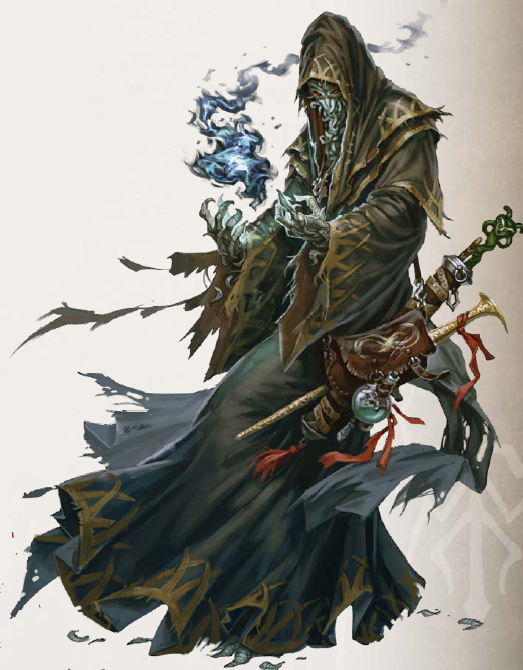
You are the worms that, after eating enough corpses, come together and become something more than the diminished sum of their parts. Crawling Ones are what happens when maggots and worms feed on body (and soul?) of spellcasters. Over the centuries all that eldritch power builds up and usually it just requires one more corpse, spell misfire or arcana calamity before a Crawling One shows up.

Yes, this is the famous Worm That Walks and the main inspiration is Gareth Hanrahan’s amazing Black Iron Gods Trilogy where spellcasting is practically magic plutonian – it is powerful, but deadly and poisoning; and most humans can’t stand much of it before burning out or dying it. Experienced sorcerers are rare and extremely careful. Other races fare better in spellcasting such as Ghouls, but now one beats the Crawling Ones’ natural gift for it. I could go on and on about the origins of the Worm That Walks but someone one did that better, so take a look at TV Tropes and open the tabs on Tabletop Games, where you can the find the origins of the critter back to it’s Call of Cthulhu origin (besides a lot of other cool games.

The idea here is a DCC RPG class that you can use since level 1, it could even be used to continuing play with a 0-level character that didn’t survive his Funnel, but whose death triggered the emergence of a Crawling One. Is the Crawling One the soul of the dead character? Maybe a bit of that soul mixed with others eaten before? Or perhaps – as in Gareth Hanrahan’s Black Iron Gods – they really are their own bizarre thing, an entire race of worm-sorcerers who feeds on the memories of the dead.

The class herein try to play on all those angles, leaving the final answer to the player and Judge. This is a mash-up of D&D, Black Iron Gods and Kill Six Billion Demons (because I absolutely LOVE Gog Magog, which is like the uber-epic-Joker-version of a Crawling One).

So, to the Crawling Ones Class…


"There is no mask!"

Hit Dice: d4. On physical combat a Crawling Ones are ridiculously easy to put down.

Attacks and Action Die: Again, like a Wizard. Your Critical Hit dice and table never improves, Crawling Ones are physically puny.

Saves: Crawling Ones are adaptable. They start with their saves as a Wizard, but when they REST for at least 8 hours they can “change” their saves between Fort, Will and Save, representing the worms rearranging and adapting.

Weapons: all one-handed weapons. The only ranged weapon that you can eventually master are crossbows. No thrown weapons.

Armor: None.

Conquering Worm: you are a mass of worms, so as long as one survives you are fine. At any moment a Crawling One can use an Action Die to scatter itself over the area. In this “unassembled” form they are immune to anything that is not an energy area attack. However, they do take a long time to reform.

A Crawling One risks death or a Roll the Body check only when brought to 0 hit points or less by an energy area attack (fire, acid, lightning, and other forms, like pure magic energy). Attacks from really big creatures also fit (Judge’s call, but this should be rare and forewarned to the player).

Otherwise, when brought to 0 hit points or less you require 1d6 turns to reform. You reduce this time to 1 turn by suffering 1d6 points of damage to Stamina AND Strength.

You are immune to diseases. Finally, if hit by a poison attack, instead of rolling a save you can “expel” the poisoned worms by suffering 1d6 Stamina damage.

Eldritch Might: Crawling Ones can spellburn any Ability Score to cast spells, not only physical ones.

Burning Magic: you ALWAYS must spellburn at least 1d3 points of damage to cast any spell. If a spell naturally requires at least 1 spellburn, the Crawling One don’t need to pay anything extra (yes, finally Chill Touch is not useless… actually, it might be a Crawling One spell).

Dead Memories: your memories are scattered through the worms and its hard to focus. You are not trained in any skill, but you can burn 1 point of Intelligence to become trained for 1 turn in things related to magic, worms, dead (and un-dead) things, graveyards (and the dungeons below them), and ghouls and other “rivals”. As usual, as the Judge.

A Mass of Horrors: you are disgusting and unnatural. Animals will flee in horror if they sense or smell you. Predators will attack you in rage if cornered. You are untrained in any social checks against humanoids (except intimidating attempts). However, you are trained in social checks against all un-dead, even mindless ones, and can try to avoid them or negotiate with them (Judge’s call). You can be turned by Law and Neutral Clerics.

Worm That Walks: you are a mass of worms and can thus pass through any place that an individual worm could given time. If time is not of essence, you could pass through a keyhole. To affect anything physically using your Strength or Agility you need to be fully assembled, which usually require 1d6 turns.

Corpse Eater: you can feed on one humanoid corpse during 1 turn to do one of the following (a) heal 1 Hit Dice; (b) heal your level in Ability Score damage (distributed as you choose); (c) gain your level in trained skills that the corpse possessed (Judge’s call) for 1 day; (d) gain 1d3 questions related to things that that corpse knew.

Finally, you can devour a corpse for magic power. This takes longer, usually 1 turn per HD/level, but it grants you 1 “spellburn point” per HD/level. These “spellburn points” last for 1d6 hours after you feasted. These are not cumulative (i.e. you can’t devour an entire village… of course, the Judge is welcome to create some grotesque Quest for the Impossible just to allow you to do that. May the Gods have mercy on her soul.) 

In Unhallowed Ground: you can only regain hit points by eating corpses (or by magic).


Worm spellburning! RUN!


Sunday, August 8, 2021

I rolled my first (space) dragon!


Actually, my first rolled dragon AND space dragon. So, my players have been stuck in the Purple Planet for a year in our campaign. They have in the last session reached that status of “Warlods of the Purple Planet”, creating a domain in the middle of the sandbox, between the Peak of the Ancients and the northern deserts. To make a long story short, they started by clashing against warbands of both major houses from Peril on the Purple Planet and then running away. That was made ridiculous easy (and created a very chaotic sandbox) because the Mercurial Magic effect rolled by the party’s warlock (none other than this poor guy) triggers a teleport of 1-6 hexes in a random direction every time he casts Sleep. So, after some (literal) zig-zag they ended up finding the Tomb of Sotark, the Destroyer (from Tombs of Ancients), almost found the City of Smoke, pillaged (and lost) lots of relics, murdered Nam-knir, the Black Queen (a potential ally), allied with the Rider of the Wasteland (potential enemies) and finally took over the Servants to the Cauldron (all from the amazing Purple Planet Companion). Because I was running a sandbox, they also missed encounters (such as with the Skymasters patrols). There was also a lot more craziness going, but based on our campaign, such as celestial nemesis, Yog-Sothothery, references to Clark Ashton Smith, comics etc.

What happened, basically, is that after 5 months of campaign I decided that I wanted to create a major player for the sandbox, one with a random location (and which changed locations quite often). I created 2 rogue Ascended Masters and a small kith house that kept ancient healing technology, but I also decided to use a dragon! Yes, a dragon in the Purple Planet. I love the monster tables from the DCC Core Rulebook, so I decided (in true sandbox fashion) to randomly generate a dragon.

To my surprise I ended up rolling a young dragon (although one about the size of an elephant), with just 6HD and 13 years of age. However, to make things interesting, this dragon’s breath was a save versus poison or you are dead. Nice! It AC was just 17, but it has a rusting hide, destroying every metal weapon that touched it. Also nice! It has two unique powers: a dust cloud that dealt suffocation damage and the power to grant a Luck Boom (+1 permanently on luck).

With those results in mind I started my favorite part: making sense out of this chaos. Considering that we are playing the Purple Planet I decided to build a space dragon. Because we are dealing with a young and small species, I used the aesthetics of a gem dragon to describe him: exotic and alien for players used to chromatic/metallic dragons (and also wrongfully assuming that this particular space dragon would have psionics powers). The dragon would have crystalline, gossamer like wings (but razor sharp), and its scales would be like green-blue gems, its eyes shinning with the same cold light of the stars. The dragon would not speak but use a limited form of telepathy (but no mind reading, although the dragon would suggest that to manipulate the players). Because dragons are vanity and pride incarnate, this dragon would also pretend to be older, wiser and powerful.

I changed the breath weapon to a “crystallizing breath”. Targets have to succeed at a Fort save (like poison) or be changed instantly to crystal (the good thing is that the party can try to find a way to reverse the crystallization).

The unique power of suffocation was eve better: I decided my space dragon would open a small hole in the upper atmosphere and drag the vacuum of space, creating the suffocation effect. As a side effect, I decided that this unique power could be see from afar, like a strange haze in the atmosphere in the shape of an inverted funnel (image a slightly dark tornado upside down). In fact, during the campaign the players would often see the dragon using this power 2-3 hexes away and wonder what was happening.

The Luck Boom acted as “small patron bond”, blessing a character as an Agent of the dragon (I was tempted to use the rules from DCC Lankhmar here).

The rusting hide was perfect as it is.

That said, here is Opulent Nebulous Resplendence (or Opuneres for short).

Age: Young (just 13 !)

Size: Elephant

HD: 6d12+12 (42 hp)

Speed 40 ft.

Daily Breaths: 1 (Poison, save vs Fort or dies as your body is crystallized)

Action Die: 2d20

Attack: +9 (bite 1d8+1d3*, claw 1d12+1d3*) (Critical 1d10)

(*House rule: I usually add the dragon’s bonus to attack to its damage rolls, in this case this is a d3)

Saves: all +6

AC: 17 (rusting hide; magic weapons are theoretically immune)

Unique Power: Vacuum Zone (like dust cloud, 1d4 stamina due to suffocation)

Unique Power: Luck Boom +1 permanently (the dragon places one of its gem-like scales in the target’s forehead)