Sunday, July 14, 2019

Unearthing Arcana: Sleep


OK, here is the first post if you’re curious why I’m offering the variants below. Basically: because spells like Sleep “bypass” hit points, which are the standard way of defeating enemies in D&D. No, there is nothing wrong with the players having more options to defeat the monsters. I love when my players think outside the box (and I’m a great fan of crazy stunts in combat or of players that like to use grapple, for example). My issue with spells like Sleep is that they’re lazy/boring ways to defeat enemies. If at least they party used them to place a powerful monster in sleep and them sneak by, that would be fine; but the truth is that most tables use Sleep to kill lots of unconscious enemies without giving it a second thought.

Let’s see if past versions of this dweomer are of any assistance:

OD&D’s version: A Sleep spell affects from 2-16 1st level types (hit dice of up to 1 + 1), from 2-12 2nd level types (hit dice of up to 2 +1), from 1-6, 3rd level types, and but 1 4th level type (up to 4 +1 hit dice). The spell always affects up to the number of creatures determined by the dice. If more than the number rolled could be affected, determine which "sleep" by random selection. Range: 24"

Alright… no help at all here.  Looking at AD&D 1st we get a lot more details (for example, I didn’t knew, but it seems possible to order a target to “sleep” using Command). In fact, the AD&D 1st version let it clear that you can kill a victim of sleep at the rate of “1 per slayer per melee round” (you gotta give Gygax credit, the guy was consistent). AD&D 2nd tries to lessen things by stating that attacks against sleeping targets are “automatically successful” (which is very “videogame” but not at all reasonable). I believe that if you’re using the Player’s Options rules or D&D 3rd we can safely assume that sleeping targets are victims of a coup de grace.

I checked some other Fantasy d20 and found either the same version of the spell (or no spell at all). One curious case was Arcana Unearthed/Evolved (one of my favorites d20s), where there’s no offensive Sleep spell but lots of beneficial spells around the theme of sleeping and dreams. Another of my favorite d20s - that's Fantasy Craft - clearly states that sleep is a terminal situation (i.e. you are toast) and usually grants a bonus on the saving throw for any PCs.


Let’s see what interesting variants we can make (note that one doesn’t exclude the other):

1D6 VARIANTS ON SLEEP
1 – No Rest for the Wicked – The caster ushers a Power Word that sends the target(s) to sleep in the Dreamlands. This is a deep sleep, from which the target can be awoken only through magic or damage. The Power Word comes from the Dreamlords, who desire slaves to work for them. Thus, killing a target of this spell offends the Dreamlords, who punish the caster and the killer by trapping them in the Dreamlands. This curse can be felt by anyone before they kill a target of this dweomer. While cursed, a short rest requires 24 hours of sleep and a long rest requires 1d6 days of sleep. The only way to get rid of the curse is to appease the Dreamlords (for example, after a ritual, the Dreamlords inform that caster that she must place a full tavern to sleep and keep them slumbering for “three days and three nights” or any other crazy idea of the DM). 
2 – Through the Gates of Horn & Ivory – The casters opens the Gates of Dream, placing the targets in a deep and comatose sleep. However, each victim of this spell is a living vortex from the Dream. Killing or wounding a target forces the attacker (and caster) to roll a saving throw against this spell. Clever parties often use this spell on a guard, and them use the sleeping guard to place more guards in sleep (they often have to carry their spellcaster, who usually also falls into the Dream). An interesting side effect of this spell, is that there is a 50% that any target passes into Dream through the Gates of Ivory, thus gaining insight into the future. If the caster waits for the spell duration to pass and talks with the target, he may gains the benefit of an Augury spell (just roll a 50% to see if the a target speaks the truth, the caster can’t know for sure, although if he’s also one of the victims, the DM might tell him if he crossed the Gates of Ivory or Horn).
3 – Little Death – The caster places the target(s) in a comatose sleep so deep that most assume that they’re dead (magic or a successful Medicine check can verify that the targets are only sleeping). The target(s) only awake at the end of the spell’s duration or through magic. That’s the good news. The bad news is that killing a target will bring her back as a vengeful undead (the DM decides the type of creature and the time… maybe the victim returns right away, as a wight, or perhaps it waits for the best opportunity, attacking as a wraith later while the caster is without slots or trying to gain the benefits of a short/long rest). This is a necromantic spell.
4 – The Burden of Mortality – What distinguish mortals from gods (or the dead) is that only mortals actually have to rest (rest, not dream). This dweomer works by transferring a caster’s fatigue and “sleepness” to the target. Killing the target actually backfires the entire thing, inflicting 1d4+1 Exhaustion on the killer and the caster (automatically, no save). The good news is that if the caster has Exhaustion, casting this spell either reduces the caster’s Exhaustion by 1 or affects +1d8 hit point of targets. The caster can only reduce his Exhaustion by casting this spell once every 24 hours. This is a transmutation spell.
5 – Dreams of the Old Ones – The caster send the target(s) in the dreaded dreams of the Great Old Ones, in the darkness between the stars. The target(s) are left sleeping but screaming and writhing in agony at the horrible revelations of those timeless entities. Awaking or killing a target from this spell sends a psychic backlash against the caster and the one responsible for awaking or killing the victim, inflicting a temporary madness (check the Dungeon Master’s Guide). The good news is that if the caster listens to the target’s ramblings for the entire spell duration she gains Inspiration (the Great Old Ones are beyond time and space, and thus able to see the unfolding of future events from multiple perspectives).
6 – Sleep Without End – The caster beseeches the rulers of Feywild to trap the victim in the deep dreams (or nightmare) of the Fair Folk. Only magic or a trigger will awake the victims. Names aside, this spell actually has a base duration of 10 minutes, although it is said that using a higher spell slot can increase the duration considerably (possible to permanent at 6th level). Killing a victim of this spell inflicts the wrath of the Fey against the killer and caster, who grow old (they gain an elderly appearance, suffering a -2 penalty to all die rolls, half Speed, dealing half damage and having their hit point maximum reduced by 25%). The curse can only be lifted by another Fey Lord or a wish. Here are some crazy triggers to awaken a victim without incurring the curse (bizarrely, the knowledge is intuitive to anyone who approaches a victim):

Roll a d6!
  • 1 – You must kiss the victim (and both must succeed at a Charisma save or become madly in love with each other);
  • 2 – You must give to the victim your must valuable or powerful item and you can’t remove it from them for the next 7 days;
  • 3 – You must tell them (and everyone around), in a loud and clear voice, your deepest and darkest secret;
  • 4 – You must swear to never hurt or let them be hurt for 7 days;
  • 5 – You must obey them as a servant for the next 7 days, otherwise you’re polymorphed in some small animal for the same period (or a lycanthrope or maybe even a kobold or goblin, in the last case forever);
  • 6 – You acquire a fey bane for 7 days: (1) you can’t touch iron and are vulnerable to it; (2) you must always tell the truth and any oath is binding; (3) you can’t accept help or gifts from anyone unless you pay for it the correct price; (4) you can only gain the benefits of long/short rests while naked and in the wilds.


Wednesday, July 3, 2019

Stuff for ‘The Sea Demon’s Gold’ adventure


Howdy folks!

As one of the playtesters of Shane Ivey’s awesome adventure I don’t think I’m the best person to offer a review. You don’t know what ‘The Sea Demon’s Gold’ is? It is a 1st level dungeoncrawl for D&D 5E, offering a brief glimpse in the author’s Broken Empires setting (more info here). In this adventure, you play raiders tasked with exploring a disturbingly organic temple (with lots of Yog-Sothothery) in a godforsaken island.


I’m obviously giving some SPOILERS from now on, so don’t read if you want to play this adventure later!

Here is basically what I liked or did with ‘The Sea Demon’s Gold’:

- It is a 1st-level adventure that fulfills what a campaign starter should do in my opinion (i.e. leaving a few loose ends for the DM to explore, like a possible warlock pact with the Sea Demon herself) but it is also perfect for a one-shot game (because it offers everything that a good game night needs in one package). Usually, when someone asks me to run for them a “traditional dungeoncrawl” – i.e. Old School style - I use the ‘Tower of the Stargazer”. Now, when someone who already plays D&D (or d20 Fantasy in general) asks me to start a new game, I use “The Sea Demon’s Gold” right away.
- It has a strong theme (Lovecrafthian horror + dungeoncrawl, without going into cliché territory) and it throws you directly into the chaos (the first combat encounter is one of the best I’ve read in a long long time). 
- It is an interesting read, giving you lots of ideas (the Sea Demon herself is a good new deity/demon lord/kraken to use as a villain or evil patron and the Sea Folk is a nice addition to any campaign setting).
- Like the DCC RPG adventures, it uses its own monsters and breaks some conceptions of what dungeoncrawling is at low levels. I had a player asking me to start a game at 3rd level, because he wasn’t much interested in “killing goblins and kobolds that were sacking farms”. What I did? I started a 1st-level game using ‘The Sea Demon’s Gold’ as an answer. 
- Although written as a 1st-level adventure, the entire thing is easily adapted to higher levels. With a minimum fuss you can run it on the spot for 2nd or even 3rd level parties. In fact, because its implied setting is indeed ‘semi-historical’, it has a really strong S&S vibe and uses Cthulhian-style adversaries, I’ve already hacked versions of “The Sea Demon’s Gold” for other RPGs (it is that easy). One for Modiphius’ Conan 2d20 RPG, using only monsters stats from the Corebook (you can also use it on Mongoose’s excellent Conan d20). The other version is for a Call of Cthulhu/BRP game where the party plays 9th century vikings raiding a lone Orkney island. The adaptations required were minimal because the dungeon itself is quite somber and avoids goofy or “gamey” elements (c’mon, even the gelatinous cube is basically a shoggoth when you see what it does in the setting… it is there as a horror element).

OK, here are a few things I added when running the adventure for D&D 5E. I hope it can also help your table.

The Heart of Iron crew

As you know, the first part of the adventure is all about surviving a merciless encounter with the Sea Folk. The basic idea is that the party has established some connections with the crew of the ship, the Heart of Iron, and they will try to save those NPCs during combat. Those relationships depend on your style as a DM and on how much time you want to spend roleplaying things before they get messy. At one of my tables, we spend one entire session just roleplaying with the crew, while at another I felt that the players would appreciate just rolling dice to see with whom they have created bonds. In both cases, I created small secrets and weird stuff about the crew - enough to draw the players in and make them remember the NPC that I was going to try to kill in the first encounter (a fun commentary: at one table, the roleplaying created rivalries between PC and NPC, so that the players actually tried to use the first encounter to toss the rival NPC in the seas).

The adventure provides us with 2 named NPCs (captain Helia Lin Haerrean and sailor Pitaja, and invites you to create more). Here’s the crew that I use:
- Captain Helia Lin Haerrean is a no-nonsense leader and a fearless woman (from an exotic land of your home setting). Her best friend (and fellow adventurer) is Riala (see Alahir below). The first time I run ‘The Sea Demon’s Gold’, Helia was actually the only survivor of the first expedition to the island and only escaped because she made a pact with the kraken. She was ashamed of her past but also needed to offer more sacrifices to the Sea Demon in one year or she would begin to transform in some kind of monstrosity (a deep one/sahuagin). In another run of the adventure, she owned a priest money because of a raise dead spell and her time was running out.
- Sailor Pitaja is a carefree young ex-pirate. I portray him as a friendly NPC that loves to gain (or lose) money by gambling. There’s always a player who likes the idea of carousing.
- First Mate Alahir is the weird NPC. He’s a brute man, always drunk and menacing. The entire crew is afraid of him and bizarrely he has the trust of Captain Helia. He has a temptress as his mistress, the fair lady Riala. Riala can only be seen at night, while has husband is passed out at his cabin. Alahir is the NPC that I created to be hated, but inquisitive players will find his relationship with Riala weird and possibly investigate it. Actually, Alahir and Riala are the same person and the woman is the true face of this NPC. A curse acquired in Riala’s adventure days with Captain Helia forces her to become an ugly and brute man during the day. Riala is so disgusted with her state that she spends most daylight hours drunk, channeling her hate against the lazy crew. One party at my table had his PC fall in love with Riala (and he was quite shocked when the truth came out) while other party actually managed to kill Riala while searching for Alahir.
- Sailing Master Hasfullihatrandy a.k.a. Master Nose is a gnome born on sea and fated to die if he ever touches land. He is a strange creature, all tattooed that goes almost naked, but with an almost supernatural scent, particularly useful to find good winds, avoid storms and direct the ship to land. In my campaigns gnomes are usually creatures defined by obsession, so this is my “sea gnome”. You can easily change him to a human, also tattooed, and regarded with awe by the crew due to his “magic nose”.
- Master Shoufa is the comic relief. He is the ship’s cook and an open promoter of cannibalism as a way to “steal your enemies’ strength”. He won’t eat any of the crew or the party, only enemies (actually, if he’s a true cannibal or not is up to the DM, because the Captain uses him as way to keep the crew in check). At one table, Soufa was a half-orc, because it fits nicely, but you can use him as a human.
The rest of the ship was just a series of names and small traits, which I used most for flavor:
Rusa (ugly as sin, possibly Hagborn), Jadikira (claims to come from another world with 3 Moons), Kitana (woman, amazing sailor, Shoufa’s girlfriend), Redrik (one eye, one hand, one ear), Bal’zahar (tattooed, no hair), Haddan (wants to be captain), Frog (jumps at everything, Gollum-like), Monkey (a kid, good at the riggings), Luha (another kid, runner), Shafik (strong) and Eyes (curious, want to be adventurer, stupid but lucky).

A Random Encounter Table

‘The Sea Demon’s Gold’ is a static dungeon. Except for the gelatinous cube, each encounter is fixed in place. Clever parties that notice this detail might be able to face each encounter and then retreat for a short or long rest at the ship. There is nothing stopping a DM from making the dungeon reacts once the party gets in, but I particularly likes surprises. Thus, I came up with a random encounter table that I used everytime the party attempted a long rest (or after 2-3 short rests).

Please, bear in mind that the adventure as written already had a deadly trigger for parties attempting a long rest: the aforementioned gelatinous cube. What I intended with the encounters below was to add dynamism and more flavor, just that:

Roll a 1d6:
1 - 1d4+1 Sea Folk. These are “holy champions” sent by the Sea Folk to try to kill the temple’s ghostly priest. The Sea Folk deeply fear the kraken (their goddess), but also want to defeat its priest. A decadent and barbaric civilization, they only approach the dungeon through religion (where a group of “chosen ones” is selected to face the Sea Demon in ritualistic combat). All end eventually killed by the gelatinous cube, which is actually the point of the entire thing (the Sea Folk leaders knows that, and use the champions as “cannon fodder” to keep the Sea Demon placated). This encounter only happens once during the adventure. If you roll it a second time, nothing happens.
2 - 1d4-1 Giant Crabs (a ‘0’ result is just a dead crab). 
3 - 1 Darkmantle.
4 - 1d4 traitorous pirates from the ship, converted to the Sea Demon through dreams.
5 - The Mud Mephit, carrying loot to his lair. Only use it once, after meeting the creature for the first time. Otherwise nothing happens.
6 - Water level raises, making all rooms difficult terrain for the next 1d4 hours.


Monday, July 1, 2019

Happy Canada Day!


Related image

Canadian Goose

Small fiend, chaotic evil
  • Armor Class 16 (Natural Armor)
  • Hit Points 55 (10d4+30)
  • Speed 10 ft., fly 60 ft.
STR
19 (+4) 
DEX
14 (+2) 
CON
17 (+3)

INT
3 (-4) 
WIS
11 (+0) 
CHA
3 (-4)
  • Saving Throws Dex +4, Con +5, Wis +2
  • Skills Perception +2
  • Damage Immunities poison
  • Damage Immunities charmed, frightened, paralyzed, poisoned
  • Senses Blindsight 10 Ft., Darkvision 60 Ft., passive Perception 12
  • Languages -
  • Challenge 3 (700 XP)
    • Pack Tactics. The Canadian Goose has advantage on attacks rolls against a creature if at least another Canadian Goose is within 5 feet of the creature and the ally isn't incapacitated.
    • Spiteful. The Canadian Goose deals double damage (treat it like a critical hit) against any creature that has dealt it damage since its last turn or that triggers an attack of opportunity.
    Actions

    • Beak. Melee Weapon Attack: +6 to hit, reach 5 ft., one target. Hit: (1d10 + 4) piercing damage. Treat as magic damage.
    • Honk of Hell (Recharge 5-6). The Canadian Goose unleashes a sonic attack in a 15-foot cone. Each creature in that area that isn't a Canadian Goose must make a DC 13 Wisdom saving throw, taking 12 (4d6) thunder damage on a failed save and becoming frightened for 1d4 (2 rounds), or half as much damage on a successful one.
    Reactions

    • Doomed! You always suffer an attack of opportunity from moving away from melee with a Canadian Goose. Even disengage and teleport fail. There's no escape.


    Saturday, June 22, 2019

    D&D 5E: Playing with (New and Weird) Conditions


    I love Conditions. They’re a great way to standardize any system (since their beginning, which I believe was with the D&D 3rd Keyword system). Like many things in D&D 5E, I believe Conditions are underdeveloped (like Hit Dice, Death Saves and Exhaustion). RPGs have been doing awesome things with conditions, like Savage Worlds’ Stunned or The Dark Eye’s amazing conditions for clerics casting spells. Lets toy a little with ideas for new conditions (just for fun and because I’m bored).

    So, here are a few crazy Condition proposals that I would love to use in my games. Not all are exactly new (check Intoxicated), but I assure you that NONE are playtested. I left those that I consider more problematic to end.


    NEW CONDITIONS

    Intoxicated
    OK, I’m in the minority that loved this Conditions back in D&D Next (actually, I’m in another minority that thinks that D&D Next was more interesting than D&D 5E, but lets leave rants aside).
    Intoxicated is what you get when your characters drinks too much, is hit by pixie arrows or is the target of a faerie dragon’s breath weapon.
    Rules: you have Disadvantage on Attack Rolls and Ability Checks, but you suffer 1d6 less points of damage (2d6 if you have 10+ Hit Dice). Once during your Intoxicated Condition, you can offer your DM a chance to roll for a random target (during combat) or to suffer a fumble (out of combat). If your DM agrees you gain 1 Inspiration (or, if you group uses that rule, 1 Plot Point).

    Jinxed
    This is usually a result of a curse, a fumble at dispel magic or just playing with forces that you don’t know about.
    Rules: you can’t gain any benefit from magic (including magic items). This condition usually lasts until you take a short rest, but a beneficent DM can allow you Charisma Saving Throw at the end of your next turn (if the Condition is the result a spell in combat, for example). This is also a good Condition to inflict on Warlocks that don’t behave before their Patrons.

    Numb
    A typical effect of poisons, mind blasts, fey charms, sanity-shattering battles and even vermin attacks (or just a result of carousing and debauchery).
    Rules: you don’t have access to your current hit points total. When you gain this Condition, your DM start to track your hit points in secret. She can tell that you’re fine (usually with half or more of you hit point total) or injured (close to 0 hit points), but nothing more.

    Shaken
    A strike to the head, a sonic attack or maybe been mauled by a giant creature.
    Rules: you go last in the round. If you’ve already acted, you go last in the next round. If you’re already the last in Initiative order, you suffer Disadvantage on all Attack Rolls, Ability Checks and Saving Throws until the end of your next turn (and if you try to cast a spell you must succeed at a Concentration check DC 10 or lose the spell).

    Tides of Chaos
    Because magic should always be CHAOS!
    This Condition is usually inflicted when an arcane spellcaster uses magic in dangerous places, toys with forces best left undisturbed or fumbles a Concentration roll.
    Rules: at the moment of your DM’s choice, your suffer a Wild Magic Surge. This is a good catch-all Condition for players that like to negotiate with their DMs for more magic power (or for recovering “just that one 1st-level slot”). If your character falls in the last group, the DM is encouraged to roll twice and pick the most “interesting” result (or rolling just rolling twice and inflict BOTH results). This is another good option to “persuade” Warlocks to pay more attention to their Patron’s “reasonable” demands.

    Weakened
    I’m totally stealing this one from one of my favorites d20s - 13th Age.
    A debilitating wound, a painful strike, a curse or poison.
    Rules: until the end of your next turn or until you succeed at a Constitution Saving Throw (DM’s call), all your damage rolls are halved.

    Wounded
    OK, this is requires a little more explanation, because it is a self-inflicted Condition. Why would I want a Wounded Condition?! To keep fighting! Basically, this works like a Consequence from FATE.
    You suffer a lingering injury.
    Rules: when you suffer damage, you can reduce the amount by your Constitution Ability Score and gain the Wounded Condition. Roll on the Lingering Injuries table, page 272 of the Dungeon Master’s Guide, to determine the nature of your wound (the DM call change it if it doesn’t fit with narrative). You can only be Wounded once.


    NEW (GAME-CHANGING) CONDITIONS

    Ecstatic
    D&D 5E follows the “Boring School” of divine magic (i.e. you can’t remove class features if a cleric doesn’t follow his deity ethos). But sometimes divine spellcasters forget that their mojo come from a Higher Power. When that happens, or when you want to flavor/complicate an encounter, please use this Condition (inspired by the Dark Eye). It still needs to be tested (a lot) because I’m not sure I got what I wanted. Maybe a Exhaustion-like track, per type of character, would be better (but also require a lot of time, which I don’t have right now).
    Divine spellcasters can suffer this Condition for breaking their ethos, fumbling a Concentration check, casting spells in the inner altar room of an enemy deity or in similar situations.
    Rules: while Ecstatic you are consumed by your deity or source of power, finding difficult to act in a different manner. If you act in accordance with your deity’s ethos, you have Advantage on Attack Rolls, Ability Checks and Damage/Healing Rolls. Otherwise, you have Disadvantage on the same checks and must always succeed at a Concentration (usually DC 10) to cast a divine spell. Here are a few examples of Ecstatic-drive behavior:
    • Cleric of Knowledge - protect and avoid the destruction of anything written in your sight (including scrolls).
    • Cleric of Life - heal or protect a living creature, DON’T kill/hurt anything besides undead and fiends (but don’t seek combat unless cornered and facing those creatures).
    • Cleric of Light - destroy the undead, banish darkness and keep light sources (in THAT order).
    • Cleric of Nature - heal or protect animals/plants, DON’T kill animals/plants, kill ONLY aberrations and undead.
    • Cleric of Tempest - destroy everything on sight. Collateral Damage is your god.
    • Cleric of Trickery - always stunt, feint or perform an action different from a straight attack. Sow chaos and confusion. You can’t dispel illusions, reveal invisibles creatures and speak truths. You’re Loki from the MCU, have fun!
    • Cleric of War - engage as many enemies as possible in melee attack, ALWAYS. Don’t leave any enemy alive, NEVER. Don’t heal anything besides yourself (so that you can kill more). Sail a road of blood and slaughter!
    • Druids - heal or protect animals/plants, DON’T kill animals/plants, seek aberrations and undead to kill, and destroy as many artificial structures and urban terrain as possible.
    • Paladin of Devotion - If there are aberration, fiend or undead around, destroy them first and forget the rest. Otherwise, fight fair and only one-to-one, never feint or deceive, be merciful (leave all enemies alive).
    • Paladin of the Ancients - If there are aberration, fiend or undead, destroy them first and forget the rest. Otherwise, your top priority is protecting and healing elemental, fey, animals and plants.
    • Paladin of Vengeance - If there are aberration, fiend or undead, destroy them first and forget the rest. Otherwise, target the most powerful enemy in sight and kill him, never retreat and don’t stop for “ignoble” deads like healing allies.
    Ecstasy ir hard on mortals. While under this Condition, every other round, you succeed at a Charisma Saving Throw at the end of your turn or gain 1 level of Exhaustion. If you reach Exhaustion 6 while Ecstatic you are consumed by divine energy and dies. After suffering Exhaustion 1-5 from this Condition you shut yourself to your divine source. This removes Ecstatic but also all your divine powers until you get a short rest.

    Momentum
    I hate both whiff factor or just hearing “roll an Attack Roll” round after round. This Condition hopefully may change that a little. It can really change the pace of a combat, se be aware. I’m aiming for RPGs like 2d20, Chronicles of Ramlar and Warhammer 1st and 4th.
    You attack swiftly, keep your enemies against the wall or otherwise has dominance in battle.
    Rules: you can gain Momentum usually accomplishing a Trigger (there a list below). Only one side of the battle can have Momentum at any time (or none can have it): your side or the monsters’ (if there are more factions, then only one of them can have Momentum). That means that if the enemy gets Momentum, you lose it instantly (and vice-versa).
    Here are the most common Triggers, to be adjusted or changed to suit the DM style and the campaign flavor:
    • You’re the first to act in the round and you hit your target.
    • You’re flanking and hit your target (only if your side is in greater number).
    • You roll a Critical Hit.
    • Your perform a stunt that change the tactical aspect of the battle (DM’s call).
    There is one “Anti-Trigger”. If you have Momentum and roll a natural 1 or falls unconscious, the other side automatically gains it.
    You can spend Momentum at any time (it’s not an action) to do one of the following:
    • Grant Advantage to an ally (Attack Roll, Ability Check, Saving Throw or Damage Roll).
    • Inflict Disadvantage to an enemy (Attack Roll, Ability Check, Saving Throw or Damage Roll).
    • Force an enemy spellcaster to roll Concentration (DC 10) to cast or maintain a spell.
    • Make an ally go next in the initiative order (only this round).

    Monday, June 3, 2019

    Unearthing Arcana: Hold Person


    Wizard: I cast hold person!
    DM: OK, the orc boss failed his save and is paralyzed.
    All the players at once: I slit his throat!
    DM: …

    You probably heard that dialogue before at some point of your Referee life (or some variation of it). Which is actually quite acceptable. Yes, acceptable… not just because it is tactically advantageous, but also because RPGs are (or were supposed to be) open-ended games, a unique mix of mechanics and a freeform narration. So, theoretically, if you paralyze your opponent during combat, you can go for the killing strike. If your players never took that opportunity to mercilessly slay their enemies then congratulations: you have heroes at your table (that is rarer than it sounds).

    Of course, maybe you don’t have a problem with Hold Person and the way it works like an “instant kill” spell at the lower levels of every edition of the game.

    Let’s take a look at this spell.

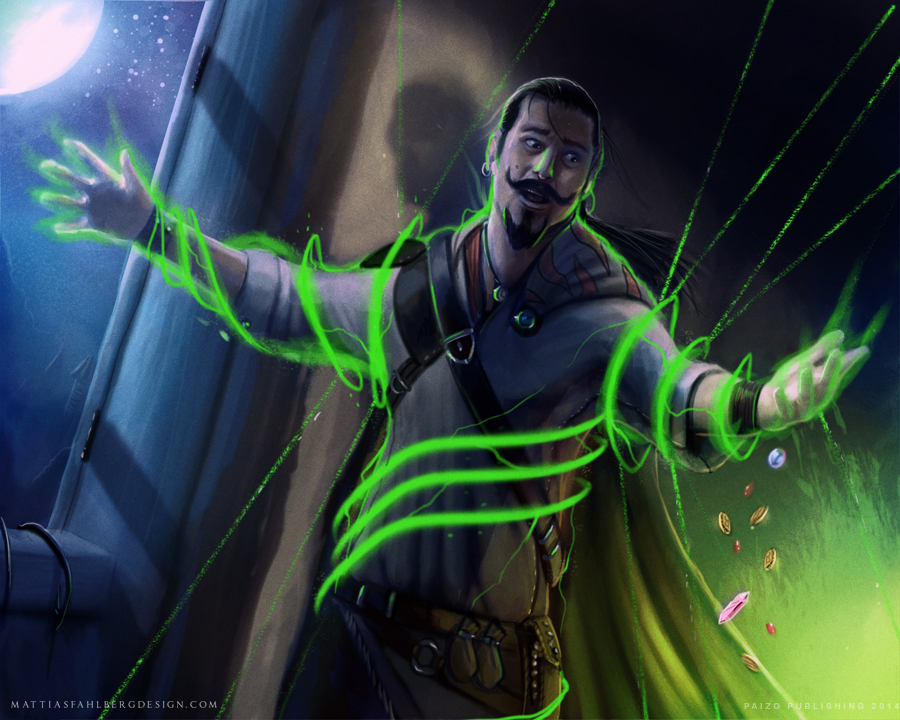
    Art by MattiasFahlberg.

    OD&D’s Hold Person: A spell similar to a Charm Person but which is of both limited duration and greater effect. It will effect from 1-4 persons. If it is cast at only a single person it has the effect of reducing the target's saving throw against magic by -2. Duration: 6 turns + level of the caster. Range: 12".

    OK, as many things in the first version of D&D, the spell entry seems both quite interesting and open-ended (also uncertain). What we can be sure is that Hold Person targets 1-4 targets and has big duration.

    The first thing that stands out is the Charm Person reference. In OD&D, our beloved Charm Person where targets that fail their save are “completely under the influence of the Magic-User”.

    After reading that we can go back to Hold Person. Actually, for someone like me (that come from BECMI and AD&D 2nd) is hard to see Hold Person as anything different than a paralyzing spell, but that seems to be the case here. If you interpret that Hold Person is just an improved version of Charm Person then things get a lot easier for the Referee (as far as I remember you can’t try to kill a target of Charm Person).

    With AD&D 1st, Gary Gygax didn’t wanted to leave doubts regarding his spells. No sir. The duration of Hold Person here is shorter (but still enough for a combat) and it affects 1-3 targets. There is quite an extensive list of what type of humanoids are affected, although we do get the description that this spell “holds immobile” and “freezes in places” the target(s).

    You can say that AD&D 1st started the whole issue. When a target is “immobile” and “freezed in place”, then it is safe to assume that the victim is helpless and that a coup de grace is in order.

    BECMI and Rules Cyclopedia didn’t added much (besides the Rules Cyclopedia letting clear that Hold Person has an opposed version called Free Person).

    AD&D 2nd didn’t changed things either, though it did added: “Held beings cannot move or speak, but they remain aware of events around them and can use abilities not requiring motion or speech. Being held does not prevent the worsening of the subjects' condition due to wounds, disease, or poison”. AD&D 2nd also kept the trend of reducing Hold Person’s duration.

    Oh, and did I said coup de grace? Although the rule wasn’t first mentioned in D&D 3rd, that edition surely made it popular. In D&D 3rd the spell lasts even less and the target “may attempt a new saving throw to end the effect” (probably because they finally noticed is such an overkill spell). You can say that 3rd Edition was honest and let it clear that a paralyzed target could be the victim of a coup de grace and, thus, finally officialized the instant kill (and no, 3.5 and Pathfinder didn’t seemed to change anything… interestingly I didn’t found any reference of Hold Person in the Pathfinder 2E Playtest).

    D&D 5E at least requires Concentration in the spell duration, which is a nice touch, but it doesn’t change anything regarding the “instant kill” aspect (and yes, 5E doesn’t have a coup de grace rules, only that all attacks against an incapacitated target are automatically criticals, which means that we are back to the “it falls to the Referee to solve the whole conundrum”).

    I purposely left Holmes for last because it is has an interesting take on the spell: “Similar to a charm person spell. Affects 1-4 persons. Holds the person or persons rooted to the spot unless released or the spell wears out. Duration is 6 turns + level of caster. If cast at one person alone it reduces his saving throw by 2”.

    For me leaving a target “rooted to the spot” and immobilized are different things. I find this version almost as good as OD&D’s Hold Person. Maybe the target is rooted by this feet (or paralyzed from the waist down) and thus she can’t be the target of a coup de grace (although I admit that it leaves spellcasters theoretically free to cast spells… and actually this interpretation kind of equals Hold Person to Entangle).

    I also remember that when I played Baldur’s Gate I and II, a Hold Person spell created a shimmering shield around the victim (you could still hit the target for normal damage and, because we’re talking of a vidoegame, coup de grace wasn’t an issue).

    OK, all this talk is because I usually hate Hold Person as an “instant kill” spell (too easy, too boring). Last week I bought the D&D 5E Starter Set and runned it for my kids as a straight tabletop RPG for the first time (I had tried RPGs before with them, but always with heavy alterations and lots of dynamic and ludic activities mid session). Because my kids love Super Mario Bros. I reskinned lots of monster and spells as effects that they would recognize from the videogames, and that included a version of Hold Person. That is when it hit me that I had just created not a reskin but a variant of Hold Person, to address the “instant kill” thing.

    Here are others!

    1D6 VARIANTS ON HOLD PERSON

    1 - Magic Bubble - The target is trapped in a magic bubble that is indestructible from the inside (although disintegration might work) but any hit from outside will blow it (leaving the target unharmed). The target floats a few feet over the ground while the spell lasts and a strong wind might move him (like a levitation spell). The good side about this variant is that it doesn’t allow a save each round. (Yes, this is the Super Mario Bros. version I used with my kids and probably moves the spell to the Conjuration School)
    2 - Force Shield - The target is restrained by a sparkling shimmering force shield. The shield provides light as torch and provides a weak protection, reducing damage by half against the first attack against the target (which can’t suffer any kind of critical hit or coup de grace). However, attacking the target grants him Advantage in his next saving throw to break free. (This is my feeble attempt of copying the spell from Baldur’s Gate and moves the spell to the Evocation School)
    3 - Bilarro’s Equanimous Hold - The target is completely restrained by crackling ethereal bands. If the target suffers damage while under this cantrap, her attacker suffers the same amount of damage as crackling bands snapback. (Another variant that takes the spell to the Conjuration School)
    4 - Mesmerizing Gaze - The target is so consumed by the caster’s presence that she can only stare back, immobilized. This version requires that the target can see the caster and the caster remains in line of sight. The charm can be broken if the life of the target is in danger. If the target is attacked he can make new saving throw as a reaction (notice that backstabs are still effective here).
    5 - Planar Misalignment - The target isn’t actually immobile but out of phase with the current plane. He can speak or even move, but no sound will come out and she won’t leave the spot where she was hit by the spell. The target can’t affect this reality while under the spell’s effect and every attack against her has a 50% of being completely ignored. (Another variant that takes the spell to the Conjuration School)
    6 - Under the nights of Arcadia - The target is enthralled by many sprites and faeries, falling under their enchantment and becoming paralyzed. The only difference here is that the faeries hate when other spoil their “fun”. So anyone attacking the target must also save or become affected by the spell.

    Awesome art choice by SeaSkyMoon.