Monday, April 27, 2020

What if metagaming is part of the setting?


In many ways metagaming is just the players letting you know that they love the setting and know everything about it. The bad news, of course, is when that behavior disrupts the game. There are tons of ways to deal with metagaming and you can find excellent advice online (the best one still is: “Don’t play with jerks”). Some RPGs in my opinion actually reward metagaming: take for example some approaches to OSR/Old School where what counts is player skill, not character skill. Following that premise, it makes sense that a player can use everything that he knows to beat the adversary.

I think one of the best metagaming examples in D&D (and F20 in general) is the troll. When PCs see a troll they all run to find fire or acid so that the creature can’t regenerate, even if they never saw a troll before. It became common knowledge. How to deal with that? (That is, if metagaming is a problem to you)

From where do you think Fire Trolls came from?
From the Metagaming Hell!

Modern F20 games like Pathfinder try to restrict monster knowledge to certain skills. I personally don’t enjoy that approach, I believe instead that “monster lore” should give some concrete mechanic benefit. Things like lore or pure information should be a result of the game and the interaction at the table, not just a mere skill roll.

Most tables that I know simply link “monster knowledge” with encounter experience (i.e. if you faced a troll and discovered its weakness, you can use it in future encounters). The bad news is that D&D (especially the latest editions) is all about beating monsters, so facing a monster like a troll, where you know you can use fire, but being denied it because it would be considered “metagaming” just doesn’t feel right. The players can feel that they’re being punished for being prepared.

In the end I believe that common sense is the best option: talk with your players and see what they think about this. In most of my tables I like to let them know that it is OK to use a certain degree of metagaming if they check first to see if they characters would know that. Now, if I find a player that wants to abuse that trust “to win the adventure”, disregarding the table and the fun, I don’t punish him. No sir, I do something worse: I change the critter. Trolls are my favorite example because in one of my Forgotten Realms campaigns I decided that they weren’t vulnerable to fire. That was actually a rumor. Trolls there were actually flammable! Setting them on fire leaves them in a crazy berserker state. If you can survive a flaming and berserker troll long enough until it “burns out” and becomes fatigued, then you can chop him to pieces but it is a crazy tactic (and one that professional troll slayers only use in desperation, when facing packs of trolls, because while berserker they will attack anything on sight, including other trolls). If, after that funny (for me) lesson, the player still wanted to abuse metagaming knowledge, I would just invite them to leave the table.

However, I found a new option recently that I really like. I believe it came from John Wick, from Legend of the Five Rings and 7th Sea fame. For someone who doesn’t like d20 games, John certainly has a lot of cool ideas for it (check Santa Vaca, his latest bundle of rules for F20).

Basically: make the metagaming a part of the setting (OSR/Old School make it a part of the game, but not the setting). Give adventurer parties a social place in the society.

I really like campaign settings where “adventurers” are integrated into the culture. It is not only a clever twist but it actually makes sense (besides giving the PCs a stronger link to the world). After all, adventurers are powerful and resourceful, so why not use it? That was one of the benchmarks of my campaign setting - Chronicles of the 7th Moon. If you like it, check the excellent OSR-inspired hack for 13th Age - The King of Dungeons. It follows the same idea and it has some cool mechanics for that.

OK, adventurers in this approach could be the young sons and daughters of nobility. They can’t inherit land or power, but they have the right education, resources and training. Instead of staying in civilization, these Scions are sent out to destroy monsters that threaten the borders of the “World of Light”.

The “World of Light” is how “civilized” races (Humans, Elves, Dwarves… your choice) call their realms. The rest of the entire setting is “The Dark” or the “World of the Dark”, where disorder, beasts and Chaos reign. Scions have the job of getting rid of the Dark. That is the excuse for adventuring here: to purge the “monsters” and the “Chaos” worshiper.

The Scions of Light ride to destroy the Dark!
 
That is where the metagaming comes in. While they were trained, the Scions had access to tomes of lore regarding the Dark, all the accumulated knowledge of the civilized races against “the Enemy”. In other words, the PCs through their Scions basically have access to the Monster Manual. They KNOW that trolls can be wounded by fire and acid, and that they must burn and kill ALL trolls!

Now the catch: did you notice all the “ ” above? That is because the World of Light is not a black-and-white setting, there are shades of gray here. The civilized realms label anything they don’t like as belonging to the Dark. So, while PCs have metagame knowledge, some of those tomes might be wrong. Usually, it is not about the mechanics (i.e. trolls are still vulnerable to fire and acid, but maybe there some mistaken information, DM’s call), but about the lore (maybe trolls are actually a race of giant curse by the Elves after they killed the original troll gods, maybe trolls actually were once more beautiful than Elves). The idea is that after a few sessions slaying monsters, the Scions (the PCs) will start to see that not all monsters are actually monsters. Maybe the “true” monsters are the haughty and unbending rulers of the World of Light (the Scions’ own families). What will the PCs do with that information? That is the true question for this campaign.

While I’m having a blast running my current DCC RPG campaign, where the PCs are a bunch of raiders and Chaos worshippers in the most classic Warhammer Fantasy fashion, I still want to try the World of Light with them in the future.

World of Light

Sunday, April 19, 2020

Twilight of Elves and Dwarves for DCC RPG


I tried to do something different with the Luck stat for my Cyclops class, based on the awesome Krull movie. Basically, Cyclopes in fiction know when they are going to die, so instead of Luck they have something closer to Doom. When a Cyclops' Luck runs out is time to meet their Doom (and because of that they can have some extra tricks with the Luck rules).

A friend of mine read that article and gave me the idea of using Luck to modulate the fall or fading of Elder Races. In a more Tolkin-like campaign setting, races like Dwarves and Elves are disappearing from the world, while the Dominion of Man grows. Why not use Luck to reflect that flavor? That is, if you want a mechanic for that in the first place and if you want a different take than the DCC Core Rulebook. I always like to change stuff, so here is madness to reflect that.

Following that premise, only Humans and Halflings have Luck. Man is on the rise and Halflings are considered lucky, things that already work great for a Tolkien-like setting. Now, let's change Dwarves and Elves. The idea in settings that follow these rules is that both Dwarves and Elves are extremely rare creatures. You can probably see one or two in the biggest cities, but they don’t have cultures of their own, their realms faded away centuries ago. Probably in a generation or two there won’t be any more Dwarves or Elves.

Both variant Luck rules below use what I call Thresholds. You have 2 Thresholds, the 1st is when you reach half your Luck score, the 2nd is when you burn your last point of Luck. Also, by using these rules both Dwarves and Elves can’t use Luck to gain bonus to checks, like Humans and Halflings (the good news is that they can’t have their Luck reduced, unless they want, that includes things like curses and spells).


DWARVES

Dwarves here are like Ents. In the same way that Ents are going to sleep and become more tree-like with each Age, Dwarves were beings originally awakened from Stone. Actually, they believe that their creator, the Forger, placed in their hearts True Fire, awakening them. When that flame is finally spent, a Dwarf goes back to Stone, literally. Dwarves here have cold and grey skin, almost rock like. They are very heavy for their height and can’t swim. The good news is that they suffer half damage for bludgeoning or crushing attacks. When a Dwarves dies (i.e. their True Flame burns out), their flesh is instantaneously fossilized (usually trapping the enemy’s weapon within, although the Judge can allow a Refl save or Agility check).

Today, that original magic is being unraveled by Time itself (or maybe something those damn Humans did) and the few Dwarves still around are slowly going back to Stone. Usually a Dwarf could hope to live a few centuries, sometimes more if they lived underground. These days they are lucky if they reach a bit more than 100 winters. Dwarves know that they are their last generation.

If you want, go ahead and change Luck to Fire. Dwarves don’t count on Luck, that is for Humans and Halflings that live and see so little. Dwarves burn inside like Fire. When their Fire goes out, they die and go back to Stone. Here are rules for Fire (i.e. Luck) if you’re a Dwarf:

  • Dwarves can burn 1 Luck to suffer half damage from magical fire or ignore non magical fire for 1 minute.
  • They can burn 1 Luck to automatically ignore a petrifying attack or poison.
  • Dwarves can burn 1 Luck to transform a critical hit in a normal hit.
  • Dwarves reduced to 0 hit points can burn 1 Luck to automatically stabilize and survive (they still fall unconscious at the mercy of their enemies until healed and the Judge has the final say when this ability can be used; for example, it probably won't save you from a disintegration attack).
  • When a Dwarves hits his 1st Threshold his AC is increased by +1d4 and his speed is reduced by half.
  • When Dwarves burn his last point of Fire, they are invulnerable to all damage and effects for 1d4 rounds. That roll can explode (i.e., if you roll a 4, roll that again and add it). Effects include things like charm person for example. In other words, your Dwarf can’t be cut, smashed, pierced or controlled, but he can still be pinned, thrown far away or buried. Use your last point of Fire to go full heavy metal in a blaze of glory!
  • Dwarves recover 1d3 Luck when they gain a new level. At the Judge’s choice, a Dwarf that reaches level 10th turns to stone after 7 days and 7 nights, unless he goes down to the underworld and never returns to the surface.


ELVES
Elves never belong to the mortal realm. Older than sun and moon, children of an eternal starlit kingdom, Time was always anathema to this Folk. It is remarkable that Elves remained in these realms for so long. Most of their people left eons ago, back to those timeless shores between Night and the Void, Dream and Madness.

Because they were born literally before Time, Elves never understood the linear way of thinking of Humans and Halflings. These always accused Elves of being aloof or even cruel, and they are probably right. Elves think that Humans and Halflings should live intensively and strongly, because they have so little time left, always so little time.

Even those Elves born in Time have minds and souls that stretch back to the original Night and Void. They see things no one sees and think in ways no one understands. But all Elves know they can’t defeat the Enemy - Time - without breaking the world. Oh, they tried, long ago and failed. That is why they are now fading. The few left are those that still believe they can break Time, or those that want to see the amazingly fast vicissitudes (for an Elf) of these constantly decaying mortal realms.

Elves don’t die of age but only through violence or when they can’t hold against Time. In the later case they Fade. Some still linger as maddened or sad spirits, most just remain as flavors or weirdly beautiful hauntings. Elves also don’t sleep or dream. For them Dream is a place, close to their original home. They need no rest and very little food or water in fact. Sometimes they seem to know things before they happen.

Because Elves came before Time, change is something hard for them. An Elf today is probably the same Elf a thousand years later. Those that change usually fade faster. That is why an Elf’s word is binding.

Elves are disturbed by the very old and the very young between Humans and Halflings. Such concepts are alien to them, although Elves seem to have lineages, families and to marriage. 

If you like this take, change Luck to Fading. The world has changed and your kind’s war, the Greatest War, against Time itself, was lost. You sought to end Death, to bring to Humans, Halflings and all those miserable mortals something greater but you failed. You’re Fading. 

  • Elves can burn 1 Luck to treat spirits, ghosts and incorporeal beings (in the ethereal or astral planes) as physical entities that can be touched and hurt. He can see such beings too if they are invisible. This lasts for 1 minute.
  • They can burn 1 Luck to ignore fear, illusions, mind control or madness for 1 minute.
  • Elves can burn 1 Luck to go without food or water for the rest of that game session or adventure (Judge’s call).
  • Elves gazed at the Void, on the shores of Night. They can burn 1 Luck to ignore Corruption or Patron Taint until the end of the game session. They can also burn 1 Luck to recover a lost spell, although most Elves only use this in desperation.
  • Sometimes you can still see through Time. Burn 1 Luck to have a small item with you that you could have bought or taken.
  • If an Elf gave his word, that is binding. Breaking an oath or outright lying cost an Elf 1 point of Luck. However, Elves always know when someone lies.
  • When an Elf hits his 1st Threshold, he is more There than Here. The Elf does not need to eat, drink or even breath. He can move to any place that he can see without crossing the distance, but he must finish his move on a surface (consider that the Elf still has the same speed, but instead of moving he can disappear in one spot and reappear in the end of the movement). He can’t do this if shackled with pure iron. Under direct sunlight the Elf seems pale and weak, and sometimes you have the impression you can see through him.
  • When an Elf hits his 2nd Threshold, he finally Fades away. He can touch in person, enemy or item of his size or less in melee range and automatically take that with him to the Shores of Night, never to be seen again (unless the Judge has a new Quest for the Impossible in mind).

Tuesday, April 14, 2020

Your wizards are losers!


Everyone, after reading enough D&D, will eventually ask why do wizards (or magic-users) adventure at all? Their magic is derived from their knowledge, from their grimoires… from books! So, if they read and study more, they should be more powerful. I can’t count how many times a player told me that he would like to use downtime to study magic (i.e. level up).

One of my favorite RPGs (and in fact one of the best ones) is Ars Magica. Wizards in Ars Magica follow almost the same flavor as traditional D&D Wizards: they’re bookworms who learn magic from experiment and ancient texts. They are “medieval scientists” if you prefer. Ars Magica’s wizards spent most of their time locked away in their towers and covenants studying and perfecting their Art. You can say that one of the awesome things about Ars Magica is how every wizard trope makes sense in the setting and in the system (there are a lot of other awesome things regarding Ars Magica and you should definitely take a look if you don’t know it yet: the 4th Edition is free!).

Still one the best RPGs out there!

Anyway, as I said, D&D Wizards work (in terms of setting and lore) almost like Ars Magica mages. They should indeed get more powerful by spending less time adventuring and more time researching. Of course, that is a rather boring way of playing D&D if you ask me. So why does it not happen?

Basically: your wizards are losers!

Yes, losers. Wizard PCs are the failures, rejects, heretics, the unorthodox, the mad and those who for same reason couldn’t stay locked in the tower studying. Maybe they disgraced their masters, or betrayed them or discovered the dark about them. I don’t know. That is the funny part and the players (and the table) should figure that out.

Without access to a master and powerful knowledge, your wizard is forced to crawl in the mud with other pariahs, doing lowly things like treasure hunt or (worst) living side by side with sorcerers and warlocks. What a shame! That is literally rock bottom!

Arcane scum! That is who you are!

OK, now you have something to work for your Wizard PC the entire trope of “book mage” makes more sense maybe***. Lets move to the second aspect of this post, what I’m calling at the moment the Tower Wizard.

Illusionist's Tower... don't trust anything you see, hear, touch etc. Also don't trust your party.
Tower Wizards never failed their master (or just killed and took their place). They never lost time with such stupid things such as adventuring and carousing. No sir, they remained locked in their sanctums and demesnes, devling in forbidden and powerful arcane knowledge nonstop. They are the real deal. Most are mad and too much removed from mortal life or reality itself. Practically all of them are dangerous and uncaring (even the rare good ones, actually I would say especially the good ones… they are almost as dangerous as your usual holier-than-thou saint).

Necromancer's Lair and its guardians: lots of dead trees.
Thankfully, Tower Wizards are completely uninterested (most of the time) in the affairs of the world - or if they are interested it is because they need a charmed minion, dominated slave or bound demon to fetch something for them (or those misfits known as adventurers). Or maybe they need to place an entire city sleeping, so they can harvest the perfect 11.111 nightmares provoked by a Far Realm abomination as a component for that one ritual that will prove that the Demiplane of Shadows and the Nightmare Dimension are one and the same. You see, that kind of “academic” stuff.

Yup, that is an Evoker Tower (of course, it is also a volcano).

Tower Wizards are the bogeyman of the arcane world and their domains are filled with treasure, monsters, traps and grimoires. In other words: the perfect place to raid (and die).

Abjurer's Fortress and its scary arcane defenses.
I would treat a Tower Wizard as a boss monster. A thematic one. Forget the spells that Wizard PCs use. That is the “player side” of the game. Create new stuff. After all, Wizard PCs are losers that play with just a shard of true arcane magic. Create a dungeon for each Tower Wizard around the chosen theme. For example: if facing a Necromancer, fill the place not only with undeads, but also with a nexus between the Positive and Negative Places, machines powered by ghosts etc. Instead of a spellbook, the Necromancer keeps his arcane knowledge locked in skulls of dead wizards. Create a Transmuter obsessed with teletransportation and space, his dungeon filled with non-euclidian rooms, gates, creatures that play with space and time etc. You see, Tower Wizards are like “small Saurons” - a great part of their mojo is invested in their domains. That is why they don’t adventure and why they are so powerful. But destroying those places and picking together part of the rubbles, your PC Wizard can discover new spells and stuff.

Transmuter's Tower... hidden behind that gate/trap/monster/thing.

***Actually, older editions of D&D came up with all kinds of interesting stuff to explain why wizards adventure. I remember fondly how D&D BECMI defined the relation between a low level wizard and his master, and how you would always return to your master between adventures to learn more. Other campaign settings, like AD&D Dragonlance, also created good excuses for the Wizards of the High Orders to travel and adventure. I just wanted to create something different.

That is some cool wizardly real estate!

Sunday, March 15, 2020

The Guardian, a (martial controller and) new class for 13th Age


The idea for this class came from years ago, still during D&D 4E, when everybody was debating how a martial controller would look like. For those of you that never played 4E, the game had different sources of power (Martial, Divine, Arcane, Primal etc.) and roles (Striker, Defender, Leader and Controller). While I was still reading 4E it seems that most or all combinations were accounted for (Martial Striker, Arcane Controller etc.) but we never saw a Martial Controller. That is when I started thinking on this class.

Now, the funny thing is that I never intended to use the 4E rules and the original design was for Pathfinder 1E. However, I never managed to do it (I created a Warlord class for Pathfinder though). Then 13th Age came along and I started thinkering again.

An important warning: this is my first 13th Age class and is probably grossly unbalanced/overpowered or even unplayable. The fact is that 13th Age is one of those RPGs where I’m sincerely intimidated/afraid of writing a class (I love to write races, powers, feats etc. but not classes). It took more than a year for me to finish this first draft. Now it is the time to test it. I still have one or two other classes that I want to create for 13th Age, but let's see how this one here fares.

The idea of the Guardian is, as I said, that of a Martial Controller. Unlike the Commander, which theoretically would be a Martial Leader, the Guardian seeks to control battlefield movement and excels against Minions (instead of directing his allies like the Commander). While everybody likes the Cleric, the party as a team should LOVE to have a Guardian around. Guardians should not inflict much damage (except against Mooks) but Conditions. They should change the tactics and dynamics of an encounter. I’m not sure that the tradeoff of “half damage” for Conditions is a good one, but I can’t think of anything else now.


On Guardians and Rangers
In portuguese Aragorn and the Dúnedain aren’t called Rangers but Guardians (and for the record, in my opinion the best translation for “ranger” in Portuguese would would be “patrulheiro”, which was the actual name used by one of the first editions of a Lord of the Rings RPG in Brazil back in the 90s. Strictly speaking “patrulheiro” means patrolman, but it sounds right as a “ranger” equivalent).
The flavor of the Guardian class is that of a dedicated warrior, an exotic duelist, a ritual fighter - maybe one who follows a martial school, tradition or a legacy, either by blood or heart. The names of the Stances, Strikes and Maneuvers are all “kind of” Eastern-style and suggest something different from a “common” Dragon Empire fighter. Inspiration came from a lot of unrelated sources, from Arcana Unearthed, to Exalted, Wheel of Time, KSBD and a lot of other mashup craziness. Guardians see more in common with Monks and behave usually in a more civilized or ritualistic way. And yes, Aragorn’s role in a battle - for me at least - is that of a Guardian. In fact, if I wanted to play Aragorn in 13th Age, I would build a Guardian with, perhaps, the Sacred Warrior talent to represent the royal Dúnedain bloodline.
A Guardian facing a Fighter (or probably a Barbarian if you're really facing the Mountain That Rides)

Saturday, February 29, 2020

Here is a table of fey curses


A friend of mine asked for a table of random fey curses because one of the PCs on his table got a cup or two of Feywild wine. So here is a table of unusual curses and fey magic effects for when you party break one of the many (contradictory) rules of the Fair Folk, or just think it is a good idea to get inside Wonderland without paying attention.


Friday, February 21, 2020

The Cyclops (DCC RPG Class)


I'm a great fan of Krull and also of DCC so why not place those two together? Here is a new (and totally not playtested) class for DCC RPG - the Cyclops! Hope you liked it.


Thursday, February 13, 2020

Utility powers, level-less effects and the kitchen sink


WARNING: This is a 100% verified rambling post. I started talking about “utility” effects (that’s a 13th Age term I believe), went over "edition-neutral" abilities, my usual rants and… I guess I’m all over the place (Sanity 1/1d3). So, please enjoy the post but be warned.

Random thought of the day: through the Open Game License, and more recently the DIY and OSR, everyone is sharing their ideas about their (mostly) d20 Fantasy games and that is awesome, but I often get the impression that we’re missing a good chance of thinking outside the box. 

The thing is D&D created benchmarks for power and effects that are still taken as sacred cows in most d20s and these limits are in my opinion mostly arbitrary. In other words, they don’t affect game balance (13th Age addresses the issue quite well when it discusses utility spells for wizards).

Read this gem!

For example, why is Augury a 2nd level spell/effect? (i.e. you only get it at 3rd level) The information provided by Augury does not correlate to level at all. It is just a yes/no question for something happening in the immediate future. It is useful at 1st or 20th level. Another example would be Disguise Self or even Speak with the Dead. These effects are useful at every level (or potentially irrelevant, given the campaign). They are things that are hard to quantify with levels. OK, you can quantify/rank them among themselves (divinations, illusions… practically anything else, that is not a problem), but that is not the same thing as stating that they correlate to a certain level/tier/power.

The idea (I guess) is that we could label those effects as “level-less” effects play more loose with them, especially when creating new stuff (and variants). This is also (at least for me) a reminder that we can create new stuff outside of the traditional d20’s effect mold. An example: you may not like D&D 4E, but at least it killed the idea that teleport must always be a high level effect. Today, in 5E, we have teleporting elves at 1st level and it doesn’t break the game (although I know some DMs who hate it).

And they named them Eladrin in 4E... oh, the hate!

One of the reasons I love the Warlock class is that it kind of steps out of the traditional class template for D&D. It is a good source of ideas for creating new and different classes… and really, new classes should only exist if they do things mechanically different, otherwise just reskin, multiclass or (if you really must have something different in the rules) try a subclass or a feat.

There are some “level-less” abilities that are just ridiculous. Tongue of the Sun and the Moon from the Monk is the perfect example. Why in the Nine Hells does it take a 13th level Monk to do that?! Usually by that point language barriers are completely non-existent (i.e. irrelevant) in most campaigns. Tongue of the Sun and the Moon would be a lot more useful at middle (and lower) levels.

There are effects that are just hard to quantify “in game”, like all the flying stuff (levitate, fly etc.) and things like gaseous form. They are amazingly useful and allow you to bypass a challenge “for free” or completely irrelevant to adventure, but that is something dictated by the narrative, not the “innate power” of those effects (unless, of course your flight gives you a really fast Speed or a new attack form).

An amazing book to show how “level-less” stuff could work on d20 games (without going completely nuts like Lamentations of the Flame Princess) is Wonder & Wickedness. This OSR sourcebook creates a flavorful, simple and entire “level-less” spell system, without shying away from high level stuff like summoning and teleport. If I had more free time, I’d be tempted to change all DCC spells to a “level-less” system (after all, they are all based on rolling the result of spellcasting on a table, so basically you’re just modulating their effects). I’d probably separate spells by rarity instead of level if I did that.

Wonder & Wickedness

Now, the worst offender in 5E might be Timeless Body. It is usually given as a high level class feature. It is awesome as a dramatic trait but completely useless as a class power. I’m more biased here because I usually see classes as a set of “combat powers”, so anything outside of combat usually doesn’t have a “minimum level requirement” for me. To make things worse, we have the same class feature giving different things for different classes in 5E (check the Druid and the Monk). Timeless Body would be a lot better as a feat (actually as a boon/reward it would be perfect). Anyway, I don’t have anything better to do right now so here is a feat:

Timeless Body
You’re untouched by the ravages of mortality. This may be because of a divine blessing, magic, esoteric training or ancestry. You suffer none of the frailty of old age and can’t be aged magically. Also, choose one of the two options below:
- You do not need air, food or water.
- You can use a short rest to remove 1 level of exhaustion or transfer 1 level of exhaustion from someone else to you. You need a long rest to regain this ability***.
Define the source of your longevity. You might be an elf of an ancient bloodline, a warrior trained in mystic forms of mediation or a druid stepped in the Old Lore. You must also determine if you age at a slower rate or if you’re immortal. The last option is more interesting if bound by some condition or circumstance. For example, your druid might not age, but only while living in the Greatwood.
(With the Dungeon Master’s authorization, after completing a specific quest, you can use downtime to gain the other option.)

***Sidenote: Exhaustion is a weird thing in 5E. I think there is just one 5th level spell and one magic item - Potion of Vitality - that can recover Exhaustion. Sometimes it seems almost like an afterthought, not widely used but at the same time lethal and hard to recover. The Exhaustion chart is a brilliant mechanic that completely ignores level and hit points, which is something that I like. I wish it was more integrated into the game (the same holds for Hit Dice, which sounds a lot like Recoveries from 13th Age but doesn’t receive the same attention).

Since we’re talking about Timeless Body, I remember that when I started playing RPGs one of the most overrated abilities was longevity. To be an immortal elf or wizard was seen as so crazily awesome. The funny thing was that most of the time it was completely useless (that’s why it is usually so cheap to buy Ageless in GURPS). In my almost 30 years of gaming I remember longevity being important just ONCE: we were playing Dragonlance and (rather suddenly) the DM declared that, after an adventure, 20 years have passed. Everyone at the table was pissed off (except the elven players), and I think the half-ogre player even tore his character sheet at that moment and stopped playing. My point is: the problem there was not even the party’s lack of longevity, but an arbitrary decision by the DM, who should have told everyone that the campaign would have long time jumps between adventures.

Don't worry, 5E has no "old age" rule.

Still on longevity and immortality: so, it obvious I believe both are “level-less”. Time for an extreme example: in Brazil the most famous fantasy campaign setting is Tormenta and it has a god of prophecies and resurrection. Yes sir, a “deity of raise dead” (I can’t think of a more authentic “D&Dish” god and I love it). His name is Thyatis (I’m not sure if it is a homage to Mystara’s Thyatis or not, I hope so). So, Thyatis’ clerics can cast raise dead at 1st level and sincerely that is great! It solves A LOT of problems regarding lethality at low levels (particularly for AD&D 2nd, Tormenta’s original system), it keeps the game going and (most important) it is fun!

If you think that the above example is absurd then please let me introduce you to Thyatis' paladins: the dudes are immortal. Yeah, you kill one and she eventually will come back from the grave. Oddly, that doesn't generate any kind of balance problem at the table. Quite the contrary: Thyatis’ paladins are one of the coolest character classes in Tormenta and at the same time they don’t rule over the table’s dynamic while in play. They don’t come back from the dead right away and when they die they don’t get any XP for the game session in which they died. Now, the funny thing is that some players (dare to) complain that losing XP is too much. It is interesting, but XP is a lot more important than dying in D&D (oh boy, I miss the old energy drain rules), so in my opinion it balances quite nicely. And the fact that your PC will come back from the grave is pure badass. And no, Tormenta’s parties aren’t filled with Thyatis’ clerics and paladins.

Of course Thyatis is a phoenix!

Another example of an immortal class is from Castles & Crusades (C&C), from Troll Lord Games. The first book that I got from them was Codex of Erde, a flavorful Tolkien-like setting for D&D 3.0, published back in 2001, which also presented the first “races as class” for 3rd Edition - The High Elf (haters went crazy at the time). As I was telling, the Player’s Guideto Aihrde, a more recent sourcebook for C&C, has an Eldritch Goblin class called the Ieragon, which is immortal, only dying under specific circumstances. Each Ieragon has a unique knack or gift. It is a very flavorful class and the fact it can “raise dead itself” doesn’t seem to break any balance during play (I believe there is a 5E version of the class).
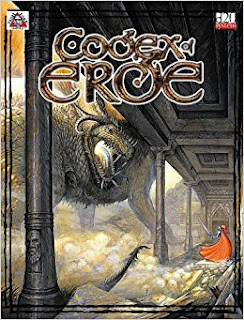
That cover!

Let me dig more crazy stuff.

Another area where I believe that “level-less” works nicely: weather. I’m not talking about raining lightning bolts upon your enemies, or destroying castles with tornados, but changing the weather (from a sunny day to rain for example). It is narratively powerful, definitely, but not game breaking (unless playing Dark Sun I guess). Most players love to have that kind of influence. I think Dungeon World’s druid has a move that does that (and I don’t understand why it is a high level move… especially in a Powered by the Apocalypse© game).

There is a Golden Age of Piracy sourcebook for D&D 3rd called Skulls & Bones. It has a lot of amazing subsystems, but I remember in particular a mystic sailor prestige class who could create small islands in the middle of the ocean. That is an awesome power, definitely not unbalanced and quite interesting in terms of narrative consequences.

The system was clunky (D&D 3.0) but full of good twists.

Another good source of weird and new powers is Legend of the Five Rings (1st Edition! Before “game balance” was an issue… 4E is so boring and I still have to read the last version). Take for example the (original) tattooed monk from the Way of the Dragon sourcebook. It would be an excellent starting point for a new class in 5E (maybe just reskinning the warlock would do it). For example: the Centipede Tattoo allows the monk to start running and reach anypoint in the same continent by the next mid-day. It is something different and potentially useful (but not abusive, because the monk can’t carry anyone with him). The power also has a drawback: the monk is considerably tired after running at such speed, which could be represented in 5E by 1d4+1 levels of Exhaustion. The power has so many conditions and limitations that it would work fine as a 1st level thing.

Probably unbalanced, but fun as hell!

Let’s keep digging: Monte Cook’s Arcana Unearthed, which was a huge influence for all d20 spellcasting systems that came later, including 5E, has a wizard’s class feature where your character can hear when someone else in the same plane speaks his name. That is an ability which should be available at 1st level because (if you stop to think about it is 100% controlled by the DM). Is it flavorful? For sure! But there is no excuse to wait for like 10 levels before getting that mojo (unless it gave you a distinct advantage, like allowing you to teleport to the side of the speaker, for example).

Still one of the best D&D variants.

Now, want a (crazy) source of ideas? Check the “D&D Next”, that was the name of 5E playtest, before fandom and commercial interest brought things back to a more common D&D experience (playtests are always the best spot to see different rules). See, for example, the initial idea for the Sorcerer. It was a class that used magic points (I believe the name was willpower), instead of slots. That is not the point, the interesting bit about the original Sorcerer was that it gained powers when his Willpower (i.e. Magic Points) started running low: for example, a Draconic Sorcerer would start manifesting claws and scales when its magic points were finishing. That is an original and cool idea both from a narrative and mechanic point.

I must also (morally and totally) suggest the Red Box Hack. I don’t have the slightest idea how it started, it is not a d20-based system. Red Box Hack is a free RPG with a splendid assortment of classes. Each class (except maybe the warrior) is a box of cool mechanics and they touch on a lot of topics described in this post. Read it, it is definitely worth of your time. Pay attention on how most classes do stuff completely different.

I started this post commenting (complaining?) about D&D traits and how they are compartmentalized in arbitrary limits and effects. I think I ended up quoting a lot of what I call “edition neutral” traits - that is, stuff that could work on any edition (and theoretically level) of D&D. To finish this rambling I’d like to share one last source of crazy powers, if you don't mind “narrative RPGs”: Spire. It is a very original take on fantasy stereotypes (drows, elves and gnolls in particular), with interesting rules (the Resistance System). However, Spire shines on its wild take on “classes”. There are good ideas worth mining there for any RPG. Take a look.

What a wonderful twist on D&D tropes.
